The U.S. military’s decision to move troops away from bases under Iranian attack to hotels and office spaces in civilian areas may amount to violations of international humanitarian law and the U.S. military’s own laws of war, human rights officials and experts say.
The constellation of American bases in the Persian Gulf region has been essential to the U.S. military’s execution of the air war over Iran. But commanders have relocated many of their troops because the sprawling compounds did not have adequate defenses to protect from Iranian ballistic missiles and drones, U.S. defense officials said.
The move illustrates the U.S. military’s lack of preparedness for a war that the Trump administration started on its own terms, military experts said.
“This is the first war the United States is facing where we see the implications of democratized air power and the long-range persistent strikes from their adversary,” said Kelly Grieco, a senior fellow at the Stimson Center. “And the lack of preparedness is not limited to this theater.”
This lethal puzzle continues to complicate U.S. war planning after thousands of airstrikes, as Iran still retains the ability to launch ballistic missiles throughout the region. This has kept American forces away from bases and dispersed among the civilian population.
“It is unconscionable that U.S. forces would knowingly put civilians at risk by leaving their bases and moving to hotels in the densely populated city centers,” said Brian Castner, a crisis researcher at Amnesty International, a human rights organization. “The commanders who ordered these relocations, not out of the conflict area but right into the heart of the civilian populations, should be investigated for violating U.S. laws of war.”
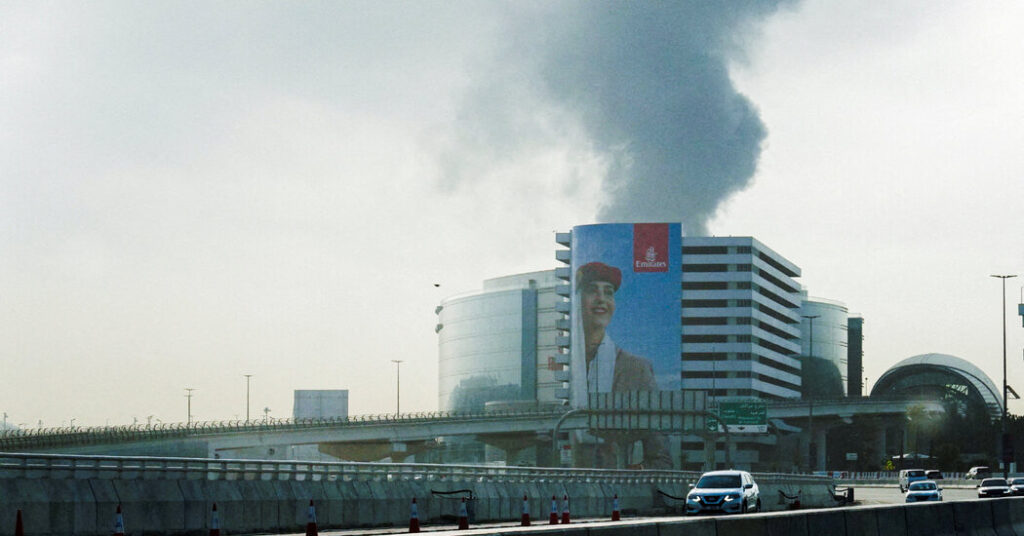
Iran has urged people in the Gulf region to report on U.S. military troop locations off their bases. Iranian strikes have since killed a number of civilians in the United Arab Emirates, Bahrain and Kuwait.
Both the Pentagon’s law of war manual and the first protocol of the Geneva Conventions outline the need to avoid placing military forces in or near civilian populations.
The U.S. Law of War Manual, which was updated in 2023, states that “military commanders and other officials responsible for the safety of the civilian population must take reasonable steps to separate the civilian population from military objectives and to protect the civilian population from the effects of combat.”
The manual gives some wiggle room for cases when troops need to be “housed in populated areas to take advantage of existing facilities, such as facilities for shelter, health and sanitation, communications or power.”
“These are mushy rules in the sense that all these obligations are to the maximum extent feasible,” said Kevin Jon Heller, a professor of international law and security at the University of Copenhagen’s Center for Military Studies.
But “do the U.S. actions raise issues here? They do,” he added.
Where the U.S. military crosses the line in international humanitarian law is around what are called “passive precautions,” or the measures militaries take to protect civilians in the vicinity of military positions from attack.
“Passive precautions are required, but they are often not followed,” said Michael Schmitt, a professor of international law at the University of Reading and an emeritus professor at the U.S. Naval War College. “Billeting troops in civilian structures in which there are civilians as in a hotel that is still being used or an apartment building where civilians are still living would be a violation of passive precautions.”
The first protocol of the Geneva Conventions and the U.S. law of war allows some discretion when it comes to placing forces among civilians when there is active combat in those areas. One example would be Ukrainian forces defending the southern city of Mariupol in 2022. Ukrainian troops were among civilians because Russian forces were directly attacking the city with ground troops, artillery and air strikes.
“This would not apply to the current situation of U.S. forces in the Middle East because the soldiers are not deployed to the cities to defend the civilian population from attack,” Mr. Castner said. “In fact, the opposite. The forces are trying to avoid attack by being in the hotels, which would not be lawful targets otherwise.”
A step further would be if a military intentionally used civilians as “human shields” to protect troops from attacks, a tactic that is considered a war crime. Insurgent forces have used noncombatants in this way in conflicts with larger and more capable militaries.
Underscoring the U.S. military’s challenges, the Pentagon solicited a contract last week for premade bunkers that could be shipped quickly to the Middle East and could “protect personnel from blast and fragmentation threats.”
Eric Schmitt and Helene Cooper contributed reporting.
Thomas Gibbons-Neff is a national correspondent for The Times, covering gun culture and policy.
The post Placing U.S. Troops in Middle East Hotels May Violate Laws of War appeared first on New York Times.