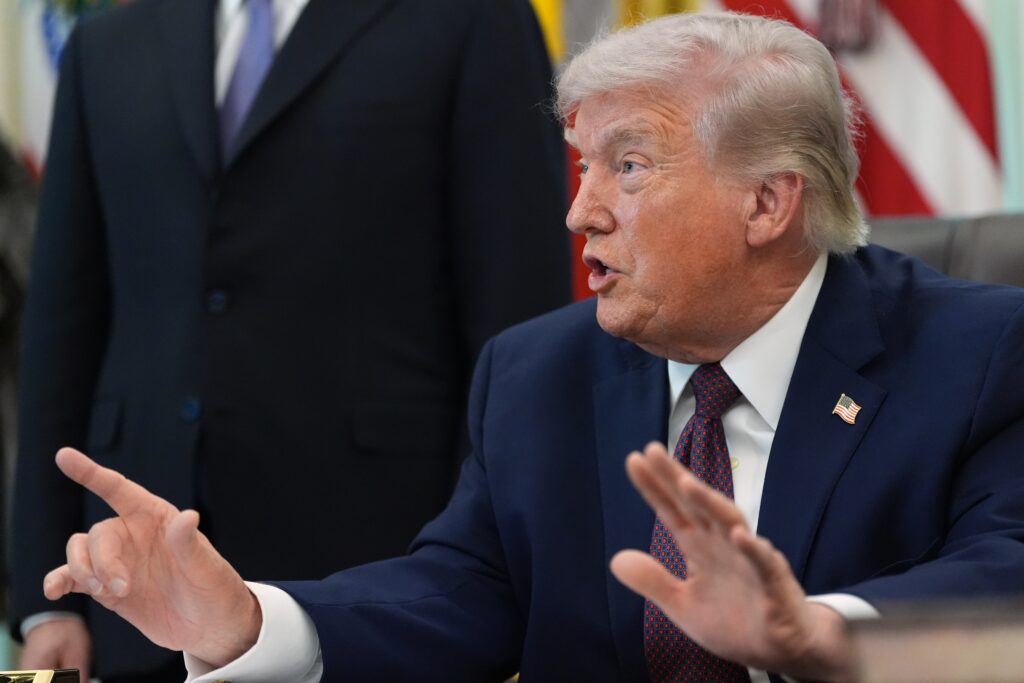
President Donald Trump arrived at the Supreme Court on Wednesday to attend a hearing on birthright citizenship, a move that would make him the first sitting president known to have attended the high court’s oral arguments.
The court is hearing arguments over the constitutionality of Trump’s executive order limiting birthright citizenship, which has been challenged by the American Civil Liberties Union and other groups. The White House appealed a lower-court ruling that struck down Trump’s restrictions.
Trump is also due to address the nation at 9 p.m. Wednesday for an “important update” on Iran, White House press secretary Karoline Leavitt said Tuesday.
In response to a question Wednesday morning about Trump’s plans to attend the hearing, the White House referred to the official schedule and his previous comments. The Supreme Court referred questions about Trump’s attendance to the administration.
ACLU Executive Director Anthony D. Romero said in a statement that he welcomes Trump being at the court.
“Any effort to distract from the gravity and importance of this case will not succeed,” Romero said. “The Supreme Court is up to the task of interpreting and defending the Constitution even under the glare of a sitting president a couple dozen feet away from them.”
There is no record of a sitting president attending the nation’s highest court for oral arguments. Trump floated the idea last year before the Supreme Court heard arguments on his tariff policy, but changed his mind. The court ultimately struck down most of his tariffs.
Early Wednesday, demonstrators began gathering on the sidewalk in front of the Supreme Court. One had a large spray-painted banner that read “Donald & Barron Trump Are the Children of Immigrants.” Barron Trump is the president’s son with wife Melania Trump, who emigrated from Slovenia. Others held placards that said “Trump Must Go Now!” Nearby, TV crews had set up to report on the historic arguments. Tourists milled around the scene.
In November, the court heard lengthy arguments about whether Trump had the legal authority to impose sweeping tariffs in a test of his major economic policy. After suggesting he might attend, Trump reversed course, saying, “I do not want to distract from the importance of this Decision,” in a post on Truth Social.
The court ended up ruling against him 6-3, saying that he could not use emergency powers to impose import levies on goods from nearly all U.S. trading partners. Trump railed against the decision, branding the justices in the majority a “disgrace” and calling the decision “an embarrassment to their families.”
The birthright citizenship case could have major ramifications for who is considered American. Trump’s executive order would deny citizenship to any child born to parents who lacked permanent immigration status and was one of the first acts of his second term.
The administration has argued that the 14th Amendment, which grants birthright citizenship, does not apply to people in the country illegally or on temporary visas, although many legal scholars disagree. If the high court reverses the long-held interpretation, it could render hundreds of thousands of children born to immigrant parents stateless.
A ruling is expected by the summer.
The post Trump attends Supreme Court hearing on birthright citizenship appeared first on Washington Post.