As thousands of additional U.S. troops arrive in the Persian Gulf, military officials are planning for two potential ground assaults in Iran: one on Kharg Island, the hub of the country’s energy industry, and the other to seize enriched uranium to hobble Iran’s nuclear-development program, according to three people familiar with the matter. They just need the go-ahead from President Trump.
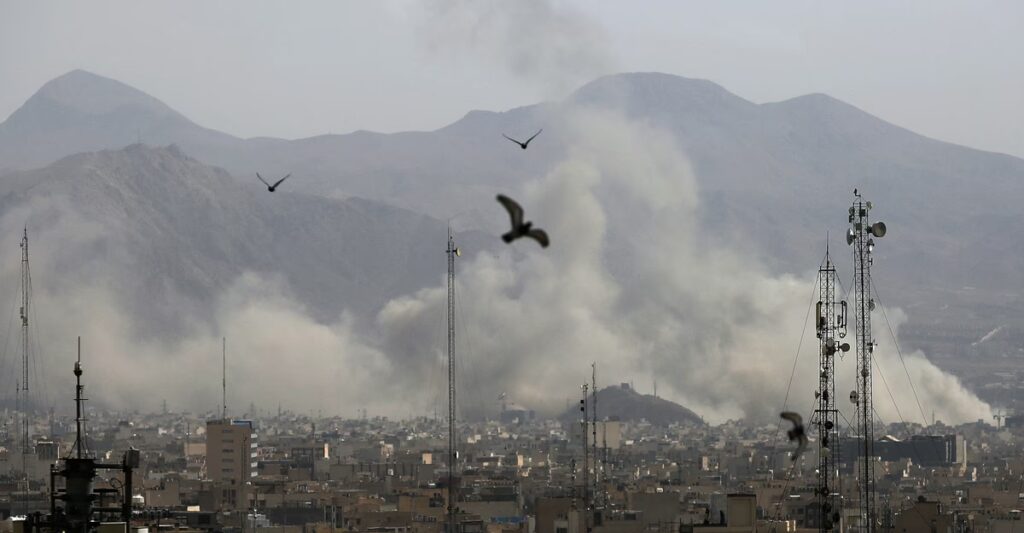
Putting troops in Iranian territory would rank among the most dangerous missions of either of Trump’s terms. And neither operation would guarantee the end of the war within weeks, as Trump has promised—nor the collapse of the regime that the United States has described as an imminent threat, nor the reopening of the Strait of Hormuz, the closure of which has gripped the world’s energy markets, said those familiar with the options, who, like others we spoke with, did so on the condition of anonymity to discuss the sensitive military plans. Trump has said negotiations are underway with the regime to find a peaceful solution, and the prospect of a land assault may be designed to pressure the regime to seek a settlement. A failed operation could escalate and prolong the conflict rather than force negotiations.
About 3,500 Marines and sailors reached the region over the weekend, defense officials said, and another 3,500 are expected in the coming weeks. Hundreds of Special Operations forces are already in the region. Military planners could send the incoming Marines to Kharg Island, off Iran’s Gulf coast and about 400 miles from the Strait of Hormuz. The island handles roughly 90 percent of Iran’s oil exports, and it has already been struck by U.S. forces over the past month. Seizing and holding it could cut off a major source of revenue for Iran’s regime, complicating its ability to fund military operations—and provide a bargaining chip for negotiations, current and former officials told us.
But the operation would be fraught. U.S. forces might have to navigate mined waters, and defend against drone and missile attacks. Even if they were successful, the economic impact on Iran could take weeks to materialize, while global markets would react immediately. Brent crude, which cost roughly $73 a barrel at the start of the war and is now hovering at just over $100, could quickly surge to $150, risking a global recession. Holding the island could require a prolonged U.S. presence as well. “Maybe we take Kharg Island, maybe we don’t. We have a lot of options,” Trump said in an interview with the Financial Times on Sunday. “It would also mean we had to be there for a while.”
Another scenario military officials are planning for is sending Special Operations forces into mainland Iran to seize highly enriched uranium that U.S. officials believe is tied to Tehran’s nuclear ambitions. Insertion of troops—likely by air—would be dangerous, and Iranian forces are expected to respond quickly. Recovering the material would be difficult, especially after U.S. and Israeli strikes last summer damaged the entrances to suspected storage sites. Service members could face ambushes en route, and specialized units would need to extract the uranium. Such a mission could allow the administration to claim that it had removed a key element of Iran’s nuclear program. But it does not guarantee the resumption of normal operations in the Strait of Hormuz, which Iran closed after the U.S. and Israel attacked.
Trump has not decided whether to authorize either of these options, the officials said, and he ultimately may not pursue them. Some in the military privately hope that the risks to U.S. forces—and doubts about whether such missions could end the war—will push the administration toward restraint. But the president could then face prolonged Iranian control of a vital waterway and soaring energy prices. He’d be reliant on faltering diplomatic efforts to end the conflict, or, as he has begun to threaten, he might abruptly pull out of the conflict and place the problem in the hands of allies. If he were to do so, he would leave behind an embittered, empowered regime ready to lash out at its Gulf neighbors and the West.
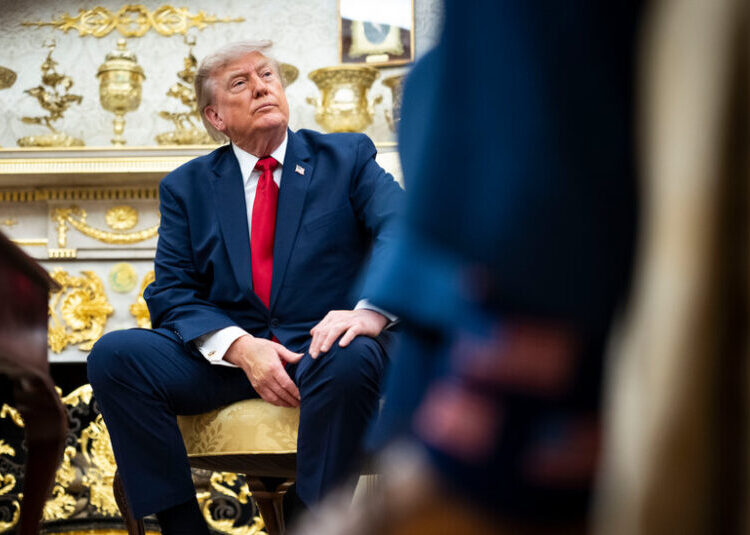
Whether to order either of the ground assaults, both, or neither will be Trump’s most consequential decision in his war of choice, with far-reaching implications for both the Middle East and the U.S. midterm elections. White House Press Secretary Karoline Leavitt announced last night that the president will deliver “an important update on Iran” in prime time tonight. She did not provide further details.
The president is getting conflicting advice: Some in his inner circle, along with many nervous GOP political operatives, are urging him to wind down the war and mitigate the economic fallout. But Tehran hawks—and Gulf allies—are urging him to finish off the Iranian regime.
When Trump first considered a full-scale attack on Iran, he was still celebrating the efficient operation to seize Nicolás Maduro from Venezuela in January. Two of his other strikes this term—against Nigeria on Christmas Day and Iran last June—were impressive one-off displays of military precision. And this war was initially planned to last days, or at most a few weeks. It has now crossed the one-month mark and is only lengthening. Trump continues to declare victory: By one count, he has announced a dozen times that the war was about to wrap up. Despite those proclamations, though, Iran has been able to launch attacks on its neighbors and, most crucially, effectively close off the strait.
Some corners of Trump world were reticent about attacking Iran at all. A number of popular MAGA influencers—including Steve Bannon, Tucker Carlson, Megyn Kelly, and Marjorie Taylor Greene—cautioned that a new Middle East war would shatter Trump’s “America First” foreign-policy pledge and alienate the isolationists in his base. Their voices have only gotten louder as talk of a ground incursion has picked up. Though most rank-and-file Republican lawmakers have remained outwardly supportive of the president, polls suggest that voters are souring on the conflict and have no appetite for a ground invasion. A Reuters/Ipsos survey of 1,021 people released today found that two-thirds of Americans want the war to end quickly, even if the Trump administration does not achieve its aims. Another 27 percent said the U.S. should keep fighting, even for a prolonged period, and 6 percent declined to answer.
[Read: How much pain is Trump really willing to endure?]
Few in the West Wing have voiced concerns about the possible escalation. Vice President Vance, who is considered an isolationist, expressed private skepticism ahead of the attacks, and his relative silence during the first weeks of the war was perceived as a subtle way of distancing himself from the conflict. (Trump was not too bothered by it, advisers told us.) Vance has since taken care to appear supportive of the president, if less so about the specifics of the war effort. The Pentagon’s firing of two dozen admirals and generals over the past year has made some wary of challenging the president’s ambitions. Instead, General Dan Caine, the chairman of the Joint Chiefs of Staff, has sought to provide a measured assessment of potential risks. Secretary of State Marco Rubio has also resisted taking a strong position, keeping his attention on Cuba.
The war’s financial toll has spooked the president’s economic advisers, a fear that will grow if the war is prolonged. Yesterday, a gallon of unleaded gas topped $4 in the U.S. for the first time since 2022. A number of GOP political operatives and those running congressional campaigns have quietly predicted that a ground invasion, particularly a protracted one with casualties, could contribute to a Democratic wave that envelops at least one and perhaps both houses of Congress.
Some close to Trump are vociferously pushing him to escalate the conflict. Chief among them is Benjamin Netanyahu. The Israeli prime minister has viewed the destruction of the Iranian regime as his life’s work. The consequences of some of his nation’s targeting decisions have complicated the White House’s goals, including the killing of would-be Iranian negotiators and a strike at an Iranian energy facility that prompted Tehran to retaliate by hitting a massive gas field in Qatar. Senator Lindsey Graham of South Carolina, long an Iran hawk and a proponent of the muscular use of American military force, has repeatedly made the case on Fox News for a ground attack, suggesting in one appearance that the U.S. could seize Kharg Island because it has previously won brutal battles such as World War II’s Iwo Jima. (He did not mention that nearly 7,000 Americans died there.) The Gulf states’ pleas have been more complex. Although Gulf nations expressed disappointment that they were not consulted before the start of the war, a number of them, including Saudi Arabia and the United Arab Emirates, want Trump to do whatever it takes to finish off the regime—including authorizing a ground strike—rather than leave behind a wounded but vengeful regime likely to strike its neighbors.
The Pentagon and U.S. Central Command declined to comment, referring questions to the White House. The White House told us that it does not comment on any potential military operations.
Trump is looking for a way out; the question is, what does he have to first accomplish to truly declare victory? He did not make the case for the war before launching it, nor has he since tried particularly hard to rally Americans to the cause. He claims with unassailable confidence that victory is at hand, yet has fumed privately that the war has taken too long. He has extended multiple deadlines to strike Iran’s energy infrastructure if the Strait of Hormuz is not reopened, an attack that could result in a failed Iranian state, a refugee crisis, and terror campaigns. Another object of Trump’s wrath: America’s allies, including those in NATO, who have refused to help reopen the strait. In a social-media post yesterday, he warned allies that they will “have to start learning how to fight for yourself.” The post fueled concern that Trump may soon abandon the NATO alliance, or at least weaken it by removing American troops from Europe.
[Read: Is the end of NATO near?]
And Trump clearly has other things on his mind. Aides have said he is anxious to hold his rescheduled summit with China’s Xi Jinping, now set for mid-May, and does not want the war with Iran to further strain relations with Beijing. Yesterday, the Chinese and Pakistani foreign ministers met in Beijing and drafted a five-point proposal that included a call to cease hostilities between Tehran and Washington and offered security agreements for shipping through the strait.
But tonight, Trump will be forced to focus on Iran, at last delivering an update to Americans on the war he opted to fight. His next decision might be even bigger.
Vivian Salama and Missy Ryan contributed reporting.
The post The Most Important Decision of Trump’s Presidency appeared first on The Atlantic.