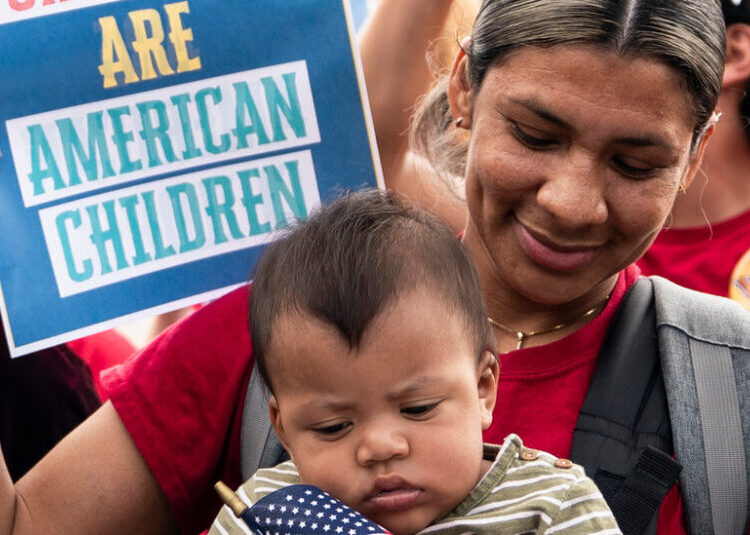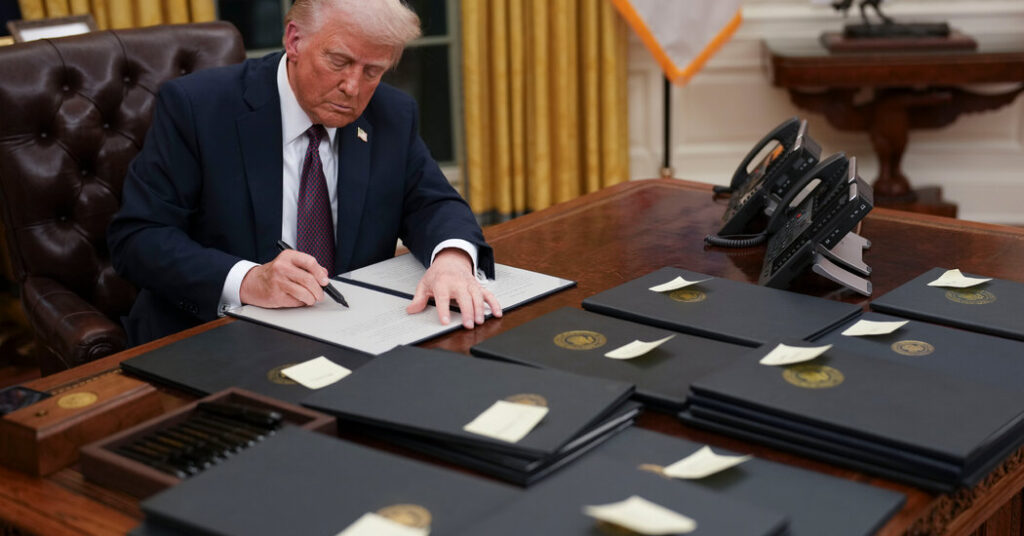
President Trump’s executive order curtailing birthright citizenship, issued on the first day of his return to office, has an improvised quality to it. It draws distinctions that are hard to justify, unprincipled and even absurd, legal scholars said.
For instance, the order says that the children of some noncitizens in the United States lawfully — namely green card holders — are entitled to automatic citizenship. But children of other people also here lawfully, like those holding visitor visas, student visas or business visas, are not. What part of the 14th Amendment, a brief filed on behalf of Akhil Reed Amar, a law professor at Yale, makes that distinction?
Similarly, the executive order, as interpreted by U.S. Citizenship and Immigration Services, lets fathers confer citizenship on their children born in the United States only if the fathers are citizens or lawful permanent residents. But mothers can also do so if they are refugees or seeking asylum.
That differing treatment seems at odds with a 2017 Supreme Court decision on conferring citizenship that said Congress could not treat mothers and fathers differently on equal protection grounds.
Other lines drawn by the order are also hard to understand.
The executive order defines “mother” to mean “the immediate female biological progenitor” and “father” to mean “the immediate male biological progenitor.”
But establishing biological parentage requires DNA tests — which were unknown when the 14th Amendment was adopted in 1868. At that time, there was a general presumption that the husband was the father of all children born during a marriage.
While the term “immediate biological progenitor” does not seem to have a settled meaning, it has the potential to disadvantage those using some forms of assisted reproductive technology. It would seem, for instance, to exclude mothers who give birth to a child conceived through in vitro fertilization using another woman’s egg.
That creates an anomaly, Scott Titshaw, a law professor at Mercer University, wrote in an analysis of the executive order. “Illogically,” he wrote, “some of the U.S.-born children the order disqualifies would be citizens if born to the same parents abroad.”
That is because the State Department recognizes that “children born abroad to parents, at least one of whom is a U.S. citizen and who are married to each other at the time of the birth, will be U.S. citizens from birth if they have a genetic or gestational tie to at least one of their parents” and otherwise qualify.
Under the executive order, by contrast, the child’s biological relationship must be with the member of the married couple who is a citizen — and that biological relationship must apparently be genetic rather than gestational.
Professor Amar, in his supporting brief, submitted by his brother, Vikram David Amar, a law professor at the University of California, Davis, wrote that the executive order was “made-up and slapdash.”
“If today’s president can make up rules one way, can tomorrow’s president reverse everything?” he asked. “Can tomorrow’s president go even further in the opposite direction?”
Adam Liptak is the chief legal affairs correspondent of The Times and the host of The Docket, a newsletter on legal developments. A graduate of Yale Law School, he practiced law for 14 years before joining The Times in 2002.
The post Trump’s Birthright Citizenship Order Draws Lines Scholars Find Indefensible appeared first on New York Times.