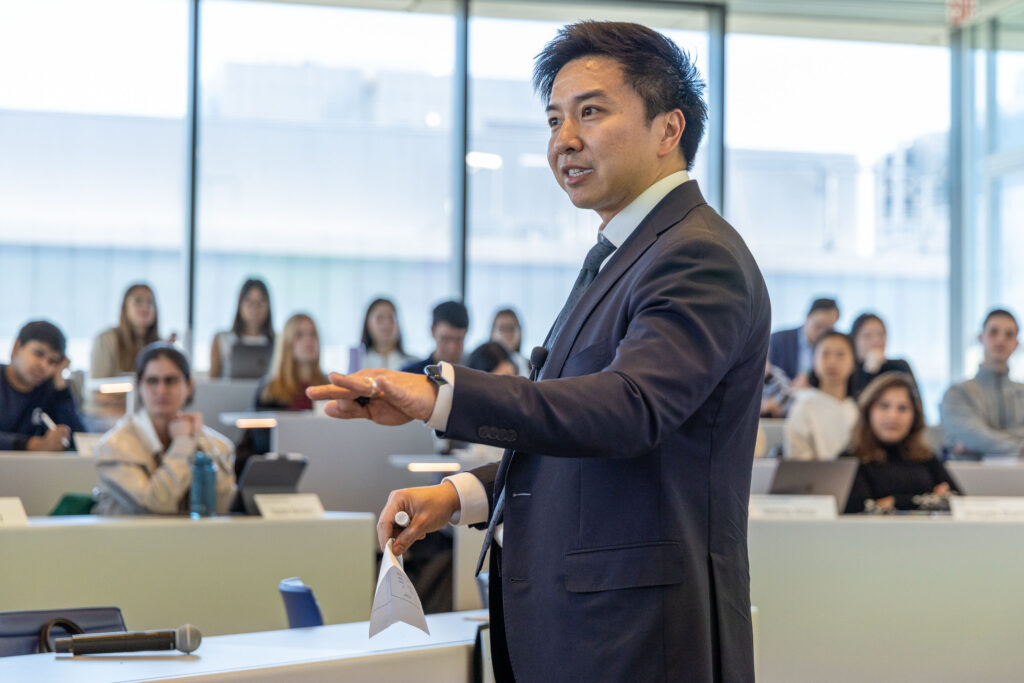
Something shifted in Dan Wang’s class at Columbia Business School in the fall of 2022. Instead of his students showing up prepared with persuasive arguments about business decisions, many students had asked ChatGPT to summarize case studies.
It was understandable that they wanted to finish their homework more efficiently, he said. But that made class discussions more challenging.
Now, students still pull out their phones to prepare for his class — but they talk to an artificial intelligence app Wang designed. Before they are faced with tough questions from the professor and classmates, they argue at home with Caisey, as Wang nicknamed it.
“A lot of AI tools in education are designed to make things more efficient,” he said. “Caisey capitalizes on precisely the opposite: the capacity to slow students down, to actually make them focus and to also make them consider very different ways of thinking about questions.”
While many faculty members worry about the impact of AI on students’ ability to think, some are harnessing the technology to create new ways for them to learn, even designing specialized apps for their students. Instead of spitting out answers, AI tools infused with faculty expertise are intended to help students think through solutions while exploring and refining ideas.
Proponents argue the new technology, at its best, enables a return to an educational ideal.
Wang said the idea behind the app that helps students debate case studies is not actually new — it’s millennia old, rooted in the Oxbridge tutorship model that linked an instructor with one or two students for deep, thoughtful exchanges about what they were learning.
Before AI, Wang said, that focused, stimulating experience was tough to scale. Now he’s seeing faculty rethinking the way they teach.
Professors are using AI tools in many fields. At the Georgia Institute of Technology, a professor designed an app that helps electrical engineering students work through thorny problems. At Arizona State University, faculty-infused AI helps health care students in health sciences practice working with simulated patient experiences, chats with students mastering foreign languages, and guides biology students to help master the basics or extend themselves far beyond the course material.
That’s despite the concerns some professors voice about the effect of popular commercially available generative AI on their students. At the University of Virginia’s business school this fall, almost two-thirds of a class got the same wrong answer to a quiz question — the answer the free version of ChatGPT gave when asked.
(The Washington Post has a content partnership with OpenAI, the creator of ChatGPT.)
Hari Subramonyam, an assistant professor at Stanford Graduate School of Education, said so many students ask large language models (LLMs) to summarize papers that class discussions have become superficial.
“And if you pose a hard problem, the impulse isn’t, ‘Oh, let me think deeply about that,’” he said. “It’s ‘Oh, let me go ask ChatGPT about it.’”
But a Brookings Institution analysis of studies earlier this year concluded that thoughtfully designed AI tools with safeguards can bring significant gains for students.
Using design that’s informed by cognitive science can help advance learning, rather than allowing students to bypass the process with a tool that provides a snap answer, said Subramonyam, who designs AI tools for teaching and learning. Learning requires active engagement, he said; shortcutting the process can lead to mental atrophy.
Well-designed AI tools can help people learn, he said, “while still preserving what makes us human: We think.”
Hey there,” a human-sounding voice greets a student opening Caisey. For one case study, the voice explains that they’ll be chatting about whether Netflix should put more money into original shows and movies or lean more on licensing from others. It asks for a quick opening argument.
After the student answers, Caisey politely counters: While licensing might seem more cost-effective, exclusive content could bring more long-term value. “Investing more in original content might drive subscriber loyalty,” Caisey said. “Think about how hits like ‘The Crown’ keep people subscribed.”
The point-counterpoint continues, then wraps up with Caisey acknowledging the merits of the argument and pointing out a way the student could improve. The professor gets a transcript and a summary of student conversations, as well as a summary of which positions the class took. Sometimes Wang will mention compelling examples in class.
“I’ve found it to be an incredibly helpful tool,” said Alexa Caban, a student in Wang’s technology strategy class. She said Caisey adapts to her responses in real time with a nuanced understanding of the facts of the case.
In a 15-minute-or-so conversation, Caban said she often finds herself considering completely new perspectives. Articulating her thoughts out loud more closely mimics the format of the classroom discussion than writing a paper. And at the end of the chat, the app suggests evidence or analysis that might have made her argument stronger.
One of the principal skills students gain from Wang’s technology strategy class is rhetorical, he said — they need to be able to discuss, argue and influence important business decisions, using critical thinking and discernment.
Wang piloted the app last spring. Now thousands of students at Columbia and 15 other institutions, including the business schools at the University of California at Berkeley, the University of Pennsylvania and the University of Virginia, use Caisey. Wang and a team of people adapt the tool for other instructors and classes, with faculty telling them what they want to teach, what they want their students to read and what they want them to discuss.
“It’s not a substitute for the really rich interaction that we have in class in the discussion,” said Rahul Bhandari, distinguished senior lecturer in AI and strategy at U-Va.’s Darden School of Business. But it’s helpful in preparing them to have more confidence in class, Bhandari said, and to present a more articulate, well-structured argument.
Jill Cohen, one of Caisey’s co-founders and a former Columbia Business School student, spoke on a panel in one of Wang’s classes last year. Multiple students came up afterward to tell her they love the app and have had so much fun with it, she said; that was mind-blowing.
“I don’t ever remember loving homework,” Cohen said. “What kid says they love homework?”
When he was stuck on a homework problem one night in his dorm at Georgia Tech, Eli Stodghill didn’t open ChatGPT. Instead, he pulled up a tool designed by a professor there and asked for help.
The AI tutor suggested steps to solve the circuit analysis problem, which, like most of the homework for Stodghill’s electrical engineering course, was designed to push students well beyond what they had learned in class. After he worked his way to a solution, Stodghill typed it in.
“Not quite,” the app responded, and recommended a few quick checks to find the mistake.
“It’s tremendously helpful,” Stodghill said. If he tries an approach that’s not right, “it’ll kind of re-vectorize you to the right direction.”
Ying Zhang, a professor and senior associate chair in the School of Electrical and Computer Engineering at Georgia Tech , said the idea for the AI tutor came from students telling professors they were often struggling with homework at midnight or later. Faculty wanted something students could turn to 24/7 for help, not answers — they knew many students were going to LLMs when they couldn’t figure problems out on their own.
While some AI apps offer a “guided learning” or “educational” mode, faculty-designed AI taps directly into their expertise in the course curriculum to shape the guidance. Zhang designed the Smart Tutor at Georgia Tech using course materials for a notoriously difficult class. It provides feedback, allowing faculty to further pinpoint where students are having trouble, and adapt their teaching to those pain points.
In a pilot study last spring, students said they appreciated getting guidance and feedback in real time, found it helpful and hoped it would be added to more classes. Nidhi Krishna, a sophomore from Atlanta, said that it gave her the insight that she kept making the same mistakes, and then helped her understand why and how to avoid that.
Stodghill, a sophomore from southern Georgia, sometimes resorted to a commercially available LLM last year when he was stuck on homework in a tough class late at night. The answers often weren’t right. But with the faculty-designed AI, he has always been able to work his way to the correct answer. He said he feels more prepared for exams and that he’s learning the material better.
Stodghill thinks the biggest risk of commercially available AI is cognitive off-loading, like using a calculator instead of multiplying five times five. The class-specific AI has guardrails that prevent that, he said.
“Just working through something like this,” Stodghill said, “I think keeps you cognitively sharp — it keeps you a more competent human being.”
The post ChatGPT fed his students easy answers, so he built an app to argue with them appeared first on Washington Post.