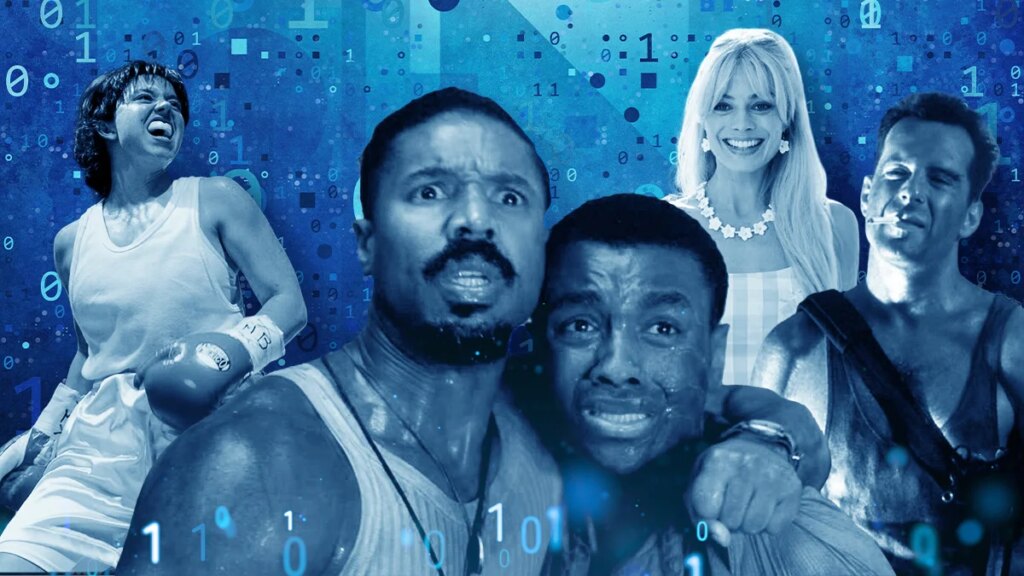
When we fed Quilty, a new AI tool that promises to analyze and provide insightful feedback on your scripts, the screenplays for “Sinners,” “Barbie,” “Christy” and “Die Hard,” the results left us slack-jawed.
Of the four, “Christy” boasted the highest “Quilty Score,” aggregated from a look at its story, commercial viability, cultural resonance and ease of production.
Yes, the boxing biopic starring Sydney Sweeney that raked in just $1.3 million in its opening weekend last year, one of the worst for a film with a wide release, edged out last year’s critical and commercial darling “Sinners”; “Barbie,” which grossed $1.44 billion and sparked a feminist movement; and “Die Hard,” one of the all-time classic action films.
Score one for the humans.
If you haven’t heard of Quilty, the startup launched on Monday with a pitch to provide studio executives, producers, writers and studios with more insight through its AI tool. It offers everything from logistical recommendations, casting suggestions for actors and directors and its “thoughts” on cultural relevance — all designed to make a script better, a movie more bankable and even predict what kind of cultural backlash the eventual film might encounter without the app’s extensive notes.
The tool seemingly strikes at the heart of what Hollywood fears so much about AI: that tools like Quilty will replace taste and human sensibility with code and hard data. It comes at a time when Hollywood is more rapidly embracing AI, even if it’s doing so quietly in an effort to avoid rankling the creative community.
Indeed, Quilty has already received its share of slings and arrows since its debut. “Crystal ball predictions AND script analysis? Sounds totally legit and useful,” cracked Danny Manus, who runs the “No BullScript” consulting site, on X. “Definitely not a quick money play that will fade away in 4 months.”
The co-founders, Simon Horsman and Daniel Wood, are framing this as a way to help people make more informed decisions.
“For decades, the industry has relied on expensive, disconnected solutions and informal networks for its decision making,” Horsman said in a press release. “Quilty connects every creative and commercial decision in one place giving filmmakers, producers, financiers, studio executives, buyers and their representatives affordable access to critical intelligence to move projects forward faster, with greater confidence and broader access to collaboration and opportunity.”
But to see how Quilty actually performs, we tried it ourselves with the four scripts (note: Quilty gave us a free account to use after a glitch on the site when we tried to purchase an analysis — which costs $49.99 per script — ourselves).
What we found was a thorough assessment of the script, its franchise and IP potential, financial projections and more. But there was a mix of notes, particularly on the creative side, that seemed way off base or failed to catch the thematic undertones.
“In terms of analyzing the creative impact of the screenplay, it feels like proof-positive that AI can’t replicate — and has trouble understanding — the creative process,” said Adam Chitwood, executive editor at TheWrap, who reviewed the reports. “It mistakes the specificity of Ryan Coogler’s ‘Sinners’ script for ‘cringe’ dialogue, even suggesting the Oscar-winning script lands ‘like a Tarantino wannabe without his rhythm.’”
While it seemed less apt at quantifying what makes a good — or Oscar-winning — script, Quilty was more useful in budget breakdowns and offering suggestions on production issues based on the elements in the script.
Before we get into what Quilty found, a few caveats.
- We didn’t have a strict methodology for picking our films. “Die Hard” was the first suggestion before we opted to go with more contemporary titles. We chose “Christy” because we wanted to see how it would treat what eventually was a massive bomb.
- Wood said that Quilty is designed to strip out identifying information and go in blind with each assessment, so its database wouldn’t be tainted by reviews or box office performance of these films. Each are effectively new scripts to the AI system.
- The AI is assuming these films will be out in 2027 or 2028, and is making its assessment partly based on this more modern period (which really puts “Die Hard” at a disadvantage).
Some of the highlights of what we found, starting from the highest-score film to the lowest:
“Christy”
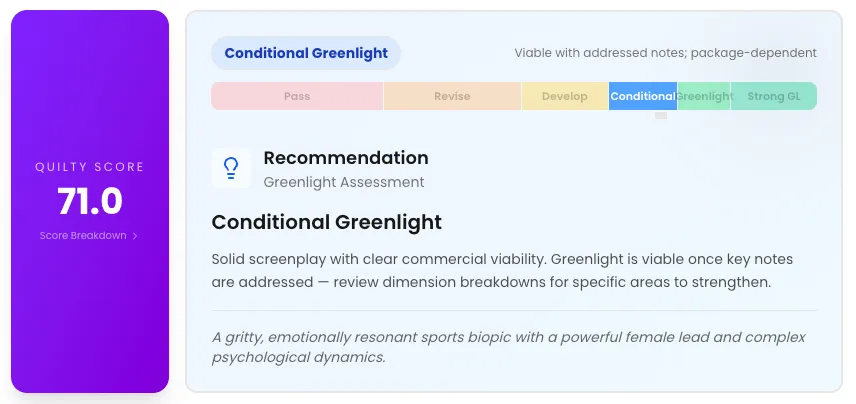
This film received the highest Quilty score at 71, which was enough to rate it a “conditional green light.” It lauded the script’s “visceral third-act pivot” and “complex protagonist psychology,” but dinged its pacing and repetition issues in the second act and “on-the-nose” dialogue from the antagonist.
In terms of the score breakdown, “Christy” received its highest score in cultural resonance at 82, while it was dinged for both commercial viability (61) and production reality (60). Under production concern, it offered suggestions for streamlining the production process, including creating detailed scene-by-scene breakdowns, identifying the 10 most expensive scenes and considering alternatives to those sequences.
Things break down a little when it comes to the initial filmmaker recommendation. It chose director Brett Ratner as a 58% fit for the film if it had a lower budget tier of $8 million to $12 million, which is problematic given the multiple allegations of sexual harassment against the “Melania” filmmaker. In fact, Quilty seems to really like Ratner, as his name also appears under “Barbie” (also problematic) and “Sinners” (huh?) under similar lower budget tiers.
Remove budget from the equation, and more appropriate options appear. Its director recommendations for “Christy” include Karyn Kusama and Debra Granik, which Quilty said are “perfect.” David Michod directed the film.
For casting, it suggested Cailee Spaeny (“Civil War”) with an “Industry Insider Pick” of Florence Pugh (“Thunderbolts”).
It set a recommended budget of $12 million with a breakeven target of $40 million at the box office. The film actually grossed $2.3 million in total against a budget of $15 million, and was produced and distributed independently by Black Bear.
“Barbie”
Scoring just below “Christy” was Margot Robbie’s “Barbie” at 70, which also made it a conditional green light film. The app praised the script’s “fearless satire” and thematic depth that elevates the fish-out-of-water story.
Like “Christy,” “Barbie” scored higher with cultural resonance (82) and story (76), but was knocked for production reality (63) and commercial viability (57). What dragged down the score was the execution risk (39) of bringing this world to life, and it said the script had significant production barriers.
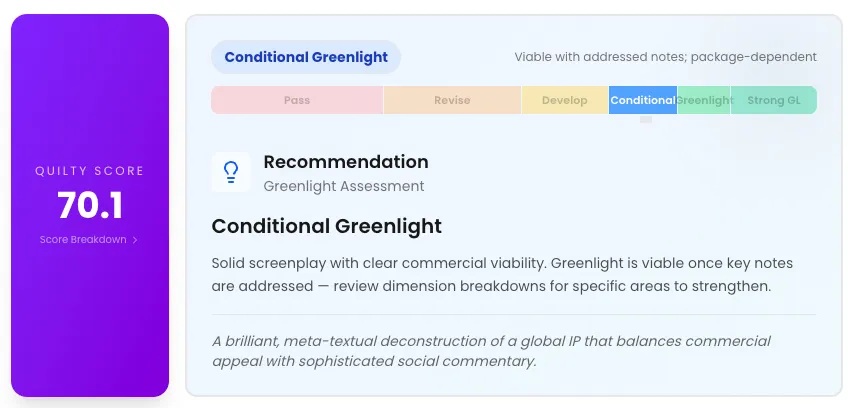
Those concerns underscore the amazing work director/co-writer Greta Gerwig did in building those iconic pink sets and making the world of Barbie a believable, if hyperreal, location.
The initial recommendations call for Sweeney and Alan Ritchson to play Barbie and Ken, respectively, again paired with Ratner. But the actual talent and casting section suggests Samara Weaving (“Ready or Not”) and Nicholas Galitzine (“Masters of the Universe”).
It set a recommended budget of $145 million with a breakeven target of $590 million.
“Barbie” was produced by Warner Bros. Pictures on a budget between $130 and $145 million.
“Sinners”
At a score of 69, “Sinners” was also on the low end of a conditional green light. Quilty lauded its thematic depth, cultural specificity and visceral visual language and emotional core, but criticized its Act 2 pacing and repetition and ambiguity of its vampire mythology.
Bringing down the overall score was production reality (50), with the high budget for the period horror film requiring a blockbuster to recoup its investment.
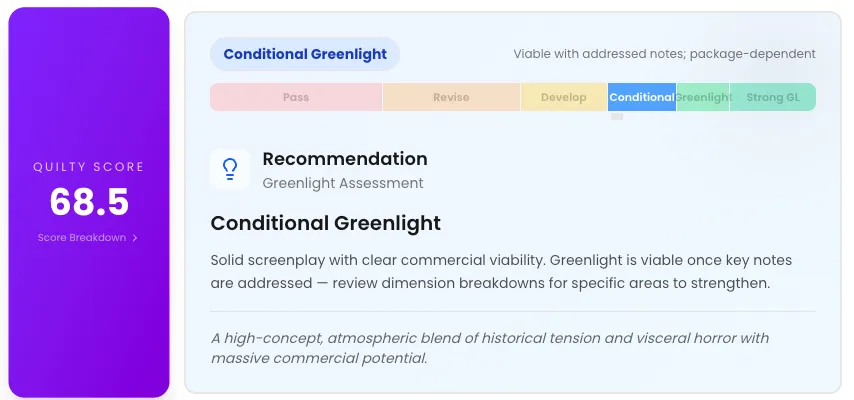
But what raises flags is how Quilty lays into the Oscar-winning script, suggesting that the “clunky dialogue, era-inaccurate vibes and casual slurs scream unpolished draft that’ll need heavy rewrites to avoid 2028 cringe backlash.”
The “Tarantino wannabe” slam does come in a section titled “Brutally Honest Review,” but still suggests the AI is missing a lot of the nuance of the script.
It had recommended a budget of $65 million with a breakeven target of $195 million. “Sinners” was produced by Warner Bros. for a $100 million budget and grossed $369 million worldwide.
“Die Hard”
Given that it came out in 1988, Quilty may have had some trouble squaring away the anachronisms throughout the film. That might be why it scored a 63, by far the lowest among the four, which puts it at the low end of needing further development before getting a green light.
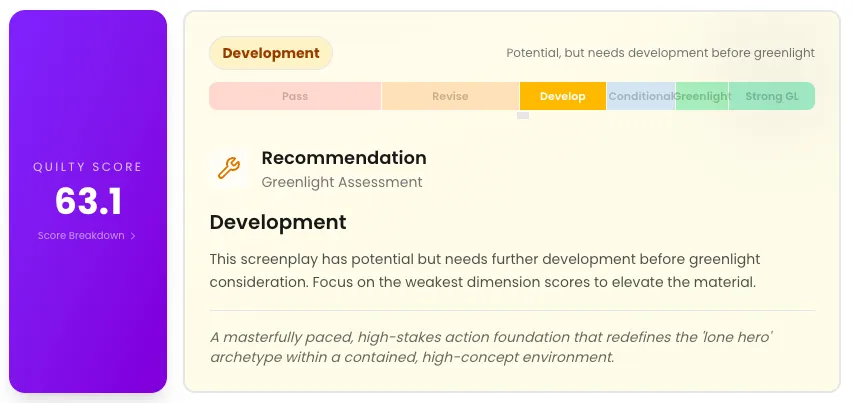
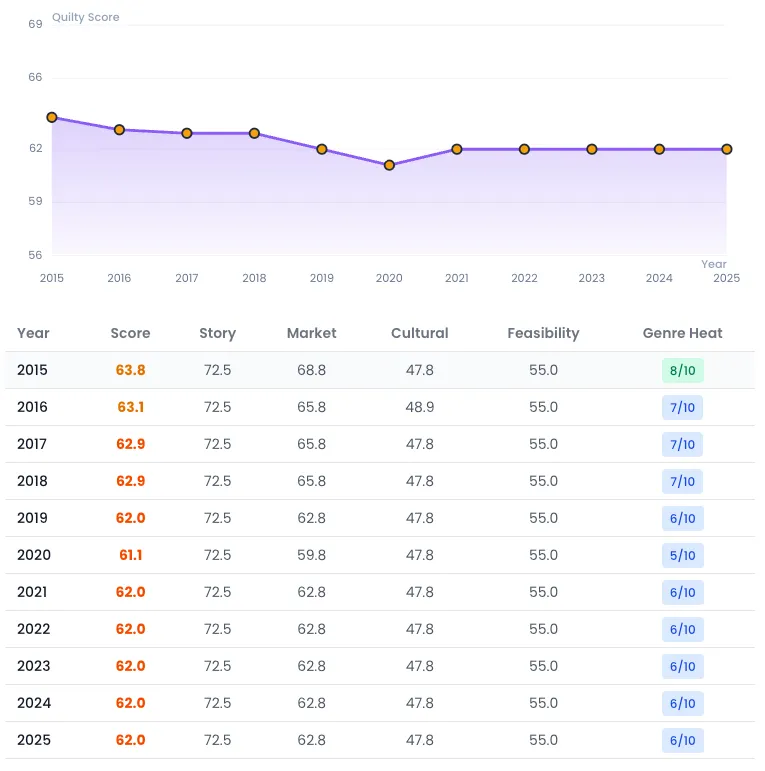
It got dinged for cultural resonance, which makes sense given its era of origin, commercial viability and production reality, which all required significant revisions. Quilty also has a chart that shows how films would’ve resonated culturally going back to 2015.
“Die Hard,” sadly, would’ve been just as irrelevant 10 years ago, according to Quilty.
It’s interesting to see how Quilty would’ve cast this film. Ratner isn’t in sight as director under that lower budget tier, with Aditya Dhar (“Dhurandhar: The Revenge”) filling that slot.
When getting into the recommendations without the budget restrictions, the options seem to make more sense, with David Leitch (“John Wick”) deemed perfect and Doug Liman (“The Bourne Identity”) labeled a stretch get.
Filling Bruce Willis’ iconic shoes (or bare feet?) as John McClane would be Glen Powell, while Michael Fassbender would play Hans.
Quilty gave it a recommended budget of $120 million and a breakeven target of $350 million.
20th Century Fox distributed Die Hard, which grossed over $140 million worldwide on a $28 million budget, but that was of course in 1988 dollars.
Conclusions
Quilty clearly gives you a lot for your money. There is extensive analysis that touches upon creative, production, marketing and financial aspects. But it is entirely unclear whether any of these insights would actually help you predict the next blockbuster or flop.
Because given those scores, it’s clear Quilty still lacks the human intuition that remains a critical ingredient to succeed in Hollywood.
For someone new to the industry, Quilty might be a useful way of approaching the business.
Or it might just be a fun way to part with $50.
The post We Tried Quilty, the AI Tool That Analyzes Scripts. The Results Were Shocking appeared first on TheWrap.