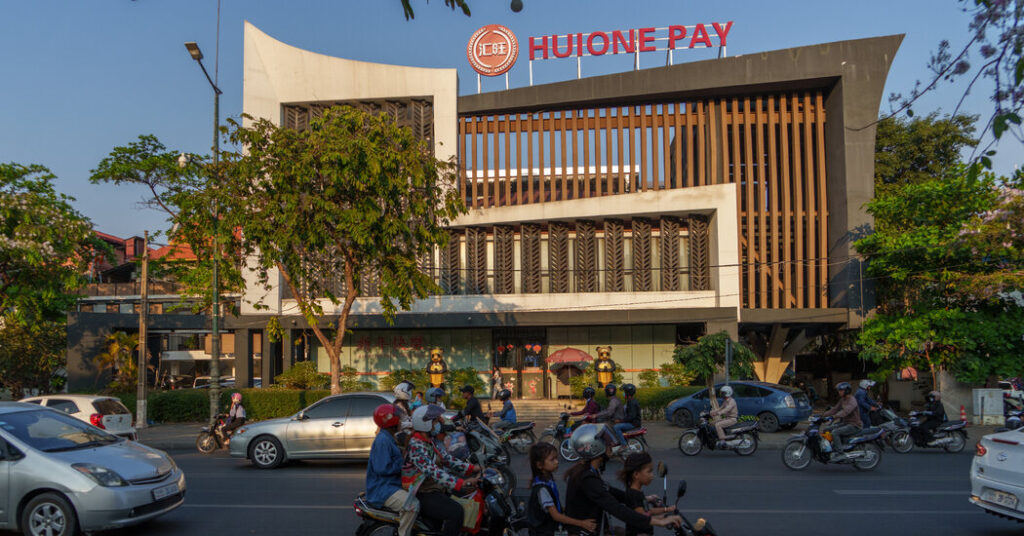
China nabbed on Wednesday the leader of a Cambodian financial conglomerate that was at the heart of a global money-laundering network, in its latest show of force against cross-border organized crime in Southeast Asia.
The man, Li Xiong, a Chinese national, is the former chairman of Huione Group and is suspected of committing fraud, concealing criminal proceeds, and operating casinos and other illegal businesses, Chinese state media reported. He was extradited from the Cambodian capital, Phnom Penh, with the help of the authorities there, the reports said.
China has conducted sporadic crackdowns on scammers in Southeast Asia as well as those who facilitate such crime by providing money laundering and other services. The criminals target victims across the world, swindling them online from the relative safety of heavily guarded compounds. Many of the scammers and their victims are Chinese nationals. Some are trafficked into the job and held against their will.
Last year, a New York Times investigation found that Huione’s group of companies operated a global money laundering network used by online scammers and other criminals.
The Chinese authorities identified Mr. Li’s company, Huione, as a subsidiary of Prince Group, which was sanctioned by the United States last year. U.S. federal prosecutors accused it of bilking victims out of billions of dollars through investment scams. The chairman of Prince Group, Chen Zhi, was extradited to China from Cambodia in January.
On Wednesday, Chinese state television showed Mr. Li disembarking from a plane handcuffed and hooded, escorted by several Chinese police officers who then removed the hood for the cameras.
The Ministry of Public Security said in a short statement that it had arrested “several key members of Chen Zhi’s criminal gang.”
For a while, Chinese law enforcement officials’ collaboration with their Cambodian counterparts netted only lower-level criminals, leaving the scamming and money-laundering industries intact.
The kingpins of the Huione and Prince Group, in particular, operated without censure and enjoyed the Cambodian government’s protection. Mr. Chen was an adviser to the prime minister and a relative of the Cambodian prime minister was a director of one of Mr. Li’s companies.
The latest extraditions indicate that Cambodia is giving in to pressure from Beijing.
“We are willing to continue increasing the intensity of law enforcement cooperation with neighboring countries including Cambodia,” China’s Ministry of Foreign Affairs said on Wednesday.
As well as sanctioning Prince Group and its affiliates, subsidiaries and associates last year, the U.S. government seized nearly $15 billion in bitcoin from Mr. Chen’s group of companies, the largest seizure ever, according to the U.S. Justice Department. American prosecutors also filed an indictment against Mr. Chen, accusing him of wire fraud and conspiracy to commit money laundering.
U.S. authorities did not explicitly establish a link between the Huione and Prince groups but the Trump administration separately blacklisted Huione as a money-laundering operation last year, shutting it out of the U.S. financial system.
Until recently, Huione was a mighty constellation of companies that sucked in money from criminals, washed it clean and moved it across borders at stunning speed.
The company had legitimate business — its QR codes were ubiquitous across Cambodia and customers used them to settle their bills in supermarkets, restaurants and hotels. It also offered other banking and insurance services.
Its less-legitimate underbelly, though, was the primary moneymaker. One affiliate of the company offered bespoke money-laundering services. Another ran an open online bazaar that served as matchmaker between criminals and money launderers.
Huione Group and its affiliates have laundered at least $4 billion for criminals, including hackers in North Korea and scammers in Southeast Asia, according to the U.S. Treasury. That figure could be higher — the online marketplace alone hosted nearly $27 billion in transactions until last spring, although some of those transactions may have been legitimate, according to the analytics firm Elliptic.
In December, the Cambodian National Bank said Huione had gone into liquidation after the government revoked its license to operate.
Siyi Zhao contributed research from Beijing.
Selam Gebrekidan is an investigative reporter for The Times based in Hong Kong.
The post The Fall of a Cambodian Money-Laundering Giant appeared first on New York Times.