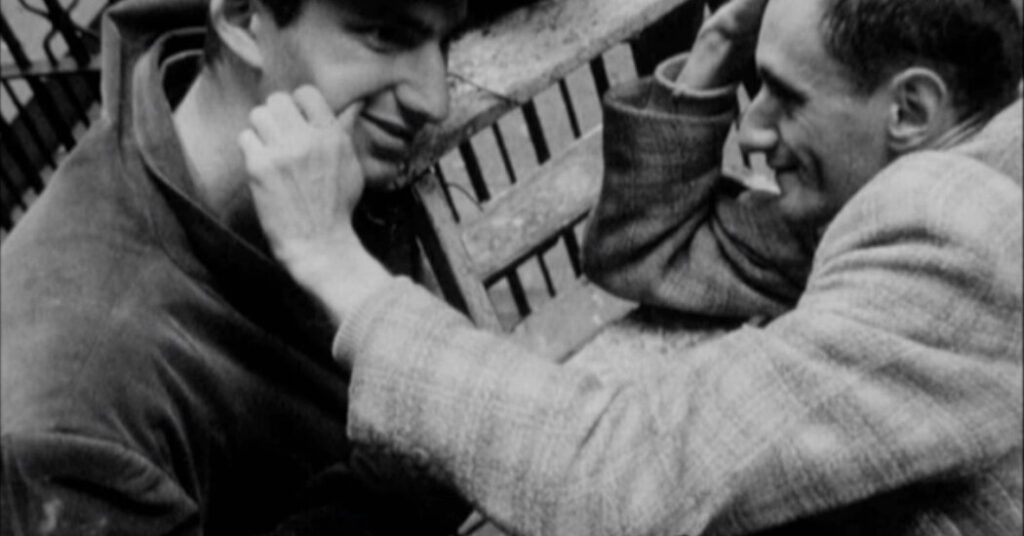
A scathing, lyrical, ambivalent celebration of motion pictures as well as an impassioned political diatribe, Ken Jacobs’s 6½-hour assemblage “Star Spangled to Death” is sui generis — a bargain- basement mash-up that variously evokes “Greed,” “Howl” and “Moby Dick.”
At one point, “Star Spangled” self-reflexively claims kinship to the Frankenstein monster. Its ambition and ingenuity honor the Museum of Modern Art, where it screens as an installation through April 7.
Jacobs, who died last September at age 92, began “Star Spangled” in the mid-1950s and showed it in various forms for decades before finishing a digital version in 2004. Simply described, the movie juxtaposes all manner of found movie footage with Jacobs and his friends — notably the artist Jack Smith — cavorting through various, often derelict, Manhattan sites.
Call it cultural dumpster diving or bricolage. On one hand, Smith and his castmates, including an emaciated embodiment of suffering played by Jerry Sims, are festooned with trash and inhabit a land of broken toys and bemused spectators. On the other, “Star Spangled” incorporates a trove of cinematic detritus — vintage cartoons, soft-core pornography, educational films, political promos and jungle safari travelogues, not to mention “Going to Heaven on a Mule,” the spectacularly offensive 15-minute blackface finale from the 1934 Al Jolson vehicle “Wonder Bar.”
“Rather than use brief clips from campy old films to score easy political points,” Dave Kehr wrote in a 2004 review in The New York Times, “Mr. Jacobs brilliantly and generously allows much of the borrowed material to play out in its entirety, at which point it indicts itself.” The effect is a vast American pageant in which not just Jolson but Richard Nixon, Nelson Rockefeller, Mickey Mouse and the cast of Oscar Micheaux’s “Ten Minutes to Live” share a time-space continuum with Smith, crowned with a paper bag and brandishing a mop, materializes in one sequence on the Bowery to consternate a meeting of winos.
Throughout, “Star Spangled” marshals painful evidence of institutionalized racism, military mobilization and instrumentalized piety. Jacobs, however, is a master filmmaker whose dynamic compositions continuously delight the eye and whose use of montage can be laugh out loud funny. Digital technology allowed him to layer the track with random sound effects as well as annotate his footage with freeze frames and titles. Using these to address the viewer, he allows a certain affection for the United States’ “nitwit charm.”
Jacobs has a residual fondness for the idealistic New Deal propaganda of his childhood and cites the revolutionary pamphleteer Thomas Paine with approval — nevertheless the film’s relentless anti-patriotism more than justifies its title. The final 90 minutes, titled “The Height of Folly” are rich with repetitions and references to what has come before. Ruth Clayton’s mid-1940s soundie “Are You Havin’ Any Fun?” reappears to disintegrate before our eyes while Jacobs discovers the “Spirit of Jack Smith” (as noted in a title card) embodied in a group of costumed Manhattan demonstrators protesting the War in Iraq in 2003. (However, the filmmaker’s battery dies before he can visually record the police response.)
Capacious as it is, “Star Spangled to Death” does not encompass all of Jacobs’s multifarious cinematic interests. Indeed, the museum’s presentation inaugurates a 14-venue, three-borough retrospective involving Light Industry, Anthology Film Archives, the Roxy Cinema, Metrograph, L’Alliance New York, Film at Lincoln Center and the Film-Makers’ Cooperative in Manhattan; UnionDocs, BAM Cinema, Spectacle Theater and Millennium Film Workshop in Brooklyn; and the Museum of the Moving Image and Rockaway Film Festival in Queens.
Even these may not be enough.
Star Spangled to Death
Through April 7, Museum of Modern Art in Manhattan, moma.org.
The post ‘Star Spangled to Death’: Ken Jacobs’s History of the United States appeared first on New York Times.