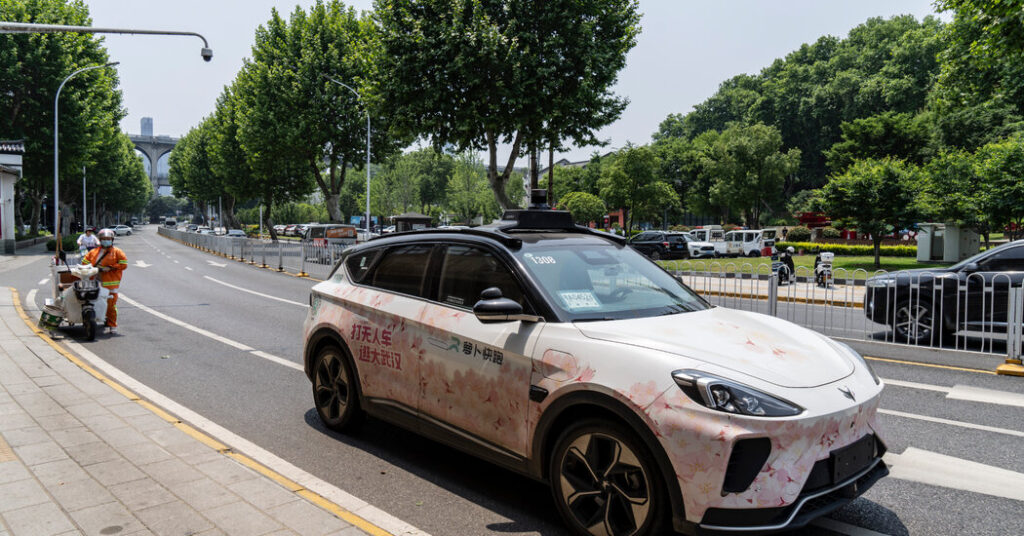
One of the world’s largest experiments in driverless cars suffered an embarrassing setback as a number of robot taxis abruptly stopped moving in traffic on Tuesday evening in Wuhan, China, stranding their passengers and sometimes blocking other vehicles.
The police in Wuhan, a large metropolis in central China, announced on Wednesday that it had received a “succession” of reports that self-driving cars had stopped. The cars were part of the extensive Apollo Go program of self-driving cars run in Wuhan by Baidu, a large Chinese internet company.
The police said an unspecified “system failure” had occurred, and did not say how many cars had been affected. Baidu has hundreds of the cars in Wuhan, where they have become a common sight.
“Following established contingency plans, the public security traffic control and transportation departments quickly mobilized forces to the scene to dispose of the situation in coordination with Apollo Go company staff,” the police statement said.
Baidu did not have an immediate comment.
Waymo, an American provider of robot taxis, had a somewhat similar incident last December in San Francisco, when an hourslong power failure prompted Waymo cars there to pull over and stop. Robot taxis are typically programmed to stop if they encounter a completely unfamiliar situation.
However, in the Wuhan incident, a video circulated on Chinese social media shows what appears to be a passenger stranded in an Apollo Go car that has stopped in the least fast lane, but not on the shoulder, of a broad expressway as trucks hurtle past. Two photos on Chinese social media shows another Apollo Go car that has stopped in the middle of a highway and appears to have been hit on the back left corner by an orange sport utility vehicle that sits nearby with considerable damage to its right front corner.
China’s regulators told automakers in early December to delay their plans for the sale of cars with a wide range of self-driving features. The authorities pulled back following a crash of a Xiaomi SU7 a year ago killed three women, all university students. The car disengaged from self-driving mode and asked the driver to take control of the vehicle one second before it hit a concrete construction barrier at 72 miles an hour.
In July, China’s state-run television reported that tests on 36 car models from 20 brands had found that slightly fewer than half the cars could safely avoid a crash when they encountered trucks near a construction site at night. Only the two models by Tesla, the American company, had assisted-driving systems that were reliable in a wide range of safety situations, according to the report, which was widely viewed on the Chinese internet.
Many auto analysts and executives believe that self-driving, which works best with electric cars, could be the next big advance for the industry. They envision hundreds of millions of drivers deciding in the years ahead to leave the driving to computers.
The rise of self-driving technologies threatens to leave behind those automakers in the West and northeast Asia that still emphasize sales of gasoline-powered cars. Gas engines respond much more slowly than electric motors to computerized driving instructions, making it difficult to design a gasoline-powered robot taxi.
China had a late start in driverless technology but has been quicker to approve widespread testing, while censoring reports of safety problems. In the United States, Waymo and Tesla are making major investments in self-driving. Waymo is also starting to roll out a fleet of robot taxis in London in a highly anticipated program.
Baidu announced last August that it would supply Lyft, an American ride-hailing service, with robot taxis to be operated this year in Germany and Britain, subject to regulatory approval. Momenta, a Chinese autonomous driving company, and Uber, the ride-hailing giant, announced last year that they planned a small experiment in Europe with self-driving cars. WeRide, another Chinese company, has begun driverless vehicle projects in Abu Dhabi and Singapore as well as several Chinese cities.
The timing of the incident in Wuhan is particularly awkward for Baidu and for China, as it comes three weeks before thousands of executives and engineers from automakers around the world are set to converge on Beijing for the city’s auto show. The exhibition has become the world’s premier showcase of automotive innovation as the Chinese government has pushed foreign and domestic manufacturers alike to showcase their latest electric vehicles and other technologies.
Siyi Zhao and Ruoxin Zhang contributed research.
Keith Bradsher is the Beijing bureau chief for The Times. He previously served as bureau chief in Shanghai, Hong Kong and Detroit and as a Washington correspondent. He lived and reported in mainland China through the pandemic.
The post Robot Taxis Stop in Traffic in Chinese City, Stranding Travelers appeared first on New York Times.