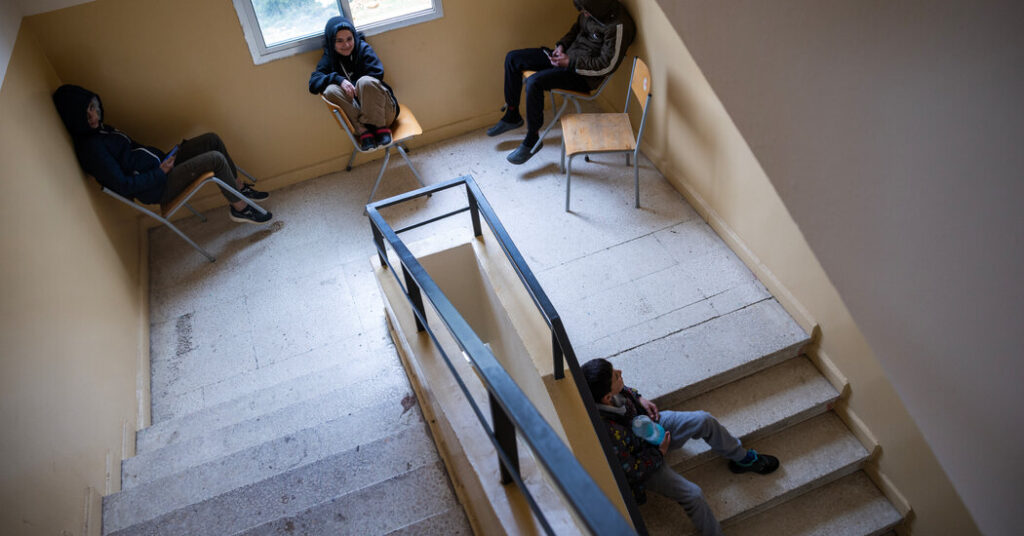
When Israel and Hezbollah last went to war two years ago, Israeli evacuation warnings came a few villages at a time for residents in southern Lebanon.
With the outbreak of a new war last month, the warnings came all at once. As fighting reignited, Israel issued blanket evacuation guidance for a vast stretch of southern Lebanon — extending 25 miles from the Israeli border — publicly urging all civilians to flee to the north.
But behind-the-scenes, Israeli officials have conveyed a more targeted message.
In private calls to local leaders across southern Lebanon, Israeli military officials have assured several Christian and Druse communities that they could remain in the evacuation zone. They have pressed them, however, to force out any Lebanese from neighboring Shiite Muslim communities who have sought refuge among them as Israeli bombardment flatten Shiite towns, according to local Christian, Druse and Shiite leaders who spoke to The New York Times. The Shiites make up the majority of southern Lebanon.
Local leaders took the messages as a clear signal: Israel is trying to force out one group in the south — Shiites, who are from the same sect as Hezbollah, the Iranian-backed militant group that Israel is trying to vanquish.
“Israel wants to create a new buffer zone, it wants us out, what can we do?” said Ali Naser, 26, a Shiite from one border village, Aitaroun.
Mr. Naser and his relatives fled their farm there when the war broke out and sought refuge in Rmeish, a predominately Christian town within the evacuation area. About two weeks later, municipal leaders informed them they needed to leave at once. First they went to the city of Sidon, on the coast, and then, after being unable to find space in any of the government-run shelters there, a relative’s home in the eastern Bekaa Valley beyond the limits of the evacuation zone.
“The town received and hosted us, we are grateful for that,” Mr. Naser said of Rmeish. But, he said, local leaders told him the pressure from Israel to make them leave was too great. “I’m at a loss,” he said.
The Israeli directives are among the earliest indicators of the plans Israel appears to be laying in southern Lebanon.
Since Hezbollah fired rockets at Israel last month in support of Iran, Lebanon has been engulfed in its second major war in less than two years. Israel has struck many areas in the east, south and the capital, Beirut, killing more than 1,200 people and displacing more than a million others, according to Lebanese government officials. Israeli ground forces have also invaded deeper into southern Lebanon and clashed with Hezbollah militants there.
On Tuesday, Israel’s defense minister, Israel Katz, laid out in the starkest terms yet that Israel plans to occupy Lebanese territory from the border up to the Litani River — nearly 10 percent of the country.
Mr. Katz said in a statement that Lebanese who had fled their homes in the south “will be completely prohibited” from returning “until the safety and security of northern Israeli residents is ensured.” He previously specified that Shiites would not be allowed to return and likened Israel’s strategy in Lebanon to that in Gaza.
That public messaging, along with the private push on local leaders, suggests that Israel is intent on redrawing not only the geographic map of south Lebanon but also the demographic one.
Over the past two weeks, Israeli military officials have called leaders of at least eight villages and told them to expel Shiites who had sought refuge in their communities, municipal officials and local Christian, Druse and Shiite leaders said in interviews. All complied, fearing that if they did not their towns could be hit next in the Israeli bombardment, they said. Most spoke on the condition of anonymity to discuss sensitive, private conversations.
The Israeli military did not respond to a request for comment on whether they had directed local leaders to expel Shiites.
The warnings targeting Shiites have raised alarm among human rights groups, who say that they could amount to forced displacement.
“The Israeli military cannot claim to be safely evacuating the civilian population for imperative military reasons when, in some areas, its expulsions are based on religion and only Shia civilians are forced to leave,” said Nadia Hardman, senior refugee and migrant rights researcher at Human Rights Watch.
The Israeli directive has also stoked long-simmering sectarian tensions in Lebanon, which includes a fractious political and social mix of Shiite and Sunni Muslims, Christians of various denominations and Druse, who practice an offshoot of Islam. They battled one another in a blood-soaked, 15-year civil war that ended in 1990.
Israel invaded southern Lebanon during that war and occupied much of it until 2000, fostering ties with some Maronite Christians while battling Palestinian militants and later Hezbollah in Muslim areas of the south. Those relationships deepened the sectarian tensions — many fear that will happen again should Israel occupy southern Lebanon once again.
In Kawkaba, a Maronite Christian town around five miles from the Israeli border, the din of fighting in villages nearby has put residents on edge.
On a recent Sunday, residents gathered for Mass inside St. Elias Church, a limestone structure more than 100 years old that took in hundreds of displaced Lebanese during the civil war. Its bell tower was struck by artillery during that war — the scars are still visible today.
Inside the church, the priest’s voice echoed through the loudspeaker over the thuds of artillery and the roar of Israeli warplanes overhead. “We will always be attached to our land, we won’t leave it,” he told the congregation. “Do not fear, keep faith in your heart.”
When hostilities between Hezbollah and Israel intensified in 2024, around two dozen Shiite families fled their villages along the border after they were hit by Israeli bombardment. The families rented rooms in Kawkaba, which is not under the sweeping evacuation order, and stayed after a cease-fire deal was reached in November 2024 because their villages had been flattened. They were the only Shiites in Kawkaba, which was open to hosting them.
But when the latest war began last month, that hospitality waned.
Municipal leaders barred any newly displaced Shiite Muslims from renting homes in the town, for fear that the newcomers may have a connection with Hezbollah that could lead to the town being targeted. Officials visited the existing Shiite families each day to ensure they were not taking in newly displaced relatives and warned them that if Israeli officials told the municipality to expel Shiites, the town would have to comply.
“I visited the families one by one and told them to prepare themselves, that if we got an alert they would have to move,” the deputy mayor, Mira Khoury, said as she sat in her office in Kawkaba. Complying with Israel is “for the safety of the town,” she explained.
Hours later, the mayor received a call from an Israeli military official who delivered the directive, according to local leaders. The town obliged, leaving the Shiites to search for refuge elsewhere yet again.
The Israeli messages have put Christian and Druse leaders in an almost impossible position as they try to protect their towns. If they comply with Israel’s demands, their towns might avoid bombardment and destruction. But many worry about the repercussions when the war ends, fearing retaliation from Hezbollah or others who could see compliance as collaboration.
When leaders in Marjayoun, a hilltop Christian town in south Lebanon, asked displaced Shiites to leave, they said they began receiving veiled threats from people they believed to be affiliated with Hezbollah.
“Some people were saying: ‘We will leave now, but you’ll see what happens after the war. We’ll deal with you after the war,’” said Sister Stephanie Hadad, who runs a cloister in a nearby town, Hasbaya. The town is currently hosting hundreds of displaced Shiites, and its leaders fear that it, too, will soon receive calls from Israeli military officials telling it to expel them.
Those threats have prompted some Christians to view more favorably the possibility of an Israeli occupation of the south when the war ends, seeing it as a bulwark against retaliation, Sister Hadad said. Others have privately expressed an openness to Israel out of sheer exhaustion from Hezbollah’s decades-long iron grip on the Lebanese state.
Shiites who have sought refuge in Hasbaya are afraid that the places within the country where they are welcome are shrinking each day. The expulsions come as many Shiites have expressed more open frustration withHezbollah for dragging the country into war.
Sanaa Saad, 58, left her home in a southern city, Khiam, at the start of the war when Israel issued sweeping evacuation warnings for the area. She and her 87-year-old father were put up in a room in a school-turned-shelter in Hasbaya.
After Israeli forces overran Khiam, she lost any hope of returning to her home. Now she fears that Hasbaya may be the next town instructed to expel displaced Shiites.
“Where will we go then?” Ms. Saad asked. “If no one accepts us, will we stay in our cars? Will we sleep on the street, praying for the war to end?”
Hwaida Saad and Dayana Iwaza contributed reporting from Beirut and Natan Odenheimer from Jerusalem.
Christina Goldbaum is The Times’s bureau chief in Beirut, leading coverage of Lebanon and Syria.
The post Israel’s Message to Southern Lebanon: Shiites Must Go appeared first on New York Times.