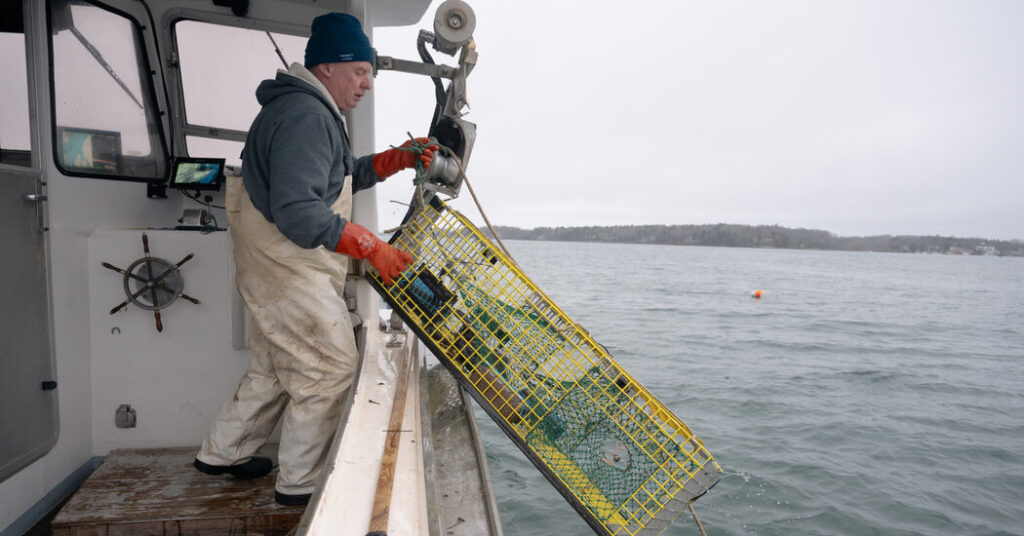
When Bob Hersey Jr., a Maine lobsterman, pulls up his traps, he gets more than tasty crustaceans. He’s collecting vital details about the changing ocean environment.
Mr. Hersey, who also dives for sea urchins, is among nearly 150 fishermen who have installed temperature sensors on their traps or trawl nets from Maine to North Carolina as part of a program run by a nonprofit organization with help from the National Oceanic and Atmospheric Administration.
The soda-can-size sensors are dragged along the seafloor, giving fishermen and scientists a three-dimensional map of the ocean rather than just conditions on the surface, which can be checked using satellites or thermometers on boats. The data is continuously collected and fed into regional weather and climate models.
“The fishing industry can collect data that nobody else can get to,” said George Maynard, a marine resource management specialist at the National Marine Fisheries Service, a branch of NOAA. “It’s a cheap way to collect a lot of oceanographic data to improve those models.”
The sensors record water temperature and oxygen levels and soon they will also record salinity, an important indicator of large-scale changes in ocean currents that influence weather patterns.
While the data is valuable to researchers, it’s also helping Mr. Hersey and others decide the best places to fish.
“I’m trying to figure out how to be more efficient,” said Mr. Hersey, 55, who has deployed four sensors on his 600 lobster traps and has been studying the temperature changes in relation to the size of his catches. “I’m trying to establish a pattern of where they are with a certain temperature.”
As New England’s fishing industry faces declining catches, restrictions to protect endangered right whales and a rapidly changing ocean ecosystem, the data collection program is fostering connections between fishermen and scientists, two groups with a history of occasional conflict.
“This is providing a way for fishermen to interact with the agency that is less combative than in the past,” Dr. Maynard said. “It is giving them a way to document their experiences on the water where they are believed and not told, ‘You’re being anecdotal.’”
In addition to informing marine forecasts, the data collected is being used by federal scientists to assess the health of commercial fisheries for lobster and black sea bass, Dr. Maynard said. That information is used to set government limits on the amount of seafood that fishermen can harvest.
Academic scientists are also using the data, feeding it into a database of global climate measurements compiled by the World Meteorological Organization, a branch of the United Nations. And the U.S. Coast Guard is applying the data to search and rescue missions, Dr. Maynard said.
When a sensor tied to one of Mr. Hersey’s traps breaks the surface, the sensor connects via Bluetooth to a tablet-size terminal on the boat’s bridge. The tablet downloads the data and then sends it via cellular connection to a remote computer server. Fishermen can view their own data and a regional map of conditions. The data is anonymized to prevent fishermen in the program from knowing where their neighbors have set nets or traps.
The program began in 2001 but expanded in 2024 with a $2 million grant from the state of Massachusetts, followed by $200,000 from the Nature Conservancy and $120,000 from NOAA. There’s now a waiting list among fishermen for the $5,000 package of sensors, software and tablets, which is paid by the program.
The sensors have collected 23 million temperature records to date, according to Erin Pelletier, the executive director of the Gulf of Maine Lobster Research Foundation which maintains the devices and compiles the data.
“It’s a pretty big data set,” she said.
Dave Casoni of Sandwich, Mass., checks the sensor data to learn when areas of low oxygen might affect his lobster catch in Cape Cod Bay.
“Before, if you pulled a trap and there were dead animals in it, we didn’t know what caused it,” Mr. Casoni said. “Now, we know what is happening and when that is occurring right away.”
Since 2010, New England’s fishing industry has been scrambling to adjust to the warming of the Gulf of Maine, which has been heating faster than 99 percent of the world’s oceans as a result of climate change.
The region’s codfish industry has collapsed. Shrimping in Maine has been on hold since 2014 because rising temperatures have diminished the population. And lobster catches, which rose for several years to record levels, plummeted in the past four years as the lobster population moved north to cooler Canadian waters.
Last year, Maine’s lobster catch fell to 79 million pounds from 121 million pounds in 2018. Experts say that young lobsters require a specific water temperature — a sweet spot — to grow on the surface before drifting to the bottom to live out their adult lives. That ideal point in the water is shifting in both location and depth because of climate change, along with the availability of food for the growing lobster.
These environmental changes are hampering the growth of lobsters from young to adulthood, said Kathleen Reardon, a senior lobster biologist at the Maine Department of Marine Resources.
In late 2024, the Gulf of Maine started cooling after nearly 15 years of gradual warming, a trend that is expected to last for the next decade, according to a peer-reviewed study published in the journal Geophysical Research Letters.
This cooling trend is occurring because the Gulf Stream, which brings warmer salty water from the tropics as it flows along the East Coast, has shifted slightly to the south and the east, allowing cooler water from Greenland to flow into the Gulf of Maine, according Andrew Ross, an author of the study and a climate modeler at the Geophysical Fluid Dynamics Laboratory, which is part of NOAA.
Cooler water does not mean that climate warming has reversed, Dr. Ross said. “We struggled with how we wanted to describe it,” he said. “We came up with a temporary pause or a predictive pause.”
Normally, a cooling trend would be great news for the New England fishing industry, but it has thrown fishermen, regulators and even scientists into a bit of a tailspin. Regulators are trying to anticipate what this pause in warming might mean for each species. Fishermen have started using different gear to catch new species, and they wonder how best to invest for the future.
Mr. Hersey is trying to stay ahead of these environmental changes, relying on the monitors on his traps.
“The sensors will help us have a better understanding of what is going on with the climate in the ocean,” Mr. Hersey said as he washed down the rear deck of his lobster boat on a recent morning. “Everybody wants to know what’s going on in the ocean all the time. If we can help provide that service, it’s a win-win all the way around.”
The post In New England, Catching Climate Data Along With Fish appeared first on New York Times.