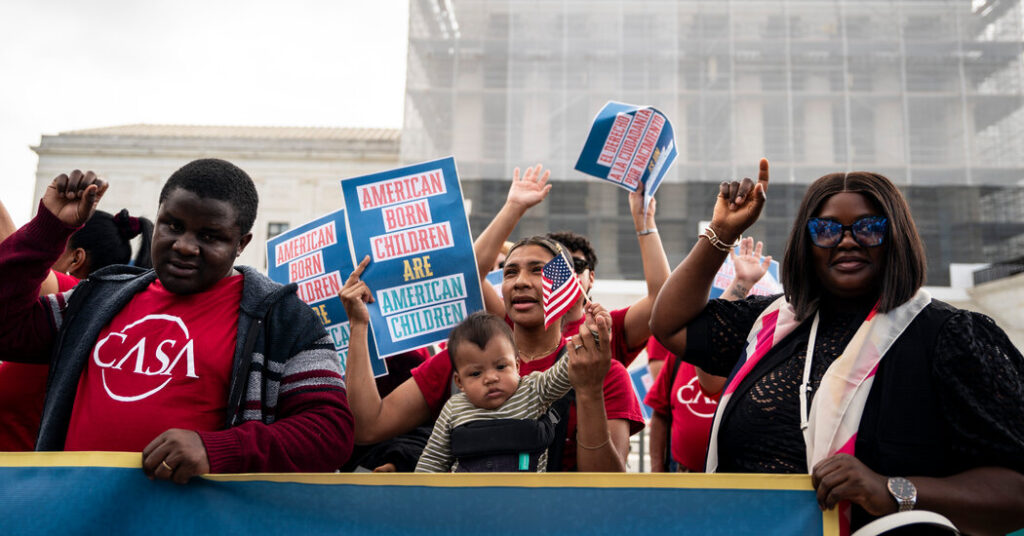
The Supreme Court on Wednesday will hear a landmark case testing whether President Trump can limit birthright citizenship, the long-held principle that nearly all children born in the United States are automatically citizens.
The case focuses on the constitutionality of an executive order signed by Mr. Trump last year that would end citizenship for babies born on U.S. soil to undocumented immigrants and temporary foreign visitors.
A ruling in favor of the Trump administration could redefine what it means to be an American. It could also have sweeping practical consequences, stripping citizenship from more than an estimated 200,000 babies born in the United States each year to undocumented immigrants.
The executive order, which was blocked by lower courts and has never gone into effect, would only affect babies born in the future. Opponents say a decision to uphold it would create chaos and uncertainty for newborns and their parents, and cast doubt over the status of millions of people who have already benefited from birthright citizenship.
A decision is expected in the case by the end of June or early July.
Mr. Trump raised the stakes for the court by telling reporters during an event at the White House on Tuesday that he planned to attend Wednesday’s arguments in person.
No sitting president has attended a Supreme Court argument, and Mr. Trump’s presence in the courtroom would add to the drama for an already emotionally charged session. Mr. Trump had previously mused about attending court arguments, but has steered clear of them.
The question before the court on Wednesday involves the meaning of the citizenship clause of the 14th Amendment, which was ratified in 1868 after the Civil War. The amendment reversed one of the Supreme Court’s most notorious decisions, the ruling in the 1857 Dred Scott case, which had denied citizenship to Black Americans.
The key provision of the amendment states that “all persons born or naturalized in the United States and subject to the jurisdiction thereof” are citizens. That language was mirrored by Congress in a 1952 law, and has been understood in court rulings and executive actions for more than a hundred years to guarantee birthright citizenship.
In a key precedent, the Supreme Court ruled in 1898 that Wong Kim Ark, a man of Chinese ancestry born in San Francisco to noncitizen parents, was a U.S. citizen.
But the administration has argued that when the 14th Amendment was adopted, it was intended to apply to formerly enslaved people and their descendants. It has also claimed that the amendment has been incorrectly interpreted as extending to the children of undocumented migrants.
The plaintiffs, a group of expectant parents and their children, argue that the guarantee of birthright citizenship is enshrined in the Constitution, and that the president does not have the power to unravel it.
They point to English common law and assert that the language in the 14th Amendment “drew on and reaffirmed a centuries-old, common-law tradition of citizenship by virtue of birth, rather than parentage,” according to a brief to the court.
The plaintiffs, who are represented by the American Civil Liberties Union, also argue that the language in the Constitution was meant to enshrine birthright citizenship as a foundational principle “beyond the reach of officials in any branch of government who might seek to overturn or narrow it.”
The case is one in a series this term testing the legality of Mr. Trump’s policies. On Feb. 20, the court struck down the administration’s sweeping tariffs on imports from most major U.S. trading partners.
Mr. Trump insisted in a social media post this week that the guarantee of birthright citizenship had been abused. The president and his top advisers have claimed that so-called birth tourism is a national security threat that incentivizes wealthy foreigners to travel to the United States to have babies.
“Birthright Citizenship is not about rich people from China, and the rest of the World, who want their children, and hundreds of thousands more, FOR PAY, to ridiculously become citizens of the United States of America. It is about the BABIES OF SLAVES!” he wrote.
Mr. Trump also vented his anger with the Supreme Court’s conservative majority, including two of his own nominees who rejected his tariffs plan.
“The World is getting rich selling citizenships to our Country, while at the same time laughing at how STUPID our U.S. Court System has become (TARIFFS!),” he wrote, adding: “Dumb Judges and Justices will not a great Country make!”
Mr. Trump has for years been a skeptic of birthright citizenship. After he won his second term in November 2024, he told NBC News during his first extended interview as president-elect that he would end the practice.
“We’re going to have to get it changed,” he said. “We’re going to end that, because it’s ridiculous.”
When he returned to the White House in January 2025, he signed an executive order to limit the citizenship guarantee on his first day back in office.
The order quickly faced legal challenges, and judges in Washington State, Maryland and Massachusetts blocked its implementation for the entire country. A federal judge in Washington State, John C. Coughenour, called the president’s order “blatantly unconstitutional.”
The Trump administration appealed, and the case came before the Supreme Court as an emergency application last year. That challenge, however, did not focus on the constitutionality of Mr. Trump’s executive order. Instead, the legal question before the justices was whether the lower court judges had exceeded their power in blocking the executive order nationwide using a legal tool called a universal injunction.
In June, in a 6-to-3 decision that split along ideological lines, the court sided with the Trump administration, finding that the lower-court judges had overstepped their bounds.
Groups challenging the policy moved to block the executive order once more. One of the lawsuits, a challenge filed in New Hampshire, is the case being argued on Wednesday before the court.
“The government is asking for nothing less than a remaking of our nation’s constitutional foundations,” lawyers for the challengers wrote in a brief to the court.
Before Mr. Trump’s executive order, there had been widespread consensus that the 14th Amendment guaranteed citizenship for U.S.-born babies. But conservative scholars have begun to take a closer look at the history of the 14th Amendment and at the Wong Kim Ark precedent.
D. John Sauer, the solicitor general, has urged the court in filings to “correct long-enduring misconceptions” of its meaning, and to uphold the president’s order.
In a brief to the court, Mr. Sauer wrote that “aliens who are just passing through the United States, and those who cross our borders illegally, lack ties of allegiance and do not obtain the ‘priceless and profound gift’ of citizenship for their children.”
There are several ways the court could resolve the case if the majority of justices disagree with the administration’s arguments.
The Supreme Court generally prefers to avoid major constitutional questions if they can decide a case based on a statute instead. The court could leave questions about the meaning of the 14th amendment for another day and instead find that the president’s order violates the 1952 law.
That would give the administration an opening to go to Congress to try to limit birthright citizenship through legislation. Such legislation has been introduced in Congress repeatedly, but has never been adopted.
Ann E. Marimow contributed reporting.
Abbie VanSickle covers the United States Supreme Court for The Times. She is a lawyer and has an extensive background in investigative reporting.
The post Supreme Court to Hear Landmark Challenge to Birthright Citizenship appeared first on New York Times.