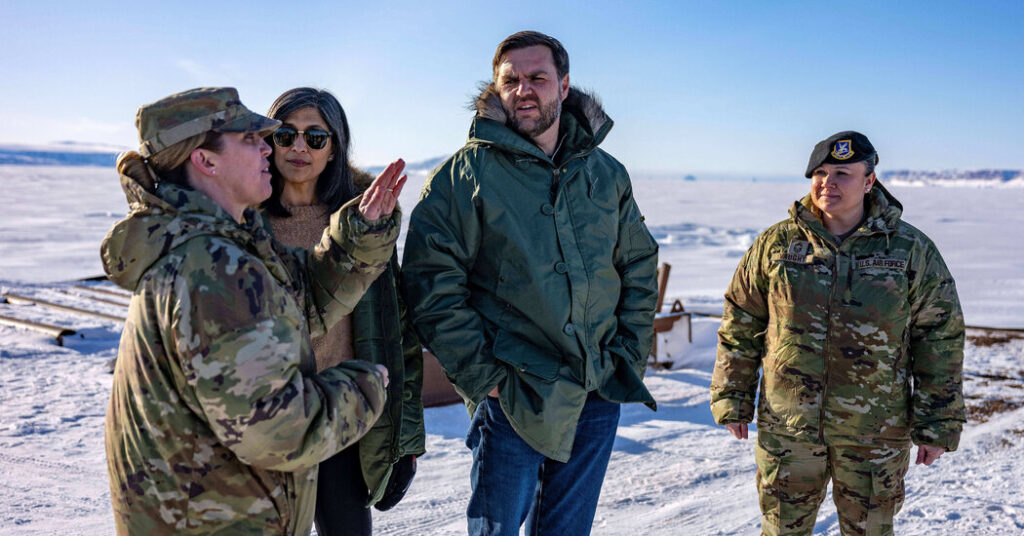
The American military is intensifying efforts to secure greater access to Greenland, a clear signal that President Trump’s interest in the enormous Arctic island has not waned.
The United States is negotiating with Denmark for access to three additional bases in Greenland — including two previously abandoned by Americans — which would mark the first U.S. expansion there in decades, according to a top Pentagon general, Gen. Gregory M. Guillot.
General Guillot, the head of U.S. Northern Command, told lawmakers in a congressional hearing in mid-March that the military wanted “increased access to different bases across Greenland as we look at the increasing threat and the strategic importance of Greenland.”
“I’m working with our department and others to try to develop more ports, more airfields, which leads to more options for our secretary and for the president, should we need them up in the Arctic,” General Guillot added.
The request places Denmark in a tricky spot. Greenland is a semi-automonous territory that has been part of the Danish kingdom for more than 300 years. President Trump, at the same time, has fixated on acquiring Greenland, and threatened to use force for months before relenting in January.
The Danish government has cited a 1951 Danish-American defense pact to push back against Mr. Trump’s threats, noting that the U.S. already has sweeping military access.
American officials are now using that same agreement to map out plans for their expansion. Scholars say there is little Denmark can do to block them, even if the trust between the United States and Denmark has been shaken, if not broken.
Lt. Comdr. Teresa C. Meadows, a spokeswoman for the Americans’ Northern Command, said that military planners were eyeing the towns of Narsarsuaq, in southern Greenland, which offers a deepwater port, and Kangerlussuaq in southwestern Greenland, which already has a long runway capable of handling large aircraft.
Both places had been American bases during World War II and the Cold War, but were turned over to Danish and Greenlandic authorities after the Americans left Narsarsuaq in the 1950s and Kangerlussuaq in the 1990s. Much of their military infrastructure has been dismantled, though both sites still have small functioning airports.
Pentagon officials would not specify how many troops would be sent to the island. General Guillot indicated that the military needs bases for special operations soldiers and “maritime capabilities.”
During World War II, when Denmark was occupied by the Nazis, the United States helped defend Greenland. It sent thousands of troops and opened more than a dozen bases. It kept many operational during the Cold War. Currently, only one base remains active — a remote missile defense installation with a few hundred personnel.
Mr. Trump seems determined to change that. His threats in the past year to “get” Greenland, “one way or the other,” ignited a crisis within Europe. That crisis has eased, for now, as the president has been consumed by the war in Iran. But many Europeans, including Denmark’s leader, Mette Frederiksen, fear that Mr. Trump hasn’t given up on his Greenland fixation, which could leave Denmark in a corner again.
So far, the talks over the base expansion seem to be going smoothly. General Guillot cited the 1951 agreement during his congressional testimony, and when Democratic lawmakers asked him if Denmark or Greenland had thrown up any roadblocks, he said no.
“They’ve been very, very supportive partners,” the general said.
Different from what Mr. Trump has suggested, General Guillot said: “We don’t really need a new treaty. It’s very comprehensive, and it’s frankly very favorable to our operations or potential operations in Greenland.”
The expansion plan remains wrapped in secrecy. The State Department declined to comment, as did Denmark’s foreign ministry and the office of Greenland’s prime minister.
It’s not clear how Greenlanders, most of whom are Indigenous Inuit, will react. Anti-American sentiment has been growing on the island, which has fewer than 60,000 inhabitants. Protests erupted earlier this year against Mr. Trump, and Greenlanders are beginning to voice concerns about more American troops coming.
“Many people don’t want more military in Greenland — but if that’s what they decide, there’s nothing we can do,” said Anso Lauritzen, who runs a sled dog center in western Greenland.
Agnetha Mikka Petersen, a retired resident of Nuuk, the capital, said the prospect of an expanded American presence makes her feel “uneasy.”
“I’m not happy about it,” she said.
The 1951 defense agreement and a 2004 update give the Americans a strong hand. Before making any major changes to their military footprint, the United States is supposed to “consult with and inform” the authorities in Denmark and Greenland. Scholars say that means the United States can pretty much do what it wants and tell the Danes and Greenlanders later.
“Denmark and Greenland can, in principle, say no to the United States — but in practice, you never do that,” said Ulrik Pram Gad, a senior researcher at the Danish Institute for International Studies. “Because if you do, the United States can frame Denmark and Greenland’s control of the island as a security risk — and argue that it should take control itself.”
Jeffrey Gettleman is an international correspondent based in London covering global events. He has worked for The Times for more than 20 years.
The post U.S. Plans Military Expansion in Greenland appeared first on New York Times.