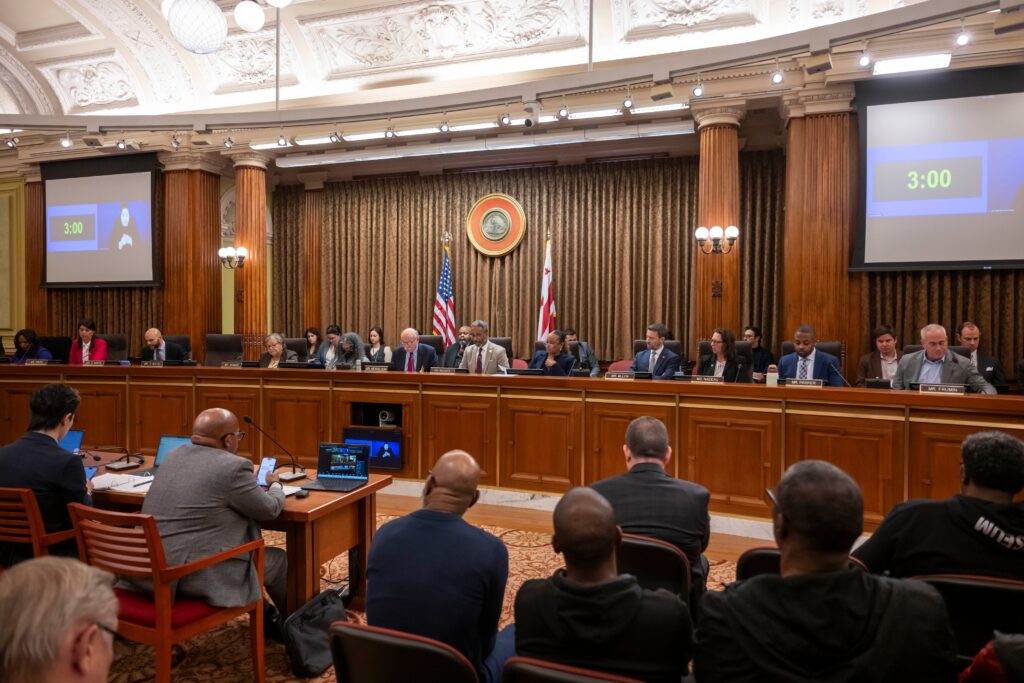
The D.C. Council on Tuesday overrode a mayoral veto on a bill that requires D.C. police to document the presence of federal law enforcement at arrests — a rare step that is part of a move by lawmakers to force more transparency from federal officers who have increased their presence in the city over the past year.
The council also postponed a vote to extend a youth curfew policy supported by Mayor Muriel E. Bowser (D) that allows police to declare special “curfew zones” and prevent teens from gathering there in larger groups after 8 p.m.
The pair of public safety actions put tension between the D.C. Council and Bowser, who have frequently clashed over public safety and policing in recent years, on display once again. Bowser vetoed the federal policing measure after it first passed last month ago, and the council’s override Tuesday was unanimous. The mayor had also urged city lawmakers to extend the curfew policy before it expires on April 15 — but lawmakers remain split on the curfew policy and will likely revisit it in late April.
Bowser did not immediately comment on the veto override Tuesday but later said she was “deeply disappointed” by the council’s decision on the curfew and urged lawmakers to reconsider. “We all want our young people to be safe,” she said in a statement on social media. “But as adults, we cannot abdicate our responsibility to respond to behaviors that put young people in our community at risk.”
She said earlier this week she thought it would be “absolutely ludicrous” not to extend the juvenile curfew ahead of spring break and before the summer months, when juvenile misbehavior tends to be more of a challenge.
“I think the council should stop playing games with this. This is a tool that we need,” the mayor said at a news conference Monday, urging the council to pass a permanent version of the legislation so they can stop having the same debate every 90 days.
The council initially passed the law enforcement bill on March 3, along with a separate measure that required the release of body-camera footage when federal law enforcement officers use serious force. Bowser signed the body-camera bill, sponsored by Council member Brooke Pinto (D-Ward 2), allowing it to go into effect immediately following her approval. But she vetoed the other measure, sponsored by Council member Robert C. White Jr. (D-At Large), which requires D.C. police to record names, badge numbers and employing agencies for federal law enforcement officers present at an arrest. White’s bill, which went into effect Tuesday after the veto override, also requires D.C. police to document use of force by federal officers.
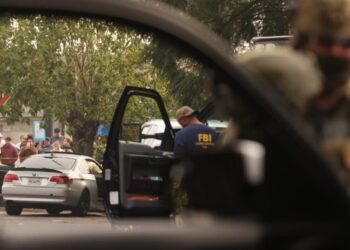
Since the D.C. Council cannot regulate federal law enforcement agencies, both transparency laws would apply only in cases when D.C. police happen to be at the same scene as federal officers — a somewhat frequent occurrence, as the two often patrol together as part of a task force convened by President Donald Trump last year. They also cannot compel federal law enforcement officers to identify themselves at a scene.
Bowser had initially opposed both bills. Then, she signed Pinto’s and vetoed White’s, saying the immediate administrative changes required by White’s bill would be too burdensome.
Bowser said she ultimately saw Pinto’s bill as an expansion of existing city policy on body-camera footage, now including incidents where D.C. police witness federal agents using force. But she said she still thought Congress should tackle federal officer body-camera policies, in the way Del. Eleanor Holmes Norton (D), the District’s nonvoting delegate, led legislation requiring U.S. Park Police to wear body cameras.
“I appreciate that the council wants some backdoor action, but it really is performance more than it is good policy,” Bowser said at a news conference Monday.
Both actions by the mayor carried some political overtones for the bills’ sponsors.
Pinto and White, who are both running to succeed Norton in Congress, had sparred over their measures earlier this month, with each irked that the other had introduced a similar body-camera bill. They ultimately agreed to move forward with the body-camera provisions of Pinto’s original bill and the additional disclosure requirements in White’s bill. White said at Tuesday’s council meeting that he believed the council had made a “collegial compromise” that allowed both bills to pass unanimously.
“I wish the mayor had stayed unanimous with us,” he said.
The council, meanwhile, was far from unanimous on extending the juvenile curfew policy; Council Chairman Phil Mendelson (D) moved to postpone considering it after coming to the conclusion that not enough lawmakers were on board to extend it.
The curfew is an attempt by Bowser and D.C. police to respond to the phenomenon of so-called “teen takeovers” — gatherings of young people in busy commercial areas that can sometimes involve hundreds, and have in some cases ended in acts of violence. The bill allows the police chief to declare special curfew zones where people under age 18 are forbidden from gathering in groups of eight or more after 8 p.m. It also imposes a citywide 11 p.m. curfew for those up to age 17.
The council initially put the expanded curfew law in place last summer at Bowser’s urging — and it has largely been active since, enacted through successive temporary bills that sunset after a period of months. The council at one point last year opted not to extend the expanded curfew, leaving a gap of a few weeks in October without one. Bowser in turn blamed the lawmakers for several large teen gatherings that occurred during that time, including one that led to 10 arrests. Lawmakers rejected Bowser’s claims that the gatherings were their fault but reinstated the curfew shortly after.
Sporadic “takeovers” have occurred since, including one in Navy Yard in mid-March that ended in chaos with a robbery and one teen shooting a gun into the air, according to police.
Some youth advocates have pushed hard against the expanded curfew, arguing that, while police say it has not led to any arrests, the policy has nonetheless increased harmful interactions between officers and teens.
Tia Bell, founder of the youth-focused nonprofit Trigger Project, opposes the curfew policy and said she wanted to see officials offer more creative solutions and send other city agencies to the areas that have been designated as curfew zones.
“I would love to see [the Summer Youth Employment Program] come down to the curfew zone and sign up babies for summer jobs,” she said. “I just wish I saw in my city more coordination.”
The council has tussled over the curfew with each temporary extension, with some lawmakers in favor of the policy and others sharing the concerns of youth advocates and urging different solutions from the city.
The Bowser administration and police department say the city does offer alternative youth programming, including at recreation centers. They argue the policy has been an effective tool for disrupting the teen gatherings in specific cases where officials know from social media posts that a “takeover” is being planned.
“The juvenile curfew has been described by some as a Band-Aid approach to preventing criminal and unsafe behavior by youth,” Bowser wrote in a letter to the council ahead of Tuesday’s vote. “While I do not necessarily agree with that description, it makes no sense to remove a Band-Aid from an active wound.”
Council member Christina Henderson (I-At Large) said she would have supported the expanded curfew had it come up for a vote Tuesday — and said the city would have to get creative ahead of a spring break without it.
Still, she acknowledged some of the concerns raised by advocates about police tactics. Henderson said she reached out to the city’s business improvement districts to start a conversation about youth programming in commercial corridors where young people clearly want to spend time. But she was also skeptical of what she perceived as a growing expectation that the government be in charge of providing late-night programming for young people, she said.
“Parents and community has to step up and be a part of the conversation too,” Henderson said. “When we ask the government to parent, we can’t also expect empathy and a tailored approach for every child.”
The actions on public safety came during a legislative meeting in which the council also took action to prevent electricity shutoffs for those behind on bills. In a separate act of defiance against the mayor, the council also disapproved a contract for purchasing fire trucks after the firefighters’ union raised concerns about the quality of the contractors’ equipment and services. The Bowser administration and fire department leadership defended the purchase as urgently needed.
Meagan Flynn contributed to this report.
The post D.C. Council overrides Bowser’s veto of police bill, underscoring tensions appeared first on Washington Post.