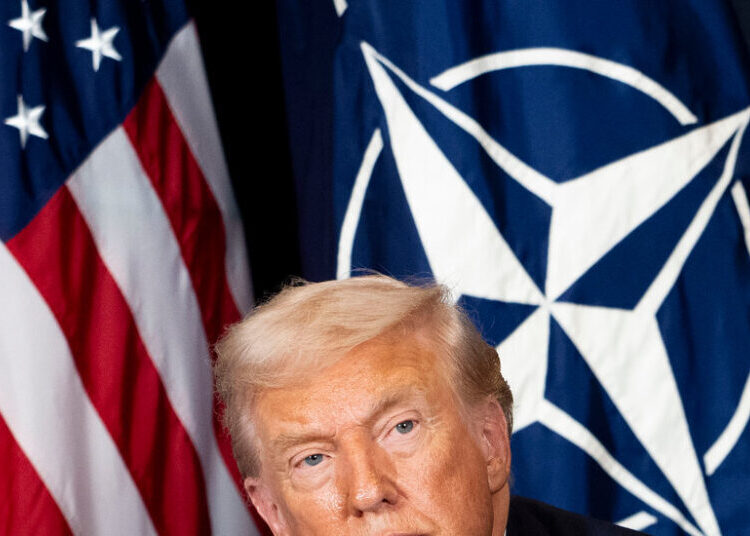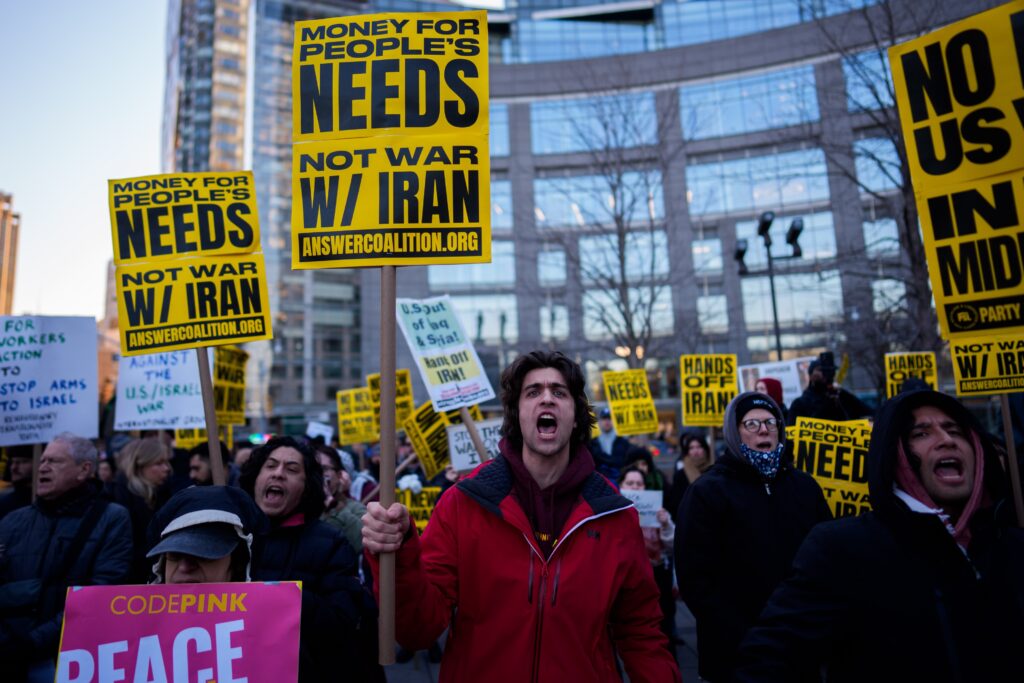
As the Iran war rolls into its second month and President Donald Trump weighs launching ground operations, polls show that Americans’ opposition to the conflict has hardened and few support sending U.S. ground troops into action beyond very limited circumstances.
An Economist-YouGov poll conducted Friday through Monday found that 14 percent of Americans favor sending U.S. ground troops into Iran, while 62 percent oppose the idea and 24 percent are not sure. Separate polls by Ipsos and AP-NORC also found lopsided results, with opposition outpacing support by more than 4 to 1.
The opposition cuts across partisan lines, as more Republicans oppose than support sending ground troops, by 37 to 30 percent in the YouGov survey. Support is even tepid within Trump’s base, with 41 percent of self-identified MAGA supporters favoring a ground operation and 27 percent opposing it. Sixty percent of non-MAGA Republicans oppose using ground troops.
That dynamic could pose a significant political problem for the president, as gas prices hit $4 a gallon and American allies show little interest in helping with the U.S. operation. Republicans face growing headwinds in the November midterms, whose outcome could be driven by each side’s enthusiasm and whose results may help determine the course of Trump’s final two years in office.
A Reuters-Ipsos poll released last week found greater support for ground operations when offering three choices: Seven percent supported deploying a “large number of troops for a large-scale ground operation,” 34 percent supported deploying “a small number of special forces for targeted operations,” and a 55 percent majority said “I do not support the U.S. using any ground troops in Iran.”
While offering multiple options to “support” can inflate the popularity of any policy, the Reuters-Ipsos question is useful in suggesting that the ceiling of support for ground operations in Iran stands at about 4 in 10 Americans, with a majority still opposed. It shows that anything beyond a small-scale operation could be deeply unpopular.
The Washington Post reported Sunday that the Pentagon is preparing for weeks of ground operations in Iran, in case Trump should choose to escalate the conflict. The administration has discussed the possible seizure of Kharg Island, an Iranian oil export hub, and raids in other coastal areas near the Strait of Hormuz to find and destroy weapons that can target commercial and military shipping.
Trump, speaking March 19 in the Oval Office, told reporters, “I’m not putting troops anywhere. If I were, I certainly wouldn’t tell you. But I’m not putting troops.”
Overshadowing the issue is concern about the risks to U.S. military service members. A Post poll in mid-March — after seven Americans had died and 140 had been wounded — found 37 percent of Americans saying the number of casualties was “acceptable,” while 63 percent said it was not. By contrast, during the U.S.-led invasion of Iraq, majorities said the number of casualties was acceptable through the war’s first three months.
Unlike earlier conflicts, such as the Iraq War launched in 2002, Trump’s attack on Iran was not highly popular to begin with, and many Americans appeared to questions the president’s reasons for launching it. Perhaps for that reason, U.S. military successes have done little to improve voters’ views of the conflict, and it has taken Americans far less time to conclude that the costs are too high.
Polls during the first two weeks of the war showed that about 4 in 10 Americans supported U.S. strikes while roughly half the public opposed them. Some polls found the public about evenly divided, and roughly 1 in 4 Americans said they had no opinion on the conflict when surveys explicitly offered that option.
The opposition has now solidified, with nearly 6 in 10 opposing the conflict across five recent surveys interviewing over 10,000 Americans. A Pew Research Center poll in mid-March found 59 percent saying the U.S. made the “wrong decision in using military force in Iran,” while a Fox News poll found 58 percent oppose “the current U.S. military action against Iran.”
Republicans have buoyed support for the war, but the party is less united in support of U.S. action than Democrats are in opposition. The Fox News poll found that 77 percent of Republicans support the campaign, 42 percent “strongly.” The same poll found 88 percent of Democrats opposing it, 65 percent “strongly.” Independents have also grown more critical of the conflict, opposing it by a roughly 40 percentage-point margin in polls since mid-March.
Americans are mixed on how the war is going
The White House shows some signs of recognizing the political peril. While Trump’s messaging on the war has varied, he and his team are increasingly suggesting that its major objectives have been achieved, even while threatening escalation at other points.
On March 24, Trump said the war had been won. On Sunday, he suggested regime change had been accomplished because so many Iranian leaders had been killed. On Monday, he said there had been “great progress” in negotiations. Vice President JD Vance said recently that “we’ve accomplished all of our military objectives.”
Those statements come as Iran’s regime has managed to stay in power, retain its supply of enriched uranium and sharply restrict traffic through the Strait of Hormuz, sending oil prices soaring.
Despite opposition to the war, polls show Americans have wide-ranging views on how well it is going. The Fox News poll — conducted by a bipartisan team of pollsters — found nearly half of registered voters said it was going “very well” (19 percent) or “somewhat well” (29 percent), while just over half said it was going “not very well” (25 percent) or “not well at all,” (27 percent).
Perceptions fell heavily along partisan lines, with 81 percent of Republicans saying U.S. military actions are going well and 79 percent of Democrats saying they are not. About 7 in 10 independents said the war was not going well.
While polls have found most Americans think the goals of the war have been unclear, polls also show the broad idea of weakening Iran is popular. A CBS News-YouGov poll in mid-March found 73 percent said it was important to permanently stop Iran’s nuclear programs, while 68 percent said the same about stopping Iran from threatening other countries.
But even more — 92 percent — said it was important to end the conflict as quickly as possible.
The Ipsos poll released Tuesday also found a clear preference for expediency: Sixty-six percent saying the U.S. should “work to end U.S. involvement in the conflict quickly, even if it means we do not achieve all of our goals in Iran,” while 27 percent wanted to continue trying to achieve goals if the conflict extended period of time.
Isabelle Gibson contributed to this report.
The post Americans have little appetite for sending U.S. troops to Iran, polls show appeared first on Washington Post.