There is a saying, popularized by the Rev. Dr. Martin Luther King Jr., that budgets are moral documents.
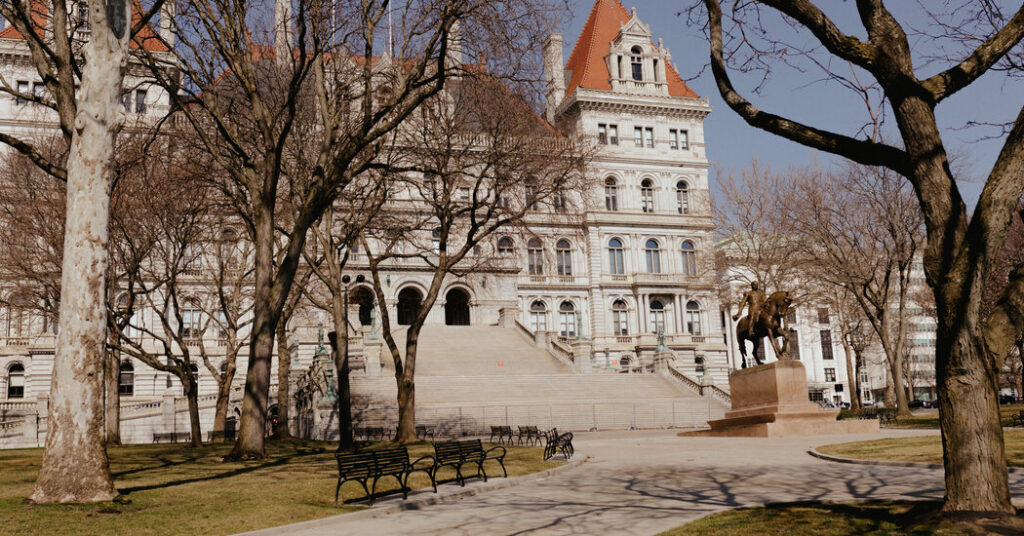
It’s an adage that often surfaces this time of year in the New York State Capitol, when the April 1 deadline for the state budget typically comes and goes without a budget being passed — often because state leaders are hung up on policy disagreements.
The budget has been late every year since Gov. Kathy Hochul, a Democrat, took office in 2021; this year is no different. After passing a weeklong budget extension, many lawmakers have already booked trains back to their districts, predicting that negotiations will drag on at least into the third week of April.
“We obviously still have a lot of work to do,” Senator Andrea Stewart-Cousins, the Democratic majority leader, said.
“Any time there is a significant amount of policy in the budget, things do seem to take longer,” she said. “So we really haven’t started on the money part yet.”
Three questions have divided lawmakers in Albany and delayed the budget, which is expected to reach roughly $260 billion.
Must New York choose between affordability and the climate?
When New York passed the Climate Leadership and Community Protection Act in 2019, it was hailed as the most ambitious law of its kind in the nation. Seven years later, however, Ms. Hochul now views that ambition as a liability, and is arguing to weaken regulations and push back deadlines for reducing greenhouse gas emissions.
She contends that unforeseen headwinds, including a pandemic, an inflation crisis and a Republican president intent on preserving the country’s dependence on fossil fuels, have made it impossible for New York to meet its goals as written.
Rather than scrap the plan altogether, the governor is pushing to put off the deadlines, the first of which is in 2030, and change the way that the state tracks methane emissions like the ones associated with natural gas. She has argued that meeting the goals could increase costs for New York households by as much as $4,000 at year at a time when gas and other necessities are already more expensive because of geopolitical tensions.
Climate activists and scientists say that this price instability is precisely why New York should be doing all it can to wean itself off fossil fuels. They are urging the governor to redouble efforts to produce more renewables, even as federal subsidies dry up and local opposition to badly-needed battery storage facilities grows.
At the heart is a question of priorities: Ms. Hochul, a centrist from Buffalo, argues that the state must compromise to address more urgent issues of affordability. Climate activists say that reliance on fossil fuels will not be cheap in the long or short run.
Is Mamdani right about taxing the rich?
Zohran Mamdani was elected mayor of New York City in part because of his message about affordability: that New Yorkers deserved to live with dignity regardless of their income. He presented a utopian vision — free buses and free child care, to start — all funded by the wealthy.
He has asked the Legislature to approve a tax increase on New Yorkers earning $1 million or more a year — a request that many lawmakers support, at least in theory. The mayor has said the funds are needed not just to fund his agenda, but to address the city’s $5.4 billion budget gap.
But any tax increase would have to be approved by Ms. Hochul, whose general opposition to raising taxes seems even more hardened as she faces re-election this year. The governor is expected to exhaust all possible alternatives before approving such an increase.
She has already offered the city $1.5 billion. Any further movement, those around her have said, will depend on whether she believes Mr. Mamdani is open to compromise.
There are some indications that such compromises are starting to happen. The Mamdani administration is hoping to delay a new class size mandate in schools and limit a rental assistance program, which would save the city $1.3 billion. At the same time, the mayor has been quietly pushing a more modest package of revenue raisers, first reported by the news site New York Focus, including a smaller increase in the corporate tax.
Perhaps most notable to those studying the fragile alliance between the mayor and the governor: Mr. Mamdani has repeatedly declined to appear at rallies aimed at pressuring the governor to raise taxes, preferring — like the governor — to do his negotiating in private.
Should state law enforcement work with ICE?
As the Democrat-led Legislature crafts bills aimed at reining in federal immigration agents in New York, a central question has arisen, which state leaders are hoping to resolve outside the budget talks.
If an undocumented person is accused of a crime, should that person face justice in the courts or be turned over to the Immigration and Customs Enforcement agency for deportation?
It’s a question at the heart of two contradictory proposals, one embraced by the governor and the other by the Legislature, both of which aim to restrict local law enforcement from collaborating with federal immigration officials.
Ms. Hochul is pushing a version that would bar counties from signing agreements to formally share resources with ICE, but would allow officers to continue to work with ICE informally and collaborate on criminal matters.
The bill championed by the Legislature would prohibit law enforcement from assisting immigration officials. That approach has the support of immigrant rights groups, which say that Ms. Hochul’s proposal would still allow local police and ICE agents to work together to deport people accused of minor violations.
Some law enforcement leaders in the state have been eager to coordinate with ICE. But others, like Tony Jordan, the Republican district attorney of Washington County, argue that they should be able to adjudicate crimes committed in their own jurisdictions. That would ensure that perpetrators are held accountable rather than simply being deported, Mr. Jordan said, and would build trust in the system, including among witnesses and victims who are undocumented.
“We rely on people feeling comfortable and trusting in their government,” Mr. Jordan said. “It takes an instant to lose credibility.”
Benjamin Oreskes contributed reporting.
Grace Ashford covers New York government and politics for The Times.
The post The Three Big Questions Delaying New York’s Budget appeared first on New York Times.