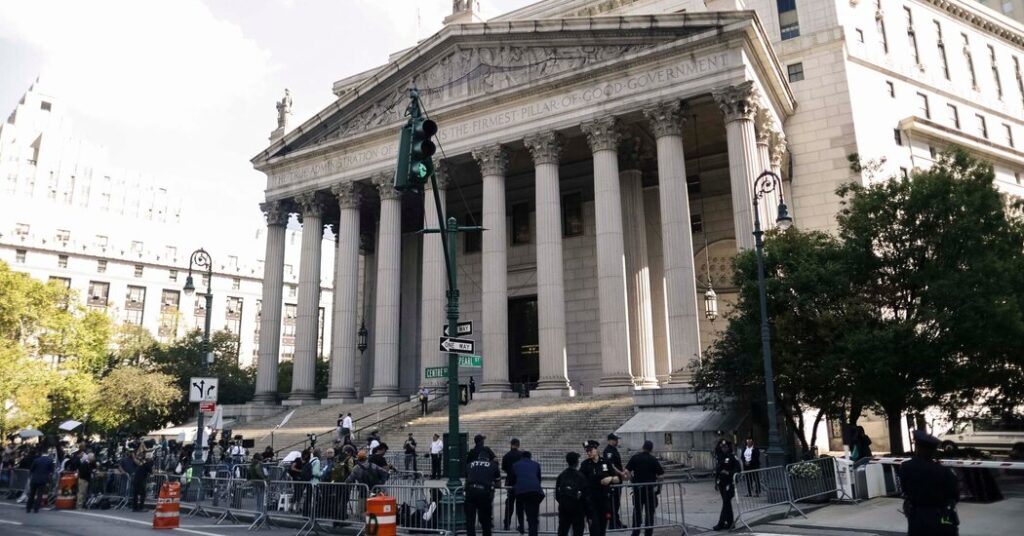
It should be a simple scheduling matter. But nothing has been easy in the case of Luigi Mangione.
The way things stand, his lawyers will be in and out of courtrooms in Lower Manhattan through the end of the year with barely a break. They will be defending Mr. Mangione, 27, in two trials, in state and federal court.
It gets even more knotty.
Some of those same lawyers now also represent Harvey Weinstein, the former Hollywood producer, who faces his third sex crimes trial in New York later this month.
Those lawyers are trying to avoid the pileup. On Wednesday, Judge Margaret Garnett will consider their request to push back Mr. Mangione’s federal trial, scheduled for October in U.S. District Court in Manhattan, until January.
If she agrees to the delay, which prosecutors oppose, that would be likely to set off a chain reaction. Mr. Mangione’s lawyers have said they would ask the judge in his state trial, slated to start in June, to push back that case. And then they would seek to delay Mr. Weinstein’s trial, set to start April 15.
The approach, the lawyers have argued, would allow them and their clients to properly prepare for the trials.
In the world of prominent defendants, it’s not unusual for sought-after defense lawyers to handle several cases at once and judges to shuffle schedules to make room.
That, in turn, can set off a “cascading effect,” with the same lawyers making repeat performances “in these incredibly complex and high-profile cases,” said Rebecca Roiphe, a New York Law School professor and former Manhattan prosecutor.
“And that’s what’s causing this traffic jam,” she said.
The challenges in bringing Mr. Mangione’s case to trial were present almost from the beginning. Police spent nearly five days after the December 2024 murder of Brian Thompson, a health care executive, searching for the person who fatally shot him outside a hotel in Midtown Manhattan.
The police arrested Mr. Mangione in the crime as he sat eating breakfast and browsing on a laptop in a McDonald’s in Altoona, Pa.
He was charged by the Manhattan district attorney’s office with 11 counts, including murder and terrorism. Days later, federal prosecutors in the Southern District of New York charged him on four counts, including one that carried a potential death penalty if the government decided to seek it. While murder cases are typically prosecuted in state courts, in Mr. Mangione’s case, federal prosecutors have said that he crossed state lines to stalk and ultimately kill Mr. Thompson, giving the federal government jurisdiction to prosecute him.
He has pleaded not guilty to all charges he faces in both federal and state court. The parallel cases have resulted in what Mr. Mangione’s lead lawyer, Karen Friedman Agnifilo, has called a “tug of war between two different prosecution offices.”
The federal prosecutors said at the time that Mr. Mangione was expected to proceed to trial first on the state charges, suggesting that the office of the Manhattan district attorney, Alvin L. Bragg, and federal prosecutors had reached an agreement to that effect.
Then, President Trump returned to office in 2025. In April, his attorney general, Pam Bondi, said prosecutors would seek capital punishment in Mr. Mangione’s case. She cited Mr. Trump’s directive that the Department of Justice renew death penalty requests, which had been halted in 2021 under President Joseph R. Biden Jr.
Both cases have since narrowed.
In the state case, the judge, Gregory Carro, dismissed the terrorism charges, saying he found the evidence behind the counts “legally insufficient.” In federal court, Judge Garnett dismissed two charges against Mr. Mangione, including the death-penalty count. He now faces a maximum sentence of life in prison.
In January, in response to a request by the parties to set a trial date, Judge Garnett said Mr. Mangione’s federal trial would begin on Oct. 8, following jury selection. Then, in February, Justice Carro announced that Mr. Mangione’s state case would start before then — on June 8.
As for Mr. Weinstein’s case, one day last month inside an unseasonably warm courtroom on the 13th floor of State Supreme Court in Manhattan, Justice Curtis Farber was left navigating what had become a court calendar version of musical chairs.
He had already set a trial date of April 14. But Mr. Weinstein had hired new lawyers, including some representing Mr. Mangione. At last month’s hearing in the Weinstein case, his lawyers asked for a postponement of the trial until late May, saying they were struggling to obtain some discovery materials from Mr. Weinstein’s “two prior counsel.”
Justice Farber said he was willing to postpone Mr. Weinstein’s trial if his lawyers could secure a later trial date from Judge Garnett in Mr. Mangione’s federal trial. That would clear a path for a later Weinstein trial, Justice Farber said.
Nicole Blumberg, an assistant district attorney, made it clear the state wanted a firm date.
“We just can’t be in limbo anymore on this,” she said.
Benjamin Weiser is a Times reporter covering the federal courts and U.S. attorney’s office in Manhattan, and the justice system more broadly.
The post A ‘Traffic Jam’ of Trials Poses Headache for Mangione’s Lawyers appeared first on New York Times.