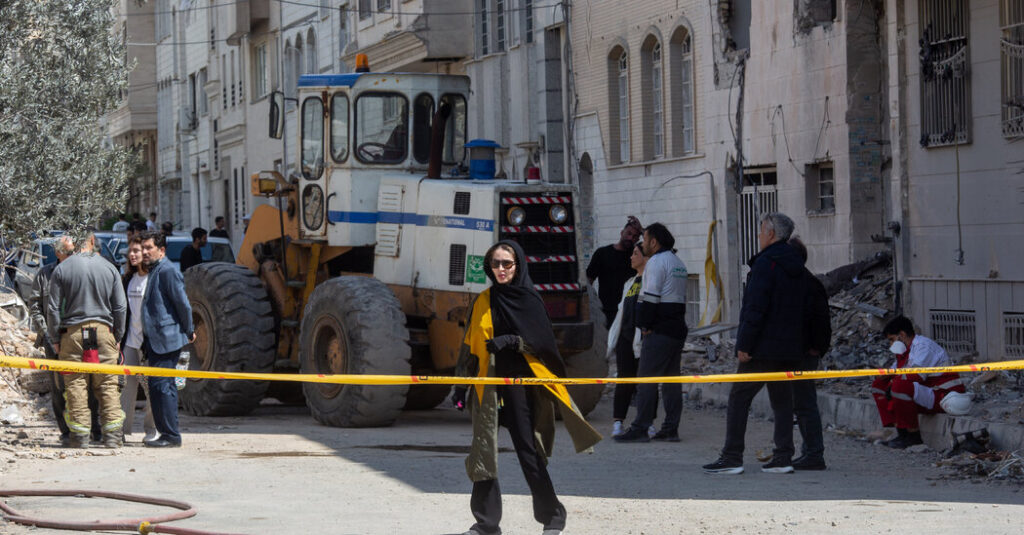
Israeli missiles struck a major pharmaceutical company in Tehran on Tuesday morning, completely destroying its raw material production units and its research and development unit, according to Iran’s state news agency, IRNA.
The attack on the company, Tofigh Daru, came as Israel stepped up strikes on Iran and President Trump alternated between threats to target the country’s energy infrastructure and talk of trying to strike a deal with Iran.
Iran’s foreign minister, Abbas Araghchi, said on Tuesday that Israel was “openly and unashamedly bombing pharmaceutical companies.”
The Israeli military said in a statement late in the day that it had struck the Tofigh Daru factory, claiming the facility was secretly supplying a potentially deadly drug to the Organization of Defensive Innovation and Research of Iran, which Israel says is responsible for developing chemical weapons.
The Israeli military said that the factory, “presented itself as a civilian company” but that it was a false front.
Iranian officials offered a different account.
Dr. Mahdi Pirsalehi, deputy minister of health and president of the Food and Drug Administration, described the strike to Iranian state media as “an attempt to disrupt the country’s health care system.”
Mr. Pirsalehi said the company was “one of the most important producers of raw materials for hospital medications and drugs used in operating rooms,” and that raw materials for some cancer medications were also produced there.
Israel claimed the drug being provided to the chemical weapons unit was the anesthetic fentanyl, which is deadly at high doses.
Tofigh Daru is owned by Iran’s largest pension fund. “The company in question belongs to the nation’s retirees,” Mr. Pirsalehi said, “and this action has targeted the health and lives of people.”
For years, U.S. sanctions on Iran have made it nearly impossible for foreign pharmaceutical companies to continue working in the country, forcing the majority of medicine production to be done domestically.
Under international humanitarian law, commanders must distinguish between military and civilian targets.
Experts say that even if a company could be considered “dual use,” working on both civilian and military projects, there is still an obligation to weigh proportionality. That means commanders must consider whether the potential damage to civilian property or harm to people would outweigh any anticipated military gain. The military must also work to mitigate civilian harm and minimize damage if the attack does proceed.
Esfandyar Batmanghelidj, head of an economic think tank, the Bourse & Bazaar Foundation, which tracks the Iranian economy, said a dual-use argument would not hold up if an entire site was demolished.
“If you’re destroying a pharmaceutical facility,” he said, “even if you could identify that certain chemicals might be used for military purposes, it doesn’t really matter. Because it’s not even collateral damage. The primary damage is civilian. The collateral is military.”
The Israeli military in its statement said that it had taken “precautionary measures” to minimize possible harm to civilians “to the extent possible.”
Parin Behrooz is an associate editor and writer for The New York Times.
The post Israel Strikes Tehran Pharmaceutical Plant, Claiming Military Link appeared first on New York Times.