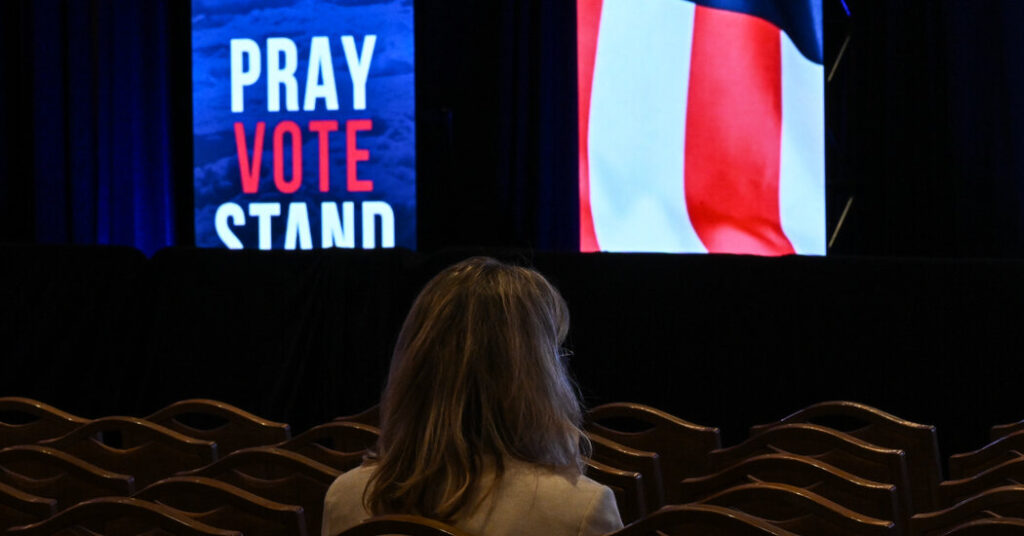
A federal judge in Texas on Tuesday dismissed a lawsuit seeking to overturn the 70-year-old ban on political activity by churches, abruptly ending a case that conservative Christian groups had hoped could free pastors to endorse candidates from the pulpit.
Last summer, those groups seemed close to a long-sought victory. The Trump administration agreed to settle the case, and said in court papers that the ban should not apply to endorsements made during religious services. That seemed to allow churches a way to make political statements without risking their tax-exempt status.
The government asked Judge J. Campbell Barker, an appointee of President Trump, to approve that settlement and support its arguments in favor of a loophole.
But instead, Judge Barker dismissed the entire case on technical grounds, finding that the plaintiffs had not followed the right procedures for bringing a tax-related suit. A lawyer for the plaintiffs said they would appeal.
Tuesday’s ruling left significant uncertainty about how — or whether — the Trump administration would enforce the ban on politicking by churches now.
The administration has not repudiated its statement from last summer arguing in favor of a loophole. But the Internal Revenue Service, which polices tax-exempt groups, still warns on its website that churches must stay out of politics.
The I.R.S. did not respond to questions about the ruling on Tuesday.
The head of the Family Research Council, a conservative group that has worked to challenge the law for years, expressed disappointment in the ruling.
“Judge J. Campbell Barker has, regrettably, sidestepped an opportunity, on the 250th anniversary of our nation, to correct a wrong that strikes at the very heart of American freedom,” Tony Perkins, the group’s president, wrote in a social media post on Tuesday evening.
Americans United for the Separation of Church and State, which has sought to keep the ban in place, praised the dismissal of the lawsuit as “a victory for church-state separation and the integrity of charitable organizations and elections.”
The proposed settlement “would have been unhealthy for our democracy because it would allow churches to become unaccountable political action committees,” said Rachel Laser, the group’s president.
Trump Administration: Live Updates
Updated
- Trump’s Miami presidential library video draws mixed reactions.
- Trump’s executive order on NPR and PBS is unlawful, a judge rules.
- A federal judge orders construction stopped on Trump’s ballroom project.
The law that bars campaigning by churches and charities is called the Johnson Amendment. It was introduced in 1954 by Senator Lyndon B. Johnson, a Texas Democrat who would later become vice president and president.
In recent years, the I.R.S. appeared to enforce the rule loosely, and it became common for Democratic and Republican candidates to campaign in church. Still, conservative groups sought to repeal it entirely, seeing the ban’s existence as an unconstitutional limit on freedom of speech and freedom of religion.
The Texas lawsuit was part of that effort. In 2024, Sand Springs Church in Athens, Texas, and the First Baptist Church of Waskom, Texas, filed suit against the I.R.S. along with two religious nonprofits: National Religious Broadcasters and Intercessors for America.
They said that they had not yet endorsed candidates from the pulpit but wanted to. They asked Judge Barker to pre-emptively tell the I.R.S. that it could not stop them. The goal, Christian groups said, was to get the case in front of the conservative Fifth Circuit Court of Appeals, then to the Supreme Court.
After the Trump administration agreed to settle the case, the two sides asked Judge Barker to approve their settlement. But Judge Barker said in his ruling that the case was doomed from the start.
Under an 1867 law, he said, taxpayers cannot challenge a tax before they pay it. Because the plaintiffs in this case had not actually paid any tax penalties, Judge Barker said, the suit had to be dismissed.
“A refund suit could be brought if a tax were ultimately collected,” he wrote.
Michael Farris, an attorney for National Religious Broadcasters, said the plaintiffs would appeal the decision. “You’re entitled to challenge the law without violating it,” he said.
Since July, when the I.R.S. seemed to reinterpret the ban on endorsements from houses of worship, religious leaders have largely continued to refrain, waiting to see the outcome of the ruling. But there have been a few exceptions.
Weeks before the mayoral election in New York in November, Rabbi Elliot Cosgrove of Park Avenue Synagogue gave a sermon urging opposition to Zohran Mamdani, then the Democratic candidate, saying he was a “danger to the security of the New York Jewish community.”
Last August, a pastor in Kenosha, Wis., the Rev. Jonathan Barker, wrote a sermon urging Representative Alexandria Ocasio-Cortez, Democrat of New York, to run for president in 2028.
But his church’s denomination, the Evangelical Lutheran Church in America, pushed back, citing its opposition to such endorsements. Mr. Barker resigned and delivered his message in an event space instead.
Seamus Hughes contributed reporting.
David A. Fahrenthold is a Times investigative reporter writing about nonprofit organizations. He has been a reporter for two decades.
The post Judge Dismisses Lawsuit That Challenged Ban on Endorsements by Churches appeared first on New York Times.