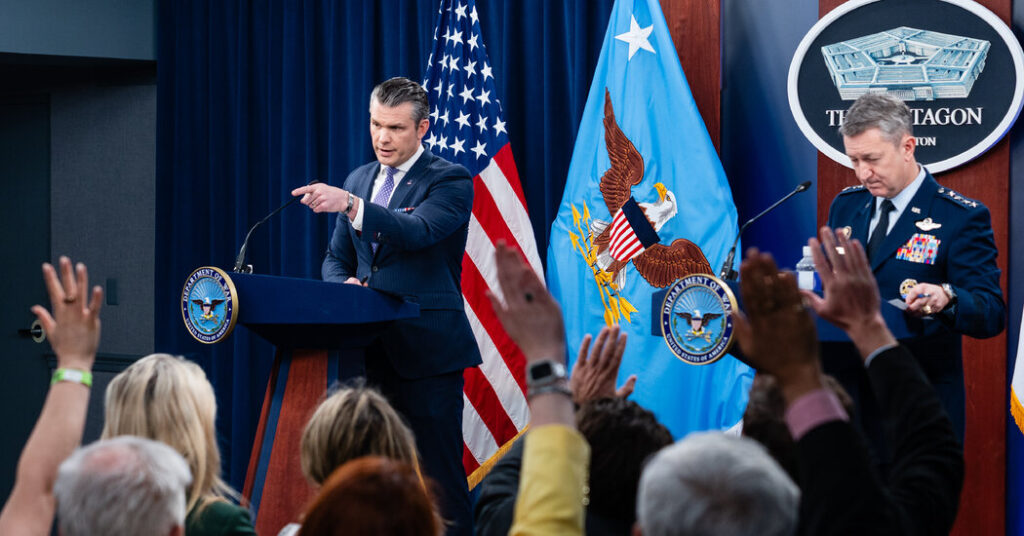
The United States has achieved such unchallenged control of Iran’s skies that it is flying B-52 bombers directly over Iranian territory for the first time since the war began, Defense Secretary Pete Hegseth told reporters at a Pentagon briefing on Tuesday.
But Iran still retains the ability to retaliate against neighboring countries with missiles and drones, he added. “They will shoot some missiles; we will shoot them down,” Mr. Hegseth said alongside Gen. Dan Caine, the Joint Chiefs’ chairman in the first public briefing on the war in nearly two weeks.
The United States was “closer than ever before to winning,” Mr. Hegseth asserted, but he did not give a time frame for the end of the war, saying that was up to President Trump and the negotiations he is pursuing with Iran.
“They are very real, they are ongoing, they are active and I think gaining strength,” Mr. Hegseth said of talks to end the war.
Iran has publicly denied taking part in direct negotiations with the United States. Abbas Araghchi, Iran’s foreign minister, said Tuesday that Iran had not responded to a 15-point proposal sent by the United States, and had not submitted any proposal of its own.
The Pentagon’s assessment of the war came as the price of gasoline in the United States crossed an average of $4 a gallon for the first time since 2022, after Russia’s invasion of Ukraine. A month of war has caused oil and natural gas prices to soar and stocks to slump.
But on international markets on Tuesday, the price of oil fell sharply to just above $100 a barrel, and stocks surged in a broad rally that seemed to signal investors’ hopes for and end to the fighting. Optimistic statements by Mr. Trump and top members of his administration have repeatedly lifted stocks and suppressed fuel prices, but the effect has been temporary as the fighting raged on.
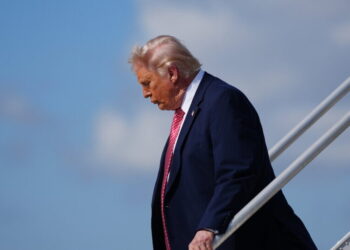
Addressing the current surge in energy prices caused by the blockage of the Strait of Hormuz, Mr. Trump suggested in a social media post on Tuesday that other countries “build up some delayed courage, go to the Strait, and just TAKE IT.”
He addressed his message to “all of those countries that can’t get jet fuel because of the Strait of Hormuz, like the United Kingdom.”
“You’ll have to start learning how to fight for yourself, the U.S.A. won’t be there to help you anymore, just like you weren’t there for us,” Mr. Trump wrote. He concluded: “Go get your own oil!”
Mr. Trump has frequently pressured allies to become more involved in the war being waged by the United States and Israel. But other countries are torn between wanting to help restore fuel supplies, and wanting to avoid entanglement in a conflict they did not choose, that most of their people do not support, and that could put their armed forces in harm’s way.
Mr. Hegseth echoed the president’s comments at the Pentagon briefing, saying countries affected by the blockage “might want to start learning how to fight for yourself.”
“It’s not just a United States of America problem set,” he said in response to question about whether securing the strait was an essential objective for the United States.
General Caine said that U.S. warplanes were now focused on destroying supply chains that feed Iran’s missile, drone and naval ship building facilities, choking off the country’s ability to replace munitions destroyed in thousands of American bombing runs, including by the aged B-52s.
Unlike the many of the newer aircraft in the U.S. arsenal, the huge B-52 bombers, built in the early 1960s, are not agile, radar-evading or particularly fast, making them highly vulnerable to antiaircraft systems. The decision to fly B-52s directly over Iran signifies the American military’s confidence that it has largely destroyed Iran’s capability to take down the lumbering bombers.
American bombers targeted Tehran on Monday night, Mr. Hegseth said, and Mr. Trump posted a video of massive explosions in Isfahan, a city in central Iran with about two million residents that has weapons production and nuclear facilities.
Mr. Hegseth, who revealed Tuesday that he had made an unannounced trip to the Middle East over the weekend to visit troops, said the last 24 hours had seen the lowest number of missiles and drones fired by Iran since the start of the war.
Still, Gulf countries reported significant barrages on Tuesday. The United Arab Emirates said its air defenses on Tuesday engaged eight ballistic missiles, four cruise missiles and 36 drones launched from Iran. A Kuwaiti oil tanker erupted in flames at a Dubai port in a drone attack that its owner, the Kuwait Petroleum Corporation, attributed to Iran. The fire was contained and no oil leaked from the vessel, the Dubai authorities said.
Saudi Arabia’s defense ministry said its forces intercepted eight missiles, most of which were launched toward Riyadh. Kuwait’s army said it responded to drone and missile attacks. And the Israeli military said it had detected a missile launch from Iran.
Iran’s Islamic Revolutionary Guards Corps also threatened top American corporations on Tuesday, accusing them of helping the United States and Israel carry out strikes against Iranians.
“From now on the main institutions involved in such operations will be considered legitimate targets,” the Guards said in a statement Tuesday that named 18 companies, including Apple, Google and Meta. The statement, carried by Iranian state media, called for employees of these companies “in all countries of the region” to evacuate their workplaces and stay a kilometer away from their offices.
It was not the first time Iran has threatened American tech companies. Earlier this month, Iran warned of wider attacks against “enemy technology infrastructure” belonging to seven U.S. tech firms.
The toll of the war, in both lives and livelihood, continued to spread.
The war could plunge four million more people across the Arab world into poverty and shave off up to 6 percent of the region’s economic output, said a report released Tuesday by the United Nations Development Program.
The report warned of “profound and widespread socio-economic impacts across the Arab region.”
The Human Rights Activists News Agency said at least 1,574 civilians had been killed in Iran, including 236 children, since the war began.
At least 50 people have been killed in Gulf nations from Iran’s attacks across the Middle East. In Israel, at least 17 had been killed as of Friday. The American death toll stood at 13 service members, with hundreds of others wounded.
Lebanon’s health ministry said that more than 1,260 in that country had been killed as of Tuesday, with more than 3,750 others wounded.
Israel on Tuesday offered its clearest indication yet that it intends to occupy a large portion of southern Lebanon even after its ground invasion ends, a development with dire consequences for more than a half of a million Lebanese.
Israel’s defense minister, Israel Katz, outlined plans to maintain control over “the entire area” from the border to the Litani River — a stretch of territory that is 20 miles from Israel at its deepest point — after the offensive had concluded.
Mr. Katz reiterated that this would include the demolition of entire Lebanese border towns and that hundreds of thousands of residents would not be allowed back to their homes.
“The return of more than 600,000 residents of southern Lebanon who fled north will be completely prohibited south of the Litani until safety and security of northern Israeli residents is ensured,” he said.
Israeli officials have said the objective of the ground invasion is to set up a “security zone” to prevent territory in southern Lebanon from being used by Hezbollah, the militant group backed by Iran, to attack Israel. But Mr. Katz’s latest comments have deepened concerns about a renewed Israeli occupation of southern Lebanon — more than a quarter of a century after the last 18-year occupation of the same area ended in 2000.
Reporting was contributed by Euan Ward, Aurelien Breeden, Erika Solomon, Johnatan Reiss, Aaron Boxerman, Gabby Sobelman, Sanjana Varghese, Joe Rennison, Yeganeh Torbati, Sanam Mahoozi, Ismaeel Naar, Emmett Lindner and Francesca Regalado.
Greg Jaffe covers the Pentagon and the U.S. military for The Times.
The post Confident of Air Supremacy, U.S. Sends B-52 Bombers Over Iran appeared first on New York Times.