Each Sunday, a group of Catholics meets in the basement of St. Joseph’s Church in Greenwich Village after the 6 p.m. Mass. They mingle over wine and cheese for half an hour, and then Father Jonah Teller, a Dominican friar and priest, usually leads an hour-long discussion—about the nature of freedom, perhaps, or the virtue of hope, or a theologically laden Gerard Manley Hopkins poem. The weekly gathering is called In Vino Veritas, Latin for “In wine, there is truth.”
Nearly everyone there is young—from the ages of 21 to 35, according to Father Teller—a contrast with the population of American Catholicism as a whole. (According to the Pew Research Center, nearly three in five U.S. Catholic adults are 50 or older.) And weekly attendance is growing. After the coronavirus pandemic, Father Teller told me, it hovered in the single digits; by 2025, it averaged a bit more than 100 attendees. So far this year, approximately 150 people, most of them young professionals in finance, tech, and the arts, spend a given Sunday evening in the Greenwich Village basement.
The popularity of places such as St. Joseph’s and other churches that draw meaningful numbers of Gen Zers has been interpreted in two very different ways. Many pastors, pundits, and politicians have claimed over the past few years that a “revival” of traditional Christianity is under way among America’s young adults. Demographers of religion, however, largely contend that nationwide data don’t support the claim that Gen Z is turning back to faith. To the former group, a gathering such as In Vino Veritas shows that Christianity really is on the upswing; to the latter, the event is simply a small example of Christian renewal against a landscape of religious decline.
[Read: The misunderstood reason millions of Americans stopped going to church]
The demographers have a lot going for their argument. Look broadly, and talk of a “revival” in this generation seems unfounded. But focus on particular communities, and it becomes hard to miss how some young Americans are discovering traditional Christianity anew.
Over roughly the past two decades, Pew has conducted its Religious Landscape Study, a large-scale survey about religious beliefs and practices in the United States. In 2007, 78 percent of U.S. adults identified as Christians; by 2023, 62 percent did, a drop driven largely by younger generations. Forty-four percent of respondents born in the 1990s—a mix of Millennials and Gen Zers—identified as religiously unaffiliated, compared with 29 percent of respondents from all generations.
The decline began to slow around 2019. The percentage of American adults who identified as Christian in Pew’s survey stabilized at a bit above 60 percent. “Nones”—those unaffiliated with a religious tradition—have held steady at around 30 percent. Gallup described a similar plateau, and a recent analysis by the political scientist Ryan Burge even found that the nones had decreased slightly.
In reaction to those developments, some observers posited that a dramatic shift was afoot: a “resurgence” or an “awakening.” News articles detailed the increased popularity of traditional denominations such as Roman Catholicism and Orthodox Christianity among young adults. Gen Z men in particular were depicted as protagonists in Christianity’s comeback story. The British historian Niall Ferguson remarked in December that “we’re probably in the very early phase of a Christian revival,” and a few months later, during the State of the Union address, Donald Trump declared that “there has been a tremendous renewal in religion, faith, Christianity, and belief in God,” especially “among young people.”
But to treat this stabilization as a revival overlooks that younger Americans are the least religious age group by many metrics. Members of Gen Z are less likely than people in other generations to profess belief in God without doubts, for example, according to the 2024 General Social Survey. Gen Zers are also the least likely to attend religious services regularly and the most likely to never attend them. Many weren’t brought up religious, and many of those who were have left the faith. Only 28 percent of adults born in the 2000s to highly religious families remain highly religious, according to Pew. And despite the claim that Gen Z men are leading a resurgence in traditional Christianity, they in fact are simply leaving the Church at a slower rate than women are.
If Gen Z’s general disinterest in religion persists, American society will only secularize further. “Unless today’s young adults become more religious as they get older, or unless new cohorts of young adults come along who are more religious than today’s young adults,” Gregory A. Smith, one of the main researchers in Pew’s Religious Landscape Study, told me, “the longer-term declines we see in American religion are likely to continue.”
National data, however, have their limits. The researchers I spoke with granted that particular congregations or particular religious communities may thrive even if their vibrancy is not reflected in the broader data. In 2023, for example, what began as an ordinary chapel service at the evangelical Asbury University turned into a 16-day, Gen Z–initiated worship marathon that wound up drawing an estimated 50,000 people. And Orthodox Christians skew young; 24 percent are under the age of 30 (10 percent more than evangelicals).
Or take Catholicism. According to reporting, conversions have increased in recent years, especially at college campuses and in metro hubs, where many young professionals live. This Easter at Harvard, nearly 50 students plan to formally join the Church through the school’s Catholic center, about double the number from last year. At Arizona State’s Catholic center, about 50 plan to join this spring, also about twice last year’s number; at the University of Michigan, 40 will do so, up from 30 last year. Many New York City parishes likewise expect far more converts than usual this Easter. Nearly 90 people will formally join the Catholic Church at St. Joseph’s, more than double the number from last year. And 70 will do so at the Basilica of St. Patrick’s Old Cathedral in the Manhattan neighborhood of Nolita, nearly double the number from 2025.
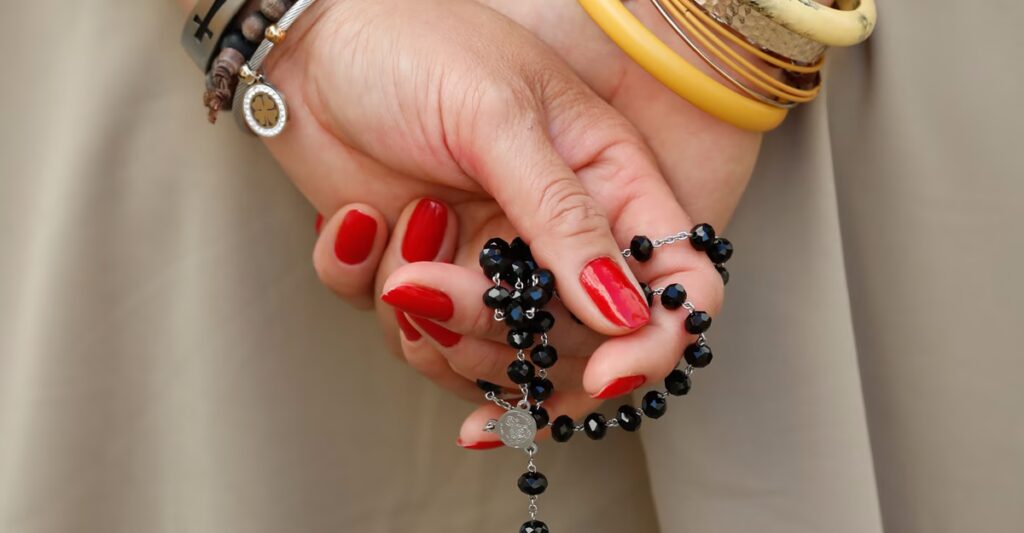
Conversion numbers are only one indicator of spiritual engagement, though. Bailey Burke, a coordinator for the St. Mary Student Parish in Ann Arbor, and a recent University of Michigan graduate herself, describes greater interest in devotional life among the students she works with. More of them, she told me, are signing up for overnight retreats and applying to the parish’s postgrad service fellowship. They also seem more interested in prayer. St. Mary recently increased the frequency of Eucharistic adoration, during which Catholics pray before the Blessed Sacrament, from two to four nights a week. A small group of students has begun holding a daily Rosary—a contemplative prayer focused on key events in the life of Jesus—in a central part of campus.
To Burke, the Catholic ministry offers “a breath of fresh air compared to some of the academic rigor” of daily college life, a community where membership isn’t predicated on achievement. “I think students are coming to college with this longing to be seen, to be known, to be loved,” she said. For the students Burke interacts with, the Catholic ministry offers this.
[Read: My father, my faith, and Donald Trump]
St. Joseph’s in Greenwich Village seems to have a similar draw. As Father Teller sees it, events such as In Vino Veritas foster a place where young professionals can find “identity and community together,” especially through philosophical and theological conversation. That identity, he insists, is decidedly nonpolitical. (“There’s a wide variety of political ideologies and opinions that are represented at St. Joseph’s,” he said.) It’s also, at times, ecumenical. A recent In Vino Veritas gathering, for example, featured a roundtable with Protestant pastors discussing interdenominational dialogue; a “smattering” of non-Catholic Christians visit. “It’s just a very healthy third space for people to encounter ideas and other people,” Father Teller said.
Perhaps the most visible testament of devotional attachment in these Catholic communities is Mass attendance. St. Mary offers six every Sunday, the last of which, at 8 p.m., was packed with students when I visited multiple times over the past few years. At St. Joseph’s, the pews tend to be filled with young people—if they can find a seat. Mass is often a standing-room affair.
It’s important not to overblow Gen Z’s renewed interest in traditional Christianity. Double the number of converts at a college campus or an urban parish, from a small baseline, is not going to stave off broader generational trends. Growing congregations have an incentive to publicize their numbers, which declining ones lack. Conversions, moreover, should be noted alongside their foil. For every Catholic convert, for example, roughly eight Catholics leave the faith. And a proper “revival”—such as the religious awakenings of the 18th and 19th centuries—is generally understood as emerging in multiple places and galvanizing a statistically significant portion of the population.
Still, overemphasizing national trend lines fails to acknowledge how new converts can change a community. A twofold or threefold increase in converts could alter a campus or a parish, increasing its commitment to service, its interest in contemplation and conversation, its desire to foster a culture that isn’t bogged down by careerism.
[Read: What atheism could not explain]
Moreover, some of history’s most consequential periods of religious renewal have been led by particular people in particular places, often not as representatives of a new common culture but as a committed counterculture. The temperance, abolition, and civil-rights movements in America were all motivated in part by religious convictions. The Dominican order, founded by St. Dominic de Guzmán in 13th-century France, emerged as a small religious community that practiced peaceful persuasion in an era of bloody Crusades; it’s now leading Greenwich Village Zoomers to conversion.
Burke told me that in addition to praying the Rosary, the St. Mary group will sometimes, when the weather is nice, bring a priest along for confessions—or just to chat, with non-Catholic students. She told me that she is surprised by “the smiles” and “the questions” of the people who pass by. “They’re like, Oh, I’m not Catholic, but I can just talk to the priest?” Most Gen Zers may not have questions about Christianity or faith, but those who do are seeking answers.
The post The Gen Z Christian Revival That Wasn’t appeared first on The Atlantic.