the latest
The ‘God Squad’ waives environmental rules for offshore drilling
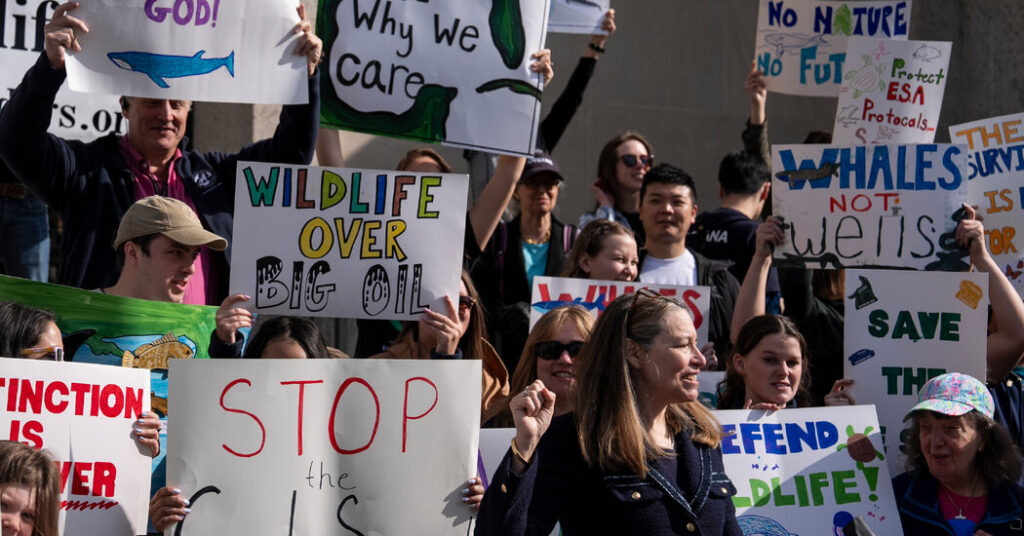
A powerful panel of Trump administration officials voted unanimously on Tuesday to exempt oil and gas drilling in the Gulf of Mexico from measures to protect endangered whales and other imperiled species.
The panel, the Endangered Species Committee, a high-level group that is often called the God Squad because it essentially holds the power to decide whether a species lives or dies, adopted the move during a brief, closed-door meeting. Until Tuesday, the God Squad had convened only three times, and never in the past three decades. — Maxine Joselow Read more.
The energy transition
Will the Iran crisis force the world to rethink oil and gas?
The war in Iran continues to rattle energy markets around the world, sending oil and gas prices higher this week. In the United States, gasoline crossed an average of $4 a gallon on Tuesday, the highest price since August 2022.
In the Persian Gulf, a Kuwaiti tanker loaded with oil was hit in an Iranian attack near Dubai early on Tuesday. No oil leakage was reported.
Countries around the world are continuing to ration energy. In Australia, the government halved its fuel tax and is offering free public transportation. Asian countries are bracing for the cutoff of liquefied natural gas from the Middle East, a fuel that underpins much of the modern economy. The European Union’s energy commissioner is pushing the bloc to cut back on energy use.
Does all of this mean the world might begin to revaluate its dependence on oil and gas?
To answer that question, I called Ani Dasgupta, the chief executive of World Resources Institute, a think tank that focuses on climate, energy and development issues.
Dasgupta is bullish about the shift away from fossil fuels. In September, he published “The New Global Possible,” a book that outlined an optimistic vision of the energy transition, arguing that the rapid rise of clean energy is inevitable. But much has changed since then.
“Already, countries are putting in policies to increase coal use and things like that,” Dasgupta said. “So there’s a bunch of household-level bad outcomes, a bunch of country-level bad outcomes.”
But he said that the war was exposing the risks inherent in a global energy supply chain that is so reliant on the Strait of Hormuz, and the benefits of countries controlling their own energy supplies with locally produced solar and wind power.
“I also think there is a serious reassessment of oil and gas as a fuel,” he said. “In the medium and longer term, there will be a shift toward much more clean energy, not for climate reasons, unfortunately, but for security and predictability of energy sources.”
A blow to the energy transition
In the short-term, the war could have the effect of pushing developed countries to become more dependent on the fossil fuels that are at the root of this disruption.
With natural gas and oil supplies suddenly tight, some countries with well-developed energy infrastructure are already ramping up their use of coal, the most polluting fossil fuel.
Japan, India and the Philippines were among the countries already signaling they would burn more coal in the short term. (Italy this week postponed the shutdown of its coal-fired power plants by 13 years.) The South Korean government said it would lift a cap on coal-fired power plant use that was designed to reduce air pollution.
Some countries are also discussing providing new subsidies for domestic oil and gas production. That, Dasgupta said, runs the risk of locking in even more fossil fuel production for decades to come.
“That is bad policy,” he said. “It’s very difficult to take them back once you have them.”
The developing world
The conflict could also mean less money will go to developing countries that are trying to build out new clean energy infrastructure. (The annual global cost for those countries to adapt to climate change is roughly $1 trillion per year.)
“Countries like India were already convinced they needed renewable energy,” Dasgupta said. “Their problem was getting enough finance and enough technology in there fast enough to build it out.”
The war is going to make that harder. As costs rise around the world and inflation ticks up, it will likely become harder to get those kinds of projects funded.
“Inflationary pressures will increase cost of capital,” he said. “And the cost of capital will slow down all the green projects that are in pipeline in all these places. It’s the new investments that I worry about.”
Oil as a risk
While the war may delay the energy transition, Dasgupta said it has made the risks associated with a centralized supply of oil and gas, and the benefits of clean, locally produced energy, clearer than ever.
At least some companies are already adjusting accordingly. In Vietnam, a conglomerate with power generation operations told the government it wanted to abandon plans to build the country’s largest gas plant and instead build a renewable energy project.
Over a longer period of time, Dasgupta said, countries across the world, at least those that can afford to, will move to adopt more clean energy, even if they are motivated by energy security rather than climate concerns.
“I don’t think we should be naïve about the short-term implications there,” he said. “But in the long term, I do think this disruption will actually go toward the transition.”
Related: The Iran War Is Revealing the Messy Middle of Our Renewable Energy Transition.
The Trump administration
The man who insists Trump is an ‘environmental hero’
Edward Russo, the chairman of the White House Environmental Advisory Task Force, has long been a fringe voice arguing that President Trump is actually an eco-warrior.
In 2016, he self-published a book titled “Donald J. Trump: An Environmental Hero.” Now he’s making the case from inside the White House, where he is the sole member of the environmental task force he chairs.
To Russo’s critics, it’s unclear what, if anything, he has accomplished. The environmental task force has not publicly shared its work and Russo has kept a low profile. Russo, 80, was once a consultant on environmental compliance for the Trump Organization’s golf courses.
Trump has derided the scientific consensus on climate change as “the greatest con job ever perpetrated on the world.” His appointees have rolled back dozens of protections for the nation’s air, land, water and climate.
Yet Russo’s supporters said he has been quietly influential in pushing the administration to take some eco-friendly moves. For instance, they credit him with helping to negotiate an agreement to end the flow of raw sewage from the Tijuana River into California. — Maxine Joselow
Quote of the day
“His job is to protect health and the environment, and he’s taking actions which are contrary to that responsibility.”
That’s from Thomas Jorling, 85, who was one of the co-authors of the 1970 Clean Air Act, commenting on recent actions by the Lee Zeldin, the administrator of the Environmental Protection Agency.
In the 1970s, Jorling was a Republican aide advising senators on the writing of the bill. This year, the Trump administration, led by the E.PA., took the extraordinary step of killing the government’s authority to regulate greenhouse gases, arguing that The Clean Air Act doesn’t allow it.
But in a recent interview Jorling said that he and the other authors of the legislation had known that scientists would continue learning about new pollutants, and so the bill was meant to be flexible enough to encompass them. Regulating planet-warming emissions is “perfectly consistent with the Clean Air Act,” he said. — Karen Zraick
Climate law
Can Vermont defend the nation’s first ‘climate Superfund’ law?
The Justice Department and the state of Vermont faced off in a federal courtroom on Monday over the state’s landmark 2024 “climate superfund” law, which will require fossil fuel companies to pay for the mounting costs of climate change.
The Trump administration sued last year to block the law, arguing it was unconstitutional. That position is supported by the U.S. Chamber of Commerce and the American Petroleum Institute, which have filed their own lawsuits against Vermont.
Over the daylong hearing before Judge Mary Kay Lanthier, two key themes emerged: first, how to differentiate the Vermont law from the proliferation of unrelated climate lawsuits that have been filed by many state and local governments; and second, whether the Vermont law amounts to an effort to regulate greenhouse gas emissions. — Karen Zraick
One last thing
Using A.I. to predict when cherry blossoms will bloom
Data scientists and other experts in Japan are turning to artificial intelligence to predict when the country’s beloved cherry blossom trees will bloom. The systems analyze decades of temperature data and deliver maps and “bloom meters” for trees in more than 1,000 spots, which blossom at different times.
More climate news from around the web:
-
Forrest loss in Indonesia surged by 66 percent last year, Reuters reports.
-
A town in Texas, Bloomberg reports, has become a dumping ground for thousands of used wind turbines.
-
The Associated Press examines how tech companies’ climate goals are becoming increasingly complicated during the rush to power artificial intelligence.
Read past editions of the newsletter here.
If you’re enjoying what you’re reading, please consider recommending it to others. They can sign up here.
Follow The New York Times on Instagram, Threads, Facebook and TikTok at @nytimes.
Reach us at [email protected]. We read every message, and reply to many!
David Gelles reports on climate change and leads The Times’s Climate Forward newsletter and events series.
The post Will the Iran Crisis Push the World to Rethink Oil and Gas? appeared first on New York Times.