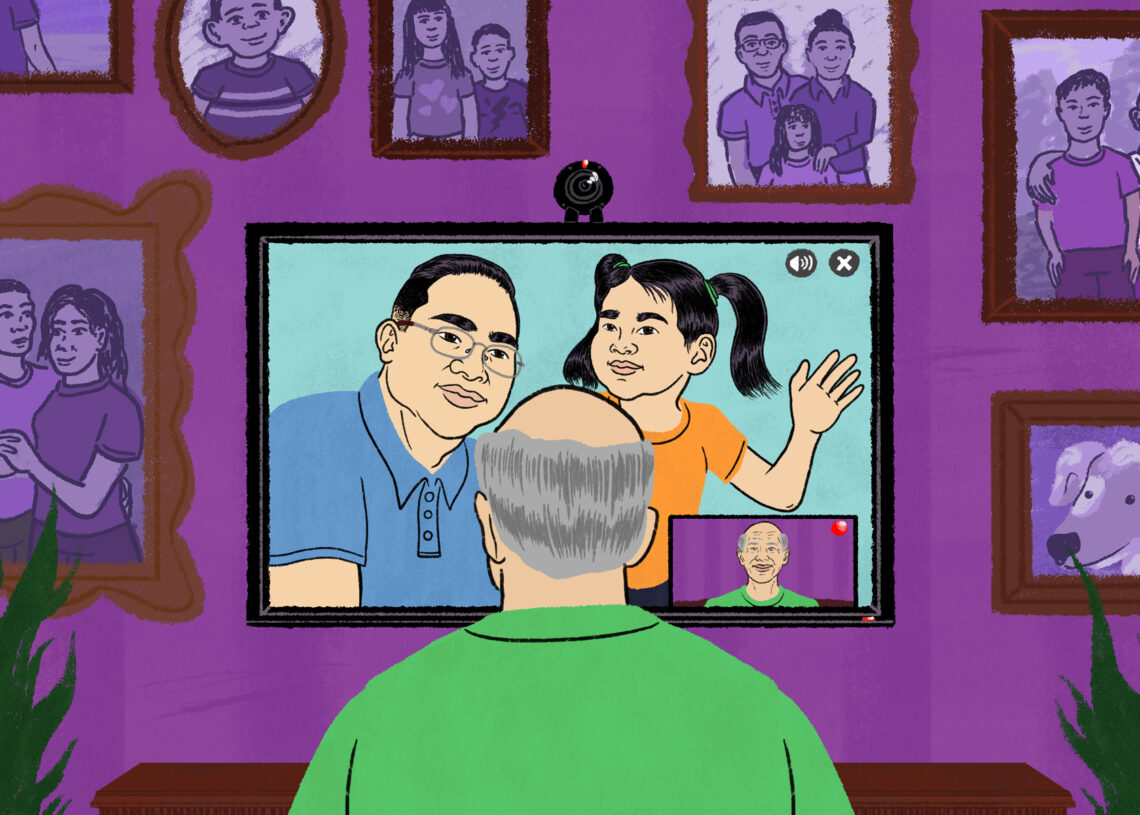
By 2030, 1 in 5 Americans will be over 65. Already, 1 in 4 adults are caregivers, and nearly 30 percent of caregivers are part of the sandwich generation supporting both young children and aging parents.
These realities are placing increasing pressure on families, many of whom are trying to care for relatives remotely. Thankfully, this is one area where technology can offer transformative solutions.
One such “age tech” innovation makes use of a near-ubiquitous household item: The television. Ashish Aggarwal, a technology entrepreneur who founded the company JubileeTV, told me that the covid pandemic highlighted both the importance of social connection and the difficulties of caring for older adults.
“The need to take care of my in-laws and my parents was just exploding to the extent that I had not anticipated,” he said.
There were plenty of new communication devices, but Aggarwal noted that they were often geared toward younger users. Rather than asking his parents to learn an unfamiliar platform, he took a different approach with something they were already using every day: the television. In fact, those 65 and older spend an average of 6.5 hours a day watching their sets.
So Aggarwal set out to turn the TV from a passive source of entertainment into a tool for active connection. He and his team developed a small box equipped with a camera and microphone that sits on top of the screen, along with a special remote control that includes a second microphone.
Using these devices, older adults can call their loved ones and see them projected on a large, familiar screen. The system includes closed captioning for those with hearing difficulties, and videos can be recorded so that people can replay them after.
These features may seem simple, but they represented a significant improvement for Andrew Barbash, a retired neurologist in Maryland. His mother was 96 when she died last year, and he described how difficult it had become for her to answer a mobile phone. She had to hold it with one hand, swipe it to answer with the other and then try to hold it steady for the video call. Over time, typing messages on the tiny keypad became nearly impossible.
Barbash discovered JubileeTV and now uses it to help care for his father-in-law. Instead of looking for the phone every time it rings and struggling to answer it, “he can literally talk back into the TV,” Barbash said. His father-in-law can dictate responses that are then sent as text messages. Barbash also uses the system to communicate remotely with his father-in-law’s health aides.
“Using this as a vehicle for establishing relationships is just enormous,” he said.
In addition to facilitating communication, the TV can also provide medication reminders. When it is time to take medications, programming pauses and a message appears on the screen, along with an image of the medication and the specific instructions. If the TV is off, it turns on with a chime that gradually increases in volume until it’s acknowledged. Family members can record personalized reminders, and if a dose is missed, they can be notified so they can follow up directly.
Another important feature is what Aggarwal calls the “drop-in,” where older adults grant permission to designated caregivers to turn on the camera remotely and check in. If a medication alert hasn’t been acknowledged or calls aren’t going through, caregivers can quickly see what’s happening. Has their loved one fallen, become unresponsive or is otherwise in need of urgent assistance?
When the company first piloted the drop-in feature, they expected users to express privacy concerns, even though the company made clear it doesn’t sell data and that older adults choose who has access. Instead, Aggarwal told me it quickly became the most-used feature. At one point, it overwhelmed their servers because of demand. Many older adults, he said, were much less afraid of being alone when they knew their family members could regularly check in on them.
JubileeTV is adding to its medical monitoring by partnering with a company that uses artificial intelligence to track movement and behavior patterns. The goal is for the technology to flag subtle changes that could signal problems such as depression, cognitive decline, increased fall risk and even acute infection. Family members can then raise concerns earlier with a clinician and begin evaluation and treatment sooner.
The service currently costs about $40 a month and includes the hardware and tech support. It is not yet covered by insurance, though it seems to me exactly the kind of support insurers should be paying attention to. As the Centers for Medicare and Medicaid Services increases its investment in digital tools, I hope it focuses on technologies like this that can help older people stay in their homes and potentially reduce medical expenses while giving a needed tool for caregivers to help their loved ones age with dignity.
The post This invention to help older adults is so right, it seems obvious appeared first on Washington Post.