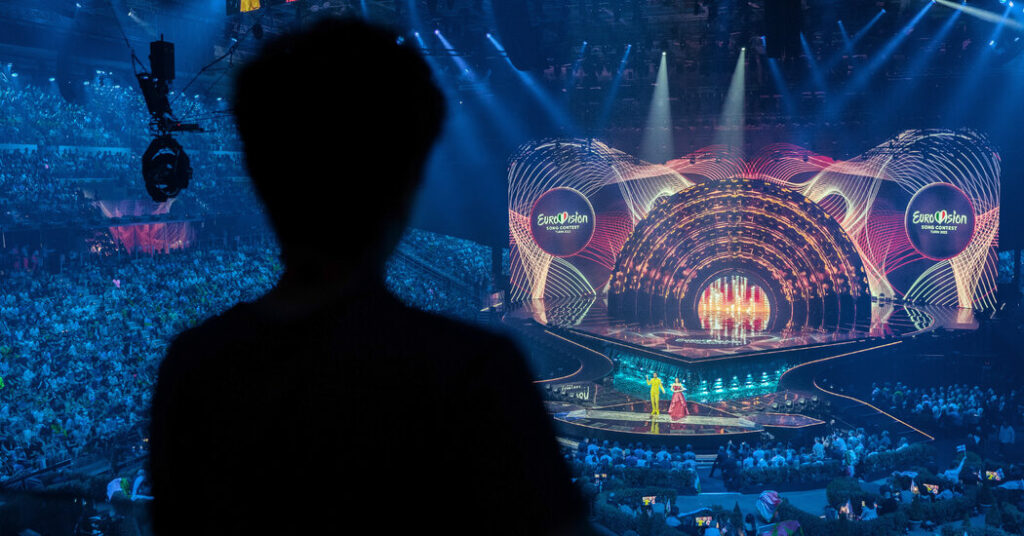
The Eurovision Song Contest, the high-camp singing competition with a fan base that extends far beyond Europe, will introduce an Asian edition in November, the competition’s organizers said on Tuesday.
The event, which will be called the Eurovision Song Contest Asia and is scheduled to take place in Bangkok, is the European Broadcasting Union’s third attempt to develop an Asian offshoot. Martin Green, the director of the Eurovision Song Contest, said Asian broadcasters appreciated that the Eurovision format was both “good television” and a chance to bring national pop stars to a wider audience.
“It’s a no-brainer,” he said in an interview.
Eurovision’s organizers, the European Broadcasting Union, said in a news release that government-owned and commercial television stations in 10 countries had agreed to take part: Bangladesh, Bhutan, Cambodia, Laos, Malaysia, Nepal, the Philippines, South Korea, Thailand and Vietnam.
Each country will hold a televised contest to select its act for Bangkok, a Eurovision spokesman said in an email, adding that the final competition will be available to international viewers on YouTube.
Green said that the winner of the Asian contest would be invited to sing in the following year’s main Eurovision edition. He added that Eurovision was committed to the project for a decade, and that he hoped broadcasters from more Asian nations would agree to participate.
The idea for an Asian edition has been around since 2008, when the E.B.U. announced the launch of the Asiavision Song Contest, but that event suffered repeated delays and ultimately never went ahead.
In 2016, the E.B.U. and Australia’s Special Broadcasting Service similarly announced that they would stage an event called Eurovision Asia the following year, but that event also did not materialize.
Josh Martin, who worked on that show for the Australian broadcaster, told reporters in 2021 that the format had proved “difficult for a number of reasons: time zones, language barriers, all sorts of issues.”
“We tried so hard, but that was one that we just could never quite pin down,” he added.
Eurovision has recently looked at expanding into other continents, too. In 2022, NBC aired the American Song Contest, in which singers representing U.S. states competed against one another. So far, that has proved to be a one-off event.
Green said that the E.B.U. and its production partners have been working on plans for the Asia edition for at least two years. He said that Asian broadcasters had asked for the show to include the name Eurovision in its title, seeing it as a brand that transcends continents.
The announcement on Tuesday comes six months after Asian nations including China and India took part in Russia’s revival of Intervision, a Cold War-era singing spectacle that was widely considered the Soviet Union’s rival to Eurovision.
Duc Phuc, a Vietnamese pop star, won that event with “Phu Dong Thien Vuong” (“Heavenly Prince of Phu Dong”), a soaring pop track with rapid dance beats.
Green said that Eurovision’s expansion had nothing to do with Russia’s efforts to create its own global song contest. “We wouldn’t ever do anything in response to whatever that is,” he said.
Jess Carniel, a humanities professor at the University of Southern Queensland in Australia who has researched Eurovision, said by phone that the new Asian Eurovision might succeed where past efforts failed. By focusing solely on Asian nations, rather than also including singers from Australia and New Zealand, Carniel said, it would avoid a Western-facing vibe.
It could be an exciting show, Carniel added: As numerous K-pop stars have shown, many Asian musicians are creating innovative and exciting music. “There’s also going to be a lot of linguistic and cultural diversity onstage,” Carniel said. “It could really make for a show worth watching.”
Alex Marshall is a Times reporter covering European culture. He is based in London.
The post Eurovision Song Contest to Add Asian Edition This Year appeared first on New York Times.