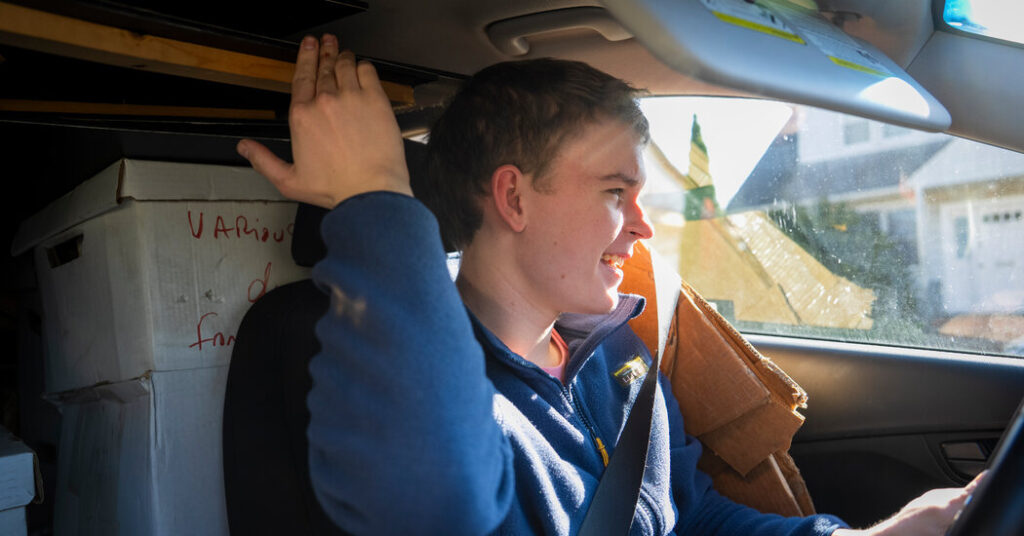
On an icy afternoon, a 17-year-old named Michael Haskell parked his battered Hyundai outside a cavernous storage facility on Staten Island. Then he fetched a hand truck and wheeled it through a maze of hundreds of identical units, its squeaking wheels echoing through the labyrinth.
“Any of these could be a gold mine,” he said.
He stopped at #3361 and unlocked the padlock. A musty odor emerged. He looked inside. The unit was crammed with birdcages, cedar chests, old paperbacks, barstools and Art Deco lamps.
“I think I’ll make good money off this locker, which isn’t bad, since I bought it for $140,” Michael said. “Copper is at $6 a pound right now, so I can sell the lamps to the scrap yard. It’s all about squeezing every dollar out of the locker.”
While some teenagers hang out after school, playing Fortnite or shooting hoops, Michael has taken up a more enterprising hobby. He buys abandoned storage lockers at bargain prices from public lien auctions with the aim of selling their contents for profit. It began two years ago, when he watched a rerun of “Storage Wars.” He has been on an urban treasure hunt since.
His adventures have brought him to CubeSmart, Extra Space Storage and Manhattan Mini Storage facilities in an around New York. He sells his scavenged goods through his eBay store, “Mike’s Unique Treasures,” to earn over $7,000 a month, a figure backed by the financial records he showed me.
He runs his operation out of the suburban New Jersey home where he lives with his mother. The garage is lined with meticulously indexed old magazines, vinyl records, World War II artifacts, rare stamps, VHS tapes and vintage fishing rods.
After finishing his homework, Michael spends his nights at a work table, packaging inventory to ship to his customers around the country. “My friends tell me they’re amazed I’m making money at this,” he said. “None have asked to come along with me yet, though. I’m not sure why.”
At the Staten Island facility, Michael took photographs of enticing objects and fed them into an A.I. image search, Google Lens, to get an idea of their value. Then he used a mechanical saw to break down tattered furniture with no selling potential.
“I’m always on the search for the next Crispo,” he said, mowing away. “That was my first big score.”
He was referring to the haul that turned his hobby into a quest, a storage unit he bought in Brooklyn for $450 that had belonged to Andrew Crispo, a shadowy 1980s art dealer. Michael sold a Man Ray painting and some Walt Kuhn drawings he found inside for nearly $50,000.
“My family took my hobby seriously after that,” he said.
After clearing the Staten Island unit with the help of two movers he had hired through Facebook Marketplace, he got back into the Hyundai.
It was so simple at the start. When Michael got into the game of flipping used goods, he just wanted to make some money. But the business of dealing in people’s abandoned possessions, it turns out, can be fraught. Two years into his pursuit, he knows all too well that every locker tells a story, many of them bleak.
“I’m always trying to figure out the lives behind the units,” Michael said as he drove toward another storage facility. “This guy was really into antiques. Maybe he was a flipper, like me. But who knows why he abandoned his unit. If you lose a locker, usually you’re not financially stable, and your life isn’t in a great place. Sometimes it can be a sad story.”
Michael woke at 7 a.m. the next day and rode the school bus to Bergen County Academies, where he is a senior. He took a math quiz and started writing an essay for English class about the poetry of Lucille Clifton. He tried not to worry too much about what he would hear back from colleges he had applied to — Wesleyan, Emory, Hamilton. But he had one thing on his mind above all else: the next hunt, the next locker, the next treasure.
On a recent afternoon at home in Bergen County, Michael was wearing fuzzy slippers as he scoured auction listings on Lockerfox.com to plot his next targets. Not long ago, the room he sat in was filled with Legos. Now it’s his office.
It was decorated with his finds — a Hermes 3000 typewriter, framed oil paintings, ancient Chinese vases. “They’re Qing, not Ming,” Michael said. “Ming vases are the ones you want.”
Beside the books and schoolwork on his desk were the tax documents his mother was helping him prepare. This year, he will file income taxes for the second time. There was also a plate of focaccia crackers, dried figs and Cheddar cheese that his mom had laid out.
He took a long look at the intel generated by a computer program he had developed with ChatGPT. It listed storage units that had been abandoned by people whose names had appeared at some point in the news. One was connected to a politician in Piscataway, N.J. Another locker had belonged to a minor celebrity: “Rapper known as ‘Ackquille Pollard’ or ‘Bobby Shmurda,’” the listing read.
After an online search, Michael confirmed that Ackquille Pollard was the birth name of the Brooklyn rapper Bobby Shmurda, whose viral ascent in hip-hop over a decade ago was cut short by headline-making gang conspiracy charges. After nearly seven years in prison, Mr. Shmurda was released in 2021. Michael paid $90 for his unit.
“From what I’ve read, it sounds like he was a one-hit wonder and mostly became famous for going to prison,” Michael said. “Who knows, maybe there’s something valuable connected to his music career in there.”
Michael’s mother, Anna Haskell, was in her study, reading The Wall Street Journal. “It all started in middle school,” Ms. Haskell, an investor, said. “Michael would go to book fairs, where he discovered he could buy books by the bag and resell them. Then he started researching Legos that were going out of production, and he started buying those up, reselling them as they got more valuable. Then he saw ‘Storage Wars.’”
“I don’t know what he could be one day, but what he’s doing is almost like distressed investing, buying distressed assets,” she added. “Maybe he’ll go into the investment path.”
Ms. Haskell considered what her son might be gaining from his locker dives, aside from money.
“I think he’s learning about human paths, about human nature,” she said. “People’s lives are in these lockers. Belongings can tell you a lot about a person. When you meet someone, you might think you know them, but you just don’t know.”
As Michael monitored outgoing deliveries in the garage, he told me about a unit in Hackensack that had belonged to a socialite. It was heaped with trash bags containing Prada dresses, Hermès scarves and jewelry. There were also empty vodka bottles, divorce papers and distressing financial documents.
“Her life had clearly fallen apart,” he said. “You think money solves all your problems. It doesn’t.”
And there was the locker on the Upper East Side of Manhattan that had belonged to a relative of the first Black mayor of Richmond, Calif. Michael showed me a yellowed local newspaper front page from 1964 that depicted him smiling as he took office.
“His name was George Carroll,” Michael said. “I read he was one of the first Black mayors of a large American city. Looking at this picture, you can imagine the adversity he faced.”
“He led an inspiring life, which wasn’t the case with Crispo,” he added. “Crispo wasn’t just connected to a murder, he was involved with so many other horrible things as well.”
About a year ago, one night after Michael cleared the locker of its valuable works of art, he searched the name Andrew Crispo online and learned about a harrowing crime that transfixed New York in the 1980s.
A striver from Philadelphia who reinvented himself in Manhattan, Mr. Crispo made his name with his sharp eye for undiscovered painters and his championing of American Modernism. After opening his namesake gallery on East 57th Street, he handled works by major figures like Edward Hopper and Georgia O’Keeffe. He became an art-world star and tabloid fixture known for the sadomasochistic sex parties that took place in his gallery after-hours.
One evening in 1985, Mr. Crispo and a gallery assistant, Bernard LeGeros, picked up a Norwegian art student named Eigil Dag Vesti and brought him to an estate owned by Mr. LeGeros’s parents in Rockland County, N.Y. After a drug-fueled night, Mr. Vesti was shot dead while naked and handcuffed. Three weeks later, hikers discovered his corpse in a smokehouse, a zipped leather hood over the head.
As Michael learned in his online sleuthing, the case became known as the Death Mask Murder. Mr. LeGeros was arrested and charged with the killing. Mr. Crispo denied involvement and was never charged, though the murder weapon, a .22-caliber rifle, was found hidden in his gallery.
Mr. Crispo later served prison time for tax evasion and for threatening to kidnap a lawyer’s 4-year-old child. He died destitute in 2024 in a Brooklyn nursing facility, causing his storage unit to go delinquent.
“He had a horrible ending,” Michael said. “I’m not sure what the lesson is. His life seems like a lesson in how not to live your life.”
The auction house Bonhams handled the artworks that Michael found in the Crispo locker. With his mother’s help, he invested the proceeds from the nearly $50,000 sale into the S&P 500. There may be more windfall yet. Still unsold from the collection is a Yoruban ceremonial staff, which will soon go to auction. Bonhams has set the bidding at $4,500.
But around the time that Crispo’s grim life story left Michael feeling shaky about humanity, he came upon something quite different in a storage unit he had unlocked in Union City, N.J. Its contents seemed routine at first — tool boxes, hammer holsters, saws, drills, some Spanish-language comic books. But deep within the clutter, in a tattered box, Michael found a Purple Heart.
After clearing the locker, he went on eBay and found a lively market for Purple Hearts. One could easily fetch $300. But he didn’t list it.
“I felt I should return it,” Michael said. “I didn’t have much to go on because I didn’t have an owner’s name for this unit. But there was a faded address on one package.”
The address brought him to a home with a rusted white fence in an immigrant enclave of Union City. A pair of dust-caked Timberland boots sat by the entrance. No one answered Michael’s knocks at the door. No one answered his calls after he pulled a phone number through public records. Then he sent a letter. He is still waiting to hear back.
He keeps the Purple Heart in a drawer. “Selling it would be disrespectful to a life, to someone who fought for something, even if I don’t know who they are,” Michael said. “I’ll never sell it.”
On an overcast Monday afternoon, Michael endured another math quiz before leaving school to investigate the Bobby Shmurda unit. Walking through the cold toward his car, he ran into Scott Demeter, his junior-year history teacher.
“What Michael is doing is what education should look like,” Mr. Demeter said. “So many teens just want to get picked up as an influencer now, but he’s doing something that involves entrepreneurial spirit and risk-taking.”
“He’s generating real income, too,” he added. “I just joked with a colleague that we should quit our jobs and do what Michael’s doing.”
After the drive, Michael arrived at a storage facility in Edgewater, N.J., and made his way inside. He found Mr. Shmurda’s unit at the end of a long, dark hall. Its blue metal door rattled as he heaved it open. To his dismay, there was nothing of note inside. A set of weights. A plasma TV. A pair of loudspeakers.
“Maybe the speakers are worth something,” he said. “Otherwise, this is junk. His name isn’t written on anything, so no one will even believe me that this is Shmurda’s stuff.”
Ever in hope of a jackpot, Michael made his way to a Storage Post facility in Long Island City. This unit had not been flagged by his ChatGPT-assisted search bot, but he figured it was worth a shot. He unlocked the door — and scowled. It was filled with gym clothes, cookbooks, a VCR and a plant pot.
But as he rummaged through the boxes, he grew interested in the life behind all this seemingly worthless stuff. The dusty Ampex tapes, recording masters and sheets of paper scribbled with lyrics suggested a working musician. Old photos depicted a handsome singer in his 1970s prime, hanging out in the studio with his band.
Buried deep in the unit, Michael found a few records by a soul musician named André Anthony Waters. On the cover of his 1988 album, “Heat Up the Night,” he wore a leather jacket with a popped collar as he stared coolly into the camera. Michael searched his name on his phone but didn’t turn up much, not even a Wikipedia page.
“You can see his hopes and dreams in this locker,” he said. “It looks like he never really made the big time, though it’s clear his music was everything to him. I doubt I’ll make much off this unit, but this was a good life story.”
He started heaving the boxes into the hall.
“But you can’t get too attached,” he said. “It’s still got to sell.”
Kirsten Noyes contributed research.
Alex Vadukul is a features writer for the Styles section of The Times, specializing in stories about New York City.
The post A New Jersey Teen Finds Treasure, and More, in Abandoned Storage Units appeared first on New York Times.