Imagine buying a beautiful new car and seeing the low fuel light blink on as you drive it home. Although it only accepts Amazon’s proprietary gasoline blend, that’s fine. Nearly 80 percent of gas stations are owned by Amazon. Then you reach into the glove box to retrieve your purchase agreement and read the fine print. It turns out you don’t own your new car after all. You licensed it. Amazon has the right to enter your driveway, remodel the interior, repossess it and even unilaterally change the license, for any reason at all.
That, in a nutshell, is the experience of buying e-books and audiobooks on Amazon’s Kindle, the most popular e-book reader on the planet. (Amazon founder Jeff Bezos owns The Washington Post.)
While workarounds exist, the company tends to limit readers’ control over the digital books they ostensibly own and make it difficult or impossible to use on other companies’ devices or lend to others. Amazon has even reached into customers’ libraries and altered what they bought. After a licensing dispute in 2009, it remotely deleted an unauthorized edition of George Orwell’s 1984 from customers’ devices. (It has since agreed to limit the practice.) The irony was lost on no one.
As corporate walled gardens have replaced the freewheeling, open internet of the 1990s and 2000s, we’ve ceded control over almost everything about our online experience. Nearly every keystroke, swipe and tap is now monitored, recorded and analyzed for potential profit.
The Kindle ecosystem is perhaps the apotheosis of this shift. One Guardian reporter found Amazon had recorded every title, highlight and page turn on her Kindle app (40,000 entries over two years). The company’s dominance sets the terms for everyone in the marketplace.
Including me. Like tens of millionsof others, I have owned a Kindle (a Paperwhite). Last year, it started to feel as if it owned me. The final straw was when Kindle removed my ability to download and back up my own e-books. So I went in search of an alternative.
I bought a Kobo.
Was it the bibliophile Eden some Kobo fans described? Not quite. The reality was messier than I expected. It turns out we can’t escape Big Brother on our e-readers just yet. But a more open society is coming into view for book lovers — and perhaps all of us.
Here’s how to turn the page.
Books unbound
I love books, physical or digital. At their best, they are humanity’s most precious artifact: the distillation of a lifetime of wisdom, and the most immersive entertainment we’ve yet invented. E-books let you read more, anywhere, for less.
The Pew Research Center found in 2021 that 30 percent of Americans read e-books. In 2025, Americans checked out 820 million digital books last year, nearly double the number in 2020, reports Overdrive, owner of library lending apps Libby and Sora.
Amazon dominates this market. Data is scarce, but industry estimates suggest the company controls between 70 and 80 percent of the U.S. e-book market, with the rest split among Apple, Google, Barnes & Noble, Kobo and others. Amazon declined to comment on its market share.
Rakuten Kobo, the company responsible for the Kobo e-reader and digital bookstore, wants a larger slice. After ceding the U.S. market to bigger players in the early 2000s, the Canada-based, Japanese-owned firm said it has become the world’s second-largest digital reading platform with a catalogue of more than 8 million titles, and major markets across Asia, Europe and Latin America.
Catching up to Amazon would be difficult. Kindle devices offer crisp screens, long battery life and, of course, more titles than anyone else. The company virtually invented a viable business model for self-published authors to earn money from readers that the traditional industry had ignored.
Millions — like Marius Masalar, a Canadian marketer and avid e-reader who owns four of the devices, including a Kobo — still love Amazon’s e-book experience. “I tend to reach for my Kindle despite the more closed ecosystem, because the day-to-day experience of browsing, buying, and reading Kindle e-books within that ecosystem is excellent,” he wrote me. “From where I’m sitting, it looks like Amazon is moving further, faster.” But, he acknowledged, “the stench of big tech” means it has lost its appeal for many.
In recent years, Amazon has tightened its grip on Kindle users: encrypting its e-book formats, making it harder for users to back up their purchases and refusing to license most Amazon Publishing titles to public libraries, a practice the American Library Association called “aparticularly pernicious new form of the digital divide,” before Amazon changed course under pressure from lawmakers. For some readers, the politics are personal: Bezos’s relationship with President Donald Trump has driven others away entirely.
Rakuten Kobo’s CEO, Michael Tamblyn, said waves of disenchanted Amazon customers have arrived on the Kobo platform since 2024 because of “political shocks that have made people examine the companies they’re supporting and why,” as well as in response to Amazon restricting access to its e-books.
“We’ve doubled our business, year over year,” he said, making the United States a major market, though it still trails far behind Amazon.
Tamblyn credited Kobo’s appeal to more than just attracting defectors from Amazon’s ecosystem. “We’re just focused on books and reading. It’s all we care about,” he said. “It means all of the decisions that we’re making from a technology perspective are about how do we make this reading experience as good as we possibly can.”
Is Kobo really better?
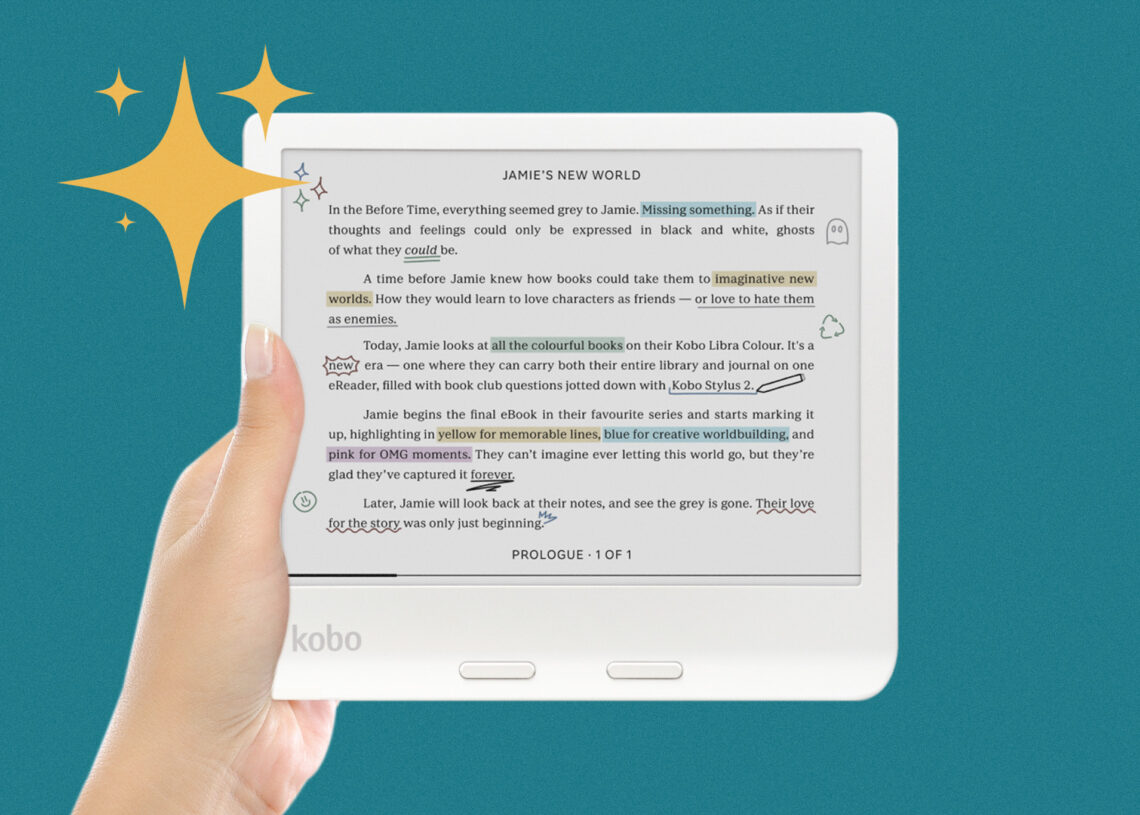
First, the test drive. I kicked the wheels on Kobo’s black-and-white Clara ($139). Kobo’s technology shines by disappearing into the book experience itself. The deep customization (fonts, margins, line spacing, justification), library management, attention to aesthetics and details (warm tones for night reading!), and uncluttered, ad-free user interfaces are refreshing. Screen, battery life and user interface on its four e-reader devices (Clara BW, Clara Colour, Libra Colour and Elipsa 2E) are all comparable or better than almost every Kindle on the market — with no third-party ads.
But if you want the latest and greatest technology, Kindle comes out on top. Kindle’s premium $630 Scribe Colorsoft lets you scribble with a stylus on a color screen, use AI tools and connect to Google or Microsoft files on your e-reader.
And there are several other more traditional e-readers to choose from. Its chips are often faster, page turns snappier. Kindle can uniquely switch between an e-book and its audiobook across all devices without losing your place. Amazon’s e-book store also has the most titles, especially niche and self-published authors. Because Kobo devices have fewer users, there are fewer accessories made by other companies.
My own Kindle Paperwhite worked flawlessly. But for me, Kobo won. Its superiority lies in how it treats words — and readers.
Kobo’s support for epub — the open industry standard for e-books — makes it easy to load files from anywhere, including free sources like Project Gutenberg. Amazon has historically required all e-books use its proprietary format and still does for most store purchases. (In January, Amazon began allowing authors and publishers to offer DRM-free titles as downloadable epub and PDF files — though most haven’t.) If you want to send online articles to your device, Kobo’s free, native Instapaper integration is seamless.
Kobo’s partnership with iFixit — which offers spare parts and step-by-step guides for home repair — is another meaningful differentiator for those who want to treasure and repair their e-reader. Most of the company’s models are waterproof.
Here’s the killer app: Library support is genuinely superior to anything Kindle offers. Kobo’s native integration with Libby, the standard lending platform for public libraries, lets me borrow library books directly on my e-reader rather than buy them and even displays them inside the Kobo marketplace. You can’t do that on Kindle, which forces you to jump through a few more proprietary hoops (assuming your library has the Kindle e-book).
Kobo told me roughly 15 percent of reading on its devices is library books. And later this year, Bookshop.org — the online bookstore that funnels revenue to independent booksellers — plans to sell e-books compatible with Kobo. Bookshop CEO Andy Hunter said that he asked Kindle to offer the same. “They have not written me back,” he said. “Right now, Kobo is the best bet for people who want to get out of the Amazon ecosystem.”
Open or closed? That is your question.
Let’s put technology and convenience aside. As a reader, the most important question may be a much older one: Do you want to live in a more open society or a more closed one?
The early promise of the internet was a marketplace of ideas, but companies have corralled us into profitable, well-tended walled gardens. Has that been all bad? Of course not. Google, Meta and Amazon all offer sleek, convenient and “free” services people use every day. You can pry Google Maps out of my dead hands.
But we’re starting to see the costs of these services. They are often not truly free.
Ownership becomes temporary licensing. Libraries are sidelined and local bookshops excluded. Proprietary formats are imposed. Information can be censored or altered at the whim of an executive or, perhaps one day, a government order. Your reading history might be subpoenaed. The advantages of scale, principally lower prices and more convenience, are turned on their head once markets become too concentrated.
E-books and audiobooks, by any standard, are dominated by one company.
Without free and fair competition, companies choose what you can buy, not customers. “Competition is going to have to discipline Amazon,” said Mitch Stoltz, who leads the Electronic Frontier Foundation’s antitrust and competition work. “Right now, it’s not.”
For now, your options are limited. Kobo and (to a lesser degree) Barnes & Noble exist in the U.S. Apple Books and Google Play Books offer content but not e-ink readers. There is a new generation of Android-powered, all-purpose e-ink tablets by Boox and Bigme that run Kindle, Kobo and Libby apps (the higher price and performance issues may be a barrier for some).
For audiobooks, Libro.fm offers 600,000 audiobooks at prices comparable to Amazon’s Audible and revenue sharing for independent bookstores (Audible’s catalogue is bigger, however). Free public sources include libraries through Overdrive’s Libby or Hoopla, as well as Project Gutenberg (e-books) and LibriVox (audiobooks) for out-of-copyright classics.
The ownership problem persists even here. When I purchase a book from Kobo, or most of these platforms, it’s still a license — one set by the publishers.
In 2023, Puffin Books silently updated customers’ Roald Dahl e-books on both Kindle and Kobo, removing words including “fat,” “ugly” and gender-specific descriptions in multiple books, including “Charlie and the Chocolate Factory,” an act Salman Rushdie called “absurd censorship.”
Amazon declined to comment on the record about its control over e-books, although a spokesperson directed me to turn off “automatic book updates” to prevent publishers from altering e-books purchased on the Kindle store (although Amazon’s license agreement still allows this). Kobo’s terms of service reserve similar rights to Amazon’s, including collecting user data. In response, Tamblyn said Kobo’s publisher contracts and internal policies are designed to prevent Kobo from altering or removing purchased books — and unlike Amazon, Kobo allows customers to download a portable copy of their e-books stored “out of our reach.”
“Even though we live in a world of digital licensing, people want to feel that these books are theirs, and we want to do everything we can to support that,” Tamblyn said.
Not everyone is reassured. “Kobo has the same issues around surveillance and censorship,” said Lia Holland, a fiction writer and communications director at Fight for the Future, a digital rights nonprofit pushing for investigations into corporate control of digital content. Holland has switched to Kobo but not without qualms: “There is no perfect solution. … It requires us to really grapple with how much our rights have eroded in the digital age.”
Cory Doctorow, an author and digital rights activist who has spent years documenting that erosion, has a rule: “Any time someone puts a lock on something that belongs to you, but won’t give you the key,” he wrote, “that lock is not there for your benefit.”
When you decide where to spend your reading hours and dollars, that might be your guiding principle. There’s no perfect option. But there are better ones.
The post I broke up with my Kindle. My new e-reader treats me better. appeared first on Washington Post.