A GOOD PERSON, by Kirsten King
Is Lillian, the 29-year-old narrator of Kirsten King’s acerbic, darkly feminine and very funny debut novel, “A Good Person,” well, a good person?
She is derisive, solipsistic, sloppy, soused and audacious. She’s as toxic as Drano, a cruel and exploitative operator, an entitled and delusional fantasist, deranged, drunk on limerence and the wine she slurps from a coffee mug on the train to work. She weaponizes her bisexuality. She acts out of self-interest and vengeance. She’s a bully and a schemer, a compulsive liar, erratic, gluttonous for vibrators and Taco Bell. Think Amy Schumer in “Trainwreck,” crossed with any given Disney villain.
So, a good person? Nah.
We first meet Lillian in her lonely childhood, getting kicked off a field trip to the zoo for nearly pushing a classmate into the gorilla pen. “I would always be outside, looking in,” she muses. Flash forward two decades, and she’s employed at a Boston marketing firm called Fizzle, where she’s the office blackbird among sunny women who do puppy yoga, wear Crocs and call one another things like “girly pop.”
For four months, Lillian has been sleeping with Henry, a preppy financial risk analyst, and daydreaming about becoming his girlfriend. When he abruptly ends their situationship the morning after a violent and degrading hookup, Lillian goes scorched earth. “I wanted him to suffer like he had made me suffer,” she seethes. “He owed me a future.”
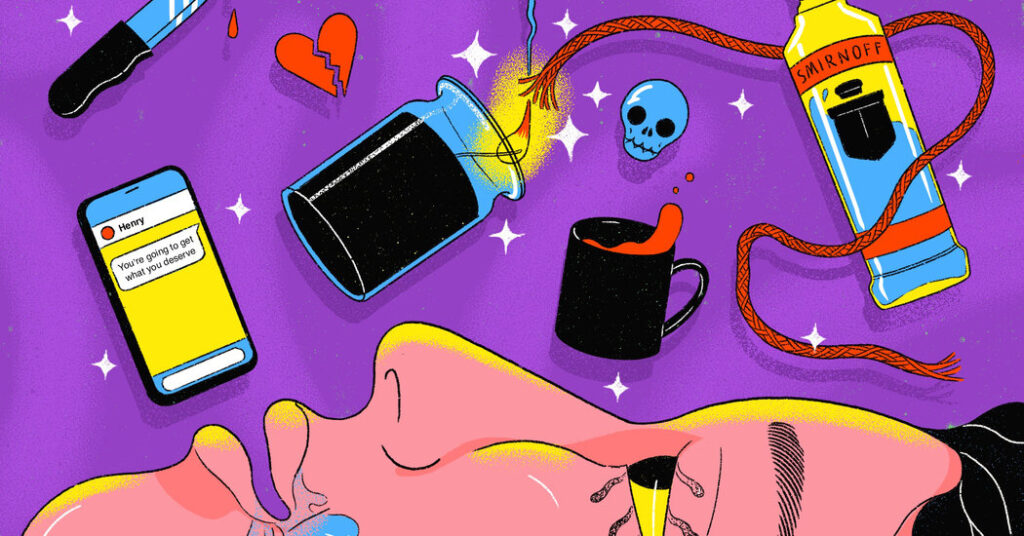
Hell hath no fury like a personality-disordered Gen-Z-millennial-cusp woman scorned. Incandescent with rage, she turns to the métier of a prized Fizzle client, a New Age influencer named the Wellness Witch, who posts spells on YouTube. Following along at home, Lillian lights a Yankee Candle and burns a string from a raveled Forever 21 sweater to perform a hex on her ex.
“You’re going to get what you deserve,” she texts him. Hours later, Henry is stabbed to death in front of a Beantown bar. From this point forward, the question of the novel becomes: Was Lillian’s hex in any way responsible for this horrific turn of events? Even if it was, who actually committed the murder? When the police call her in for questioning, Lillian hires a cheap lawyer from a bus stop ad and manipulates her “boring” best friend, Jamie, into paying the fee.
The whodunit mystery might drive the plot, but comedy is the irresistible force of this unwaveringly caustic novel. Lillian is as wild as a protagonist in a novel giving “chick lit energy” could possibly be. She has kinky, unprotected sex, passes gas and confesses to anal waxing. “My blood was still 90 percent Smirnoff and my colon was hanging on by a thread,” she admits at one point.
Lillian crosses every boundary, pulls down her pants and pees on it. She tries to break into Henry’s apartment with an ice scraper. She creates burner accounts to cyber-harass Henry’s actual girlfriend, Nora, whom she only learns about after his death. She presses her breasts against her uncomfortable attorney. She DMs marketing clients while inebriated. “My therapist thinks you’re a narcissist,” her roommate informs her, before moving out. (Similarly, her lawyer suggests a psychiatric evaluation.)
Her first-person voice, too, is hilarious. On her own countenance: “I looked like a Costco-brand Chappell Roan.” On her white privilege: “I had never been accused of shoplifting when I was shoplifting.” Nora “looked like someone who would play the only non-depressed character in a Sally Rooney adaptation.” On making new friends: “I thought about joining Bumble BFF, but decided I would rather kill myself.”
King, a Los Angeles screenwriter by trade, stacks present-day detail to hook the modern 30-something reader. Lillian numbs her brain with Bravo and “RuPaul’s Drag Race.” Vodka tampons, HomeGoods, Coachella, Swifties, Kris Jenner and Glossier all get shout-outs. Uber, Instagram and Ambien — that holy trifecta — play key roles in the story.
Lillian occasionally shows her sensitivity. Henry was no perfect victim, and the hurt he caused her and other women is real. She grew up poor, attention-starved and fatherless, the product of a one-night stand. “I felt different from most people,” she divulges. She genuinely desires to be loved, but her intense emotional instability and chaotic behavioral patterns make it impossible to form lasting relationships.
Most protagonists learn and grow over the course of a novel. But can a self-described “hyena” change her spots? King tenderly touches the possibility of her character’s transformation without indulging it, or sacrificing the delightful demons that propel the story. “Sometimes humans carried darkness inside them, like a drug mule,” Lillian reflects near the end of the book. Shortly thereafter, she visits her new therapist. “I told her that I thought I was a good person,” Lillian says. “But sometimes I felt other people were too stupid to see that.”
A GOOD PERSON | By Kirsten King | Putnam | 291 pp. | $29
The post Did This Spurned Lover Accidentally Murder Her Ex? appeared first on New York Times.