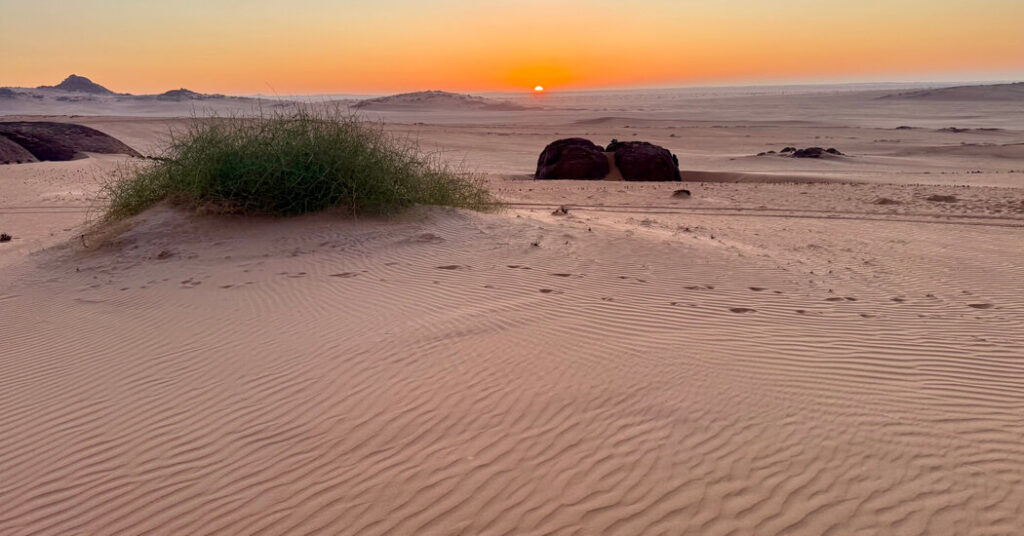
For me, it was the silence that was the most overwhelming as I stood in a carved out sandy valley between two sweeping crescent-shaped golden dunes. With vibrant sapphire-blue skies overhead, there was no birdsong, no hum of background activity, just a soft bellow of wind that gently danced over the sand, etching rhythmic ripples in its wake.
There was something about the untouched perfection of this part of the Skeleton Coast dune belt — where the sands can reach 300 feet, or 100 meters — that I wanted to bash and leave a mark. Like being the first person to plunge a knife into a fresh jar of smooth peanut butter, there was something hugely satisfying about making a first impression in this sand-swept landscape. As it was the first day of the year, I wrote “2026,” before noticing that a centipede had also decided to leave its mark.
I know sand dunes better than many because I spent my childhood summers (and time in my adult life as well) running, dancing, jumping and climbing the glorious dunes that are dotted across Lake Michigan’s shores in northern Michigan. But with aging knees and a deep understanding of how hard dunes can be to climb, I no longer feel the need to traipse up them. Any chance I have to be near them, though, I am all in.
These dunes had been an unexpected bonus of my trip to Namibia, a place I had been desperate to visit for several years. I had heard about the Skeleton Coast and the hulking carcasses of shipwrecks scattered up and down its rough and foggy coastline. That image was quickly quashed by my guide, Richard, who said that after being pounded over the decades by Atlantic storms, bashed against rocks, buried by the shifting sands and eaten away by saltwater, there is really nothing discernible left of most of those relics.
But there are still skeletons: of animals that are washed away when the rains sweep through the ephemeral riverbeds of Hoanib, Mudorib and others; and of people who have perished while trudging through the punishing but stunning landscapes. There are also bones of whales that have washed ashore and bleached out over the decades.
I had started my adventure further south in Namib-Naukluft National Park, known for its clay pan, Deadvlei, or “dead marsh.” This stark scene of white cracked earth formed over 900 years ago when sand dunes cut the area off from its water source, the Tsauchab River. Over the centuries, the black camel thorn trees in the long-gone marsh have atrophied. Now they cast striking shadows in the blazing hot desert sun and have become a photogenic backdrop for travelers’ photos after they have trekked over the dunes.
Arriving at camp near Hoanib, near the border of the Skeleton Coast National Park, the next day, I couldn’t wait to get to the coast. Over a New Year’s Eve dinner, guests regaled me with stories about how the dunes at Mowe Bay have a soft roaring sound. These mammoth natural works of architecture are constantly shifting because the winds around this stretch of the Atlantic are so extreme that they help form the Benguela Current, which flows up from the Cape peninsula through to Angola.
I was also told to keep my eyes out for Alpha and Bravo, two desert-adapted lionesses that roam this landscape, along with their cubs, often bedding down at a large oasis past the dunes. (A third lioness, Charly, was euthanized last spring after a fatal attack on a camper in the Hoanib riverbed.)
The next morning, we headed out in a four-wheel drive vehicle that was able to handle the sand. We passed through the dry riverbed of the Hoanib, where we came across a family of elephants and saw baboons and giraffes chomping on their New Year’s breakfast.
The landscape kept changing, becoming green and lush at certain points, fragrant with silver bush and wild tamarisk, and dotted with the pretty but highly poisonous flowering Datura bush. A horned adder made an appearance in the road, and I was struck with the diverse changes in the landscape and the flora and fauna. When we finally reached the dunes, after a bumpy drive of almost five hours that Richard jokingly called a “bush massage,” I jumped out of the jeep to stretch my legs.
Richard told me he had once seen Alpha and Bravo crossing over the dunes and it had taken his breath away. No luck for me, but I hoped to catch a glimpse of the lionesses when we reached the Mowe Bay seal colony.
One of the ways the lionesses have adapted to their environment is by hunting the Cape fur seals. An estimated 40,000 dot the beach and create an overpowering stench — a combination of urine, fishy poo and decomposing carcasses of their young that didn’t make it. It is easy feasting for Alpha and Bravo, and they are probably unbothered by the stench, which stayed in my nostrils long after the 12-minute flight back to camp after lunch on a windswept beach.
My last stop was along the Kunene River, a natural border between Namibia and Angola. I had come here to not only get a chance to visit the Himba, a seminomadic tribe known for wearing otjize, a red ocher and butterfat paste, but also to get a much-desired glimpse into Angola. But it was the sand dunes that really took my breath away.
Guided by the upside-down horns of oryx antelopes, Namibia’s national animal, that had been left to direct guides to the camp in case the paths had been obscured by sand, we plowed over small dunes. To reach our camp on the river, we drove down a steep dune and I subconsciously leaned back, as if on a horse, to coax the Jeep down safely.
At sundown, we shared wine and local beers on a small outcrop over the dunes, and I was overwhelmed by their shape-shifting vastness. Being here to start a new year felt somehow like foreshadowing for what lay ahead in 2026 — a blank canvas that was mysterious but unfolded all around me. Standing there, as the winds wove their artistry into the sands, I was hopeful and in awe of what was to come.
The post Silence and Sand Dunes on Namibia’s Skeleton Coast appeared first on New York Times.