Before I learned anything else about American history in elementary school, I knew about the grape boycotts that Cesar Chavez promoted.
My grandfather was a farmworker who had toiled in the Texas fields as part of the bracero program, a partnership between Mexico and the United States that used Mexican workers to alleviate labor shortages in America. Decades later, my teenage cousins spent summer breaks working 14-hour shifts in fruit and vegetable fields.
I was raised in Hidalgo County, Texas, with images of Mr. Chavez dotting community meetings that were run by his organization, which connected my mother with a legal aid clinic that helped low-income residents find homes that had been seized by the government and were being auctioned. Those services helped people like my mom achieve a dignified life, and she was able to buy our discounted family home — a three-bedroom, two-bathroom house with shaggy brown carpet.
So when I read a recent New York Times investigation on Mr. Chavez and the abuse he had inflicted on the young daughters of people in his movement, I wept.
Mr. Chavez had embodied a civil rights movement that cemented Mexican American power. He had spoken out on behalf of those who worked the fields. He had given pride to Mexican Americans — like my relatives — whose voices had been muted. He had inspired so many that he was remembered with streets, statues and schools named in his honor.
The revelations cut deep for legions of us who benefited from Mr. Chavez’s activism, rousing complicated emotions about a man who is arguably the movement’s most revered Mexican American.
Juventina Herrera, 67, who had detasseled corn until undergoing knee replacement surgery 17 years ago, said she felt as if there had been a death in the family. Ms. Herrera, who lives in Hidalgo County, where Mr. Chavez is memorialized with a namesake road, is the daughter of fieldworkers who had become enthralled by Mr. Chavez and volunteered for decades on his behalf.
“It’s like having to bury your parents all over again,” Ms. Herrera said, her voice breaking. “All the work that the entire Hispanic community did has been erased.
Like Ms. Herrera, I feared for the movement that had secured better protections for people like my abuelito Juan Manuel, whose mind and body were ravaged by Parkinson’s, a disease that has been linked to the pesticides that my family and I have been exposed to in rural South Texas. Ms. Herrera, who became a public-school teacher after leaving farm work, is worried that efforts to remove Mr. Chavez’s name could diminish the history of the labor movement that he helped lead.
Last week, the Texas Education Agency ordered public schools to omit mentions of Mr. Chavez from lessons. Greg Abbott, the Republican governor who opposes removing Confederate monuments linked to racist historical figures, said that the state was working to end celebrations honoring Mr. Chavez and to change mentions of his name in public places.
Stephanie Alvarez, who teaches Mexican American studies at the University of Texas Rio Grande Valley, said that the allegations against Mr. Chavez felt heavier as Latinos are targeted by the Trump administration’s expanding immigration crackdown.
“People are criminalizing Latinos, dehumanizing Latinos, kidnapping Latinos,” Ms. Alvarez said. “There’s a lot of emotions happening all at the same time because, at the same time, you want to defend your culture.”
Many of us feel angry and betrayed by the movement that failed to protect its most vulnerable people — Ana Murguia and Debra Rojas, who said that they were as young as 12 and 13 when Mr. Chavez assaulted them. Their stories triggered trauma for those of us who grew up with victims of child sexual abuse.
La Union del Pueblo Entero, an organization in the Rio Grande Valley that was founded in 1989 by Mr. Chavez and Dolores Huerta to improve living conditions in poor neighborhoods — the same group that helped my mother buy the home that she still lives in today — has been holding community sessions with mental health professionals in the aftermath of the allegations. Ms. Huerta revealed recently that Mr. Chavez, with whom she created the powerful United Farm Workers union, had taken her to a secluded grape field and raped her.
Ramon Romero Jr., a Democratic state representative from Fort Worth, Texas, and the chair of the Mexican American Legislative Caucus, said he was devastated to read that Ms. Rojas had developed a drinking habit and that Ms. Murguia had attempted to commit suicide. Mr. Romero, who had planned to speak at a Cesar Chavez parade before the event was canceled, hoped their stories would inspire victims to speak out and people to believe them when they did.
“When is the environment going to change?” Mr. Romero said. “Se puede hablar hoy de lo que pasó ayer. (We can speak today about what happened yesterday.) If we can move past the fear, hopefully my daughters and granddaughter are not in a place where they don’t feel as though if this happens to them, they can’t come forward.”
Alberto Rodriguez, the director of the program that Ms. Alvarez teaches in, said that many scholars had known of Mr. Chavez’s misogyny before the recent revelations, but publishing the information was considered inflammatory because of his fame. My older sister, Jazmin — who did not touch a grape until she was in her 20s — had become disillusioned with Mr. Chavez after learning that he had used racist slurs to describe undocumented immigrants.
Mr. Rodriguez, who worked in the fields as a teenager with his parents, said that the revelations could shine a light on the contributions of other community leaders, including women, who have been largely overlooked. Maybe, he said, Mexican American studies would experience a revival, having already become more popular among students who were inspired to learn about their heritage after President Trump’s immigration crackdown.
The movement for Mexican American rights was bigger than Mr. Chavez, Mr. Rodriguez said, and in addition to farmworkers, it included women and L.G.B.T. people of Mexican descent. It was influenced heavily by African Americans who had already developed sophisticated techniques to fight for equal treatment, with many leaders to draw inspiration from, including Harriet Tubman, Ida B. Wells, Ella Baker, Frederick Douglass, Booker T. Washington and James Baldwin.
At the time, Mexican Americans relied on Mr. Chavez. Even Ms. Huerta had kept her secret about him — for six decades — because she did not want to compromise the movement.
Mr. Rodriguez stressed the need for more female exemplars, especially as more Latina students are attending college. The majority of Mr. Rodriguez’s students are women.
“There’s a light at the end of the tunnel,” he said. “This light is giving freedom to so many people, so many women, so many advocates, so many scholars to now talk about things that really matter — that those people on the ground, those families, were there — and shift the lens away from Chavez.”
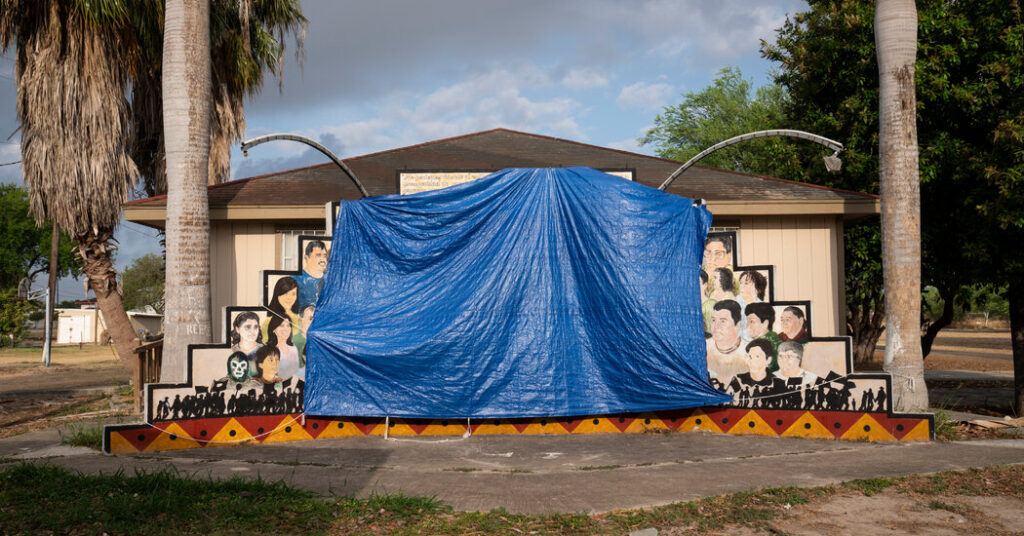
In Hidalgo County, which is more than 90 percent Latino, public officials are considering renaming Cesar Chavez Road. Many of my relatives live near the road, a prominent thoroughfare, not far from Ms. Herrera’s home.
My sister Jazmin, who as a child attended rallies with our grandmother, remembers when the street used to be called Morningside Road. Despite protests by winter Texans — retirees primarily from the Midwest who drive their motor homes south to spend part of the year in the warmth of the Valley — it was renamed in Mr. Chavez’s honor in the 1990s.
“Grandma and the rest of us were so happy when it happened,” Jazmin told me over WhatsApp. “And now it’s like — I wish it was still called Morningside.”
Ana Ley is a Times reporter covering immigration in New York City.
The post Cesar Chavez Was a Voice for Mexican Americans Like Me. Now, We Grieve. appeared first on New York Times.