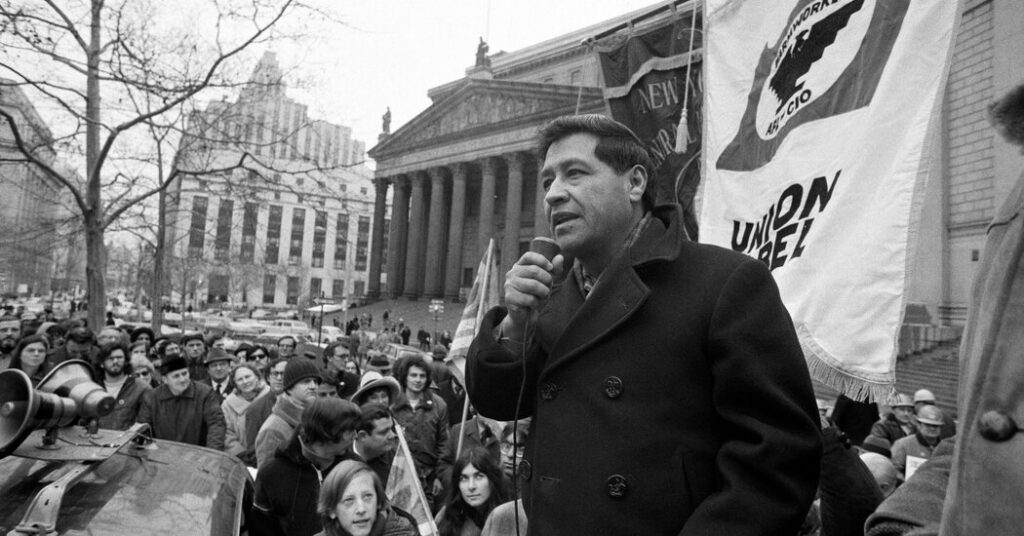
In life, Cesar Chavez was the face of the labor rights movement, revered for his work organizing farmworkers in the fields of California.
In death, he became something much more: a symbol of the power of a rapidly expanding Latino community, in a place that often seemed to be hostile to their ascendance.
Dozens of streets in California were renamed for him. The government made his birthday, March 31, a paid state holiday, one of only two celebrating an individual person. More schools in California bear his name than that of the civil rights leader Martin Luther King Jr.
“For me, it just represented giving people an opportunity to recognize our own,” said Mike Hernandez, a former Los Angeles City Council member who spearheaded efforts in the 1990s to make Cesar Chavez Day a paid day off for city workers.
“We had all these holidays,” Mr. Hernandez said. “We didn’t have a Latino holiday.”
But after an investigation published by The New York Times earlier this month found evidence that Mr. Chavez had abused women and girls, his name was quickly erased. Murals were painted over. Statues came down.
And for the first time since 1995, March 31 is not Cesar Chavez Day in California — it is “Farmworkers Day.”
Some people are left wondering if they rushed into canonizing a man whose misdeeds now overshadow his achievements, and they are once again questioning the wisdom of celebrating men instead of movements.
“For a community that doesn’t see themselves in history books — or at least didn’t when I was growing up — to have an icon who fought for social justice was obviously something people were proud of,” said Antonio Villaraigosa, 73, the former mayor of Los Angeles. His career in politics was inspired by meeting Mr. Chavez and Dolores Huerta when he was 15 years old.
He described the removal of Mr. Chavez’s name from the public square as “painful but necessary” — a reminder that “the legacy of the farmworkers’ struggles belongs to them, not to any one man.”
From Icon to Idol
When Mr. Chavez died in April 1993, passing away in his sleep at age 66, Latinos were on their way to becoming the largest ethnic group in California. They had jumped from a fifth of the state’s population in 1980 to more than a quarter by 1990. They would hit a third by the turn of the century.
But a tremendous amount of what felt to some like anti-Latino sentiment was growing as well, said G. Cristina Mora, a sociology professor at the University of California, Berkeley, who studies Latino migration.
On the ballot in 1994 was Proposition 187, an initiative intended to deny public education and social services to undocumented immigrants. In the state’s highest office was Gov. Pete Wilson, a Republican who supported the ballot initiative and whom many Democrats accused of racism and of stoking anti-immigrant sentiment.
The public honoring of Mr. Chavez, the best-known Latino figure in the state, felt like an antidote, Ms. Mora said. Many Latinos in California had grandparents or other relatives who had been farmworkers.
“All this stuff is happening in the 1990s: They’re all telling you that you don’t belong, they’re all telling you that you’re mooching off our services, they’re all telling you that you’re criminals,” said Ms. Mora, 45, who grew up in Los Angeles. “Chavez was one of the few places we’d find respite, one of the few places we could find a positive story about our community.”
And so Mr. Chavez came to symbolize not just the farmworker rights movement but also Chicano identity. Mr. Hernandez, the former Los Angeles City Council member, said that Mr. Chavez had been a personal hero for him as a Chicano activist in northeast Los Angeles during the 1960s and 1970s.
It made sense, Mr. Hernandez said, for him and other Latino leaders, who were just beginning to gain a foothold in city politics, to use their power to recognize Mr. Chavez — especially in a city with a vast Latino population and Spanish roots.
He said he would visit the homes of his constituents and “on their mantles, next to pictures of Jesus Christ, they had a picture of Cesar Chavez. He was our hero.”
“I think the reality is that we do need heroes, and we don’t have many,” said Mr. Hernandez, 73.
The former councilman said he had been feeling conflicted about the rapid effort to remove Mr. Chavez from public spaces. Had he and others known about the allegations before, they would have never moved to honor him the way they did.
But he said officials were now moving too quickly, and he saw erasing Mr. Chavez as a way of erasing Latino history.
Darlene Tenes, who lives in San Jose and runs an organization supporting farmworkers, said that Mexican Americans felt deeply connected to the Chavez story, particularly in San Jose where he lived in the 1950s. The city recently applied a layer of concrete over an etching of his name at Plaza de Cesar Chavez, the central gathering place in downtown.
“There were people who wanted to make him a saint,” she said. “It was this guy on the level of Martin Luther King Jr., a Latino that was a hero for us. So it’s just completely heartbreaking for people that that image has been torn down.”
Heroes and Villains
Since the revelations came to light earlier this month, the fallout has been swift. Statues have been wrapped in tarps. City councils have set meetings to change the names of streets. Gov. Gavin Newsom signed legislation renaming Cesar Chavez Day.
Erika Doss, an art historian and a professor at the University of Texas at Dallas, said that the way people honor history — with statues and street names and all the rest — conflicts with the fact that their understanding of historical events almost always changes with time, even when no shocking new information comes to light.
Memorializing a movement or an idea by celebrating a single, charismatic figure can complicate things even further. Lionization strips away any nuance. At the same time, the public view of an entire movement can come to rest on one person’s reputation, she said.
“At the end of the day, we’re humans, we’re fallible, and many of our heroes turn into villains,” she said.
Even before the recent allegations, there was some resistance to the quick push to commemorate Mr. Chavez’s life.
In July 1993, just three months after Mr. Chavez died, a campaign was already underway to create a statewide holiday, and cities had already begun adopting local holidays and debating street renamings. The editorial board of The Visalia Times-Delta, a newspaper in the San Joaquin Valley, wrote that while Mr. Chavez deserved to be honored, the movements to put his name on the calendar were “inappropriately hasty.”
“There is a reason why it takes so long to be canonized a saint or elected to the Hall of Fame or depicted on a postage stamp. It’s to allow memory and respect to endure the judgment of time.”
Even before the state holiday effectively canonized Mr. Chavez, some had more complicated memories of him. The descendants of Filipino grape farmworkers felt that their legacies had been jettisoned in favor of Latinos, led most prominently by Mr. Chavez and Dolores Huerta. Some remembered Mr. Chavez’s tough organizing tactics as harmful. He had also been criticized for starting a campaign to fight illegal immigration, a stance that put him at odds with other Latino activists.
Oliver Rosales, a history professor at Bakersfield College who studies labor movements, said that growing up in Bakersfield, he had only known Mr. Chavez as a local leader.
It wasn’t until he got to the University of California, Berkeley, and started taking Chicano Studies courses that he began to understand how far Mr. Chavez’s reputation had spread and how entwined it was with the rise of the Chicano movement.
Those who challenged that narrative, including historians who complicated the image of Mr. Chavez as a moral authority, were sometimes “blackballed,” he said.
Now, public sentiment has reversed. Several local governments in California have already taken steps to erase Mr. Chavez’s name from schools and streets. The school board in Los Angeles voted to rename two campuses honoring Mr. Chavez by the start of the new school year in the fall.
Blocks from the State Capitol in Sacramento, a statue of Mr. Chavez has been cloaked in black plastic in Cesar Chavez Plaza. In Fresno, in the heart of California’s farm belt, the City Council decided to erase Mr. Chavez’s name from a prominent boulevard.
Joel Ruiz Herrera, 73, planned to drive more than four hours each way on Tuesday from his home in San Jose to César E. Chávez National Monument, the mountain compound where the labor leader set up his headquarters. Mr. Herrera said he is grieving as he tries to reconcile the man he had so admired with the abuse he inflicted on girls and women.
Mr. Herrera said he had been proud when Cesar Chavez Day was created, and when in 2021 President Biden put the labor leader’s bronze bust in the Oval Office. It was so rare to have a Mexican American elevated to such prominence, he said.
“I’m accepting what the women are saying. It’s just painful,” said Mr. Herrera, a retired school superintendent. “Chicano heroes were very hard to come by, and still are.”
Soumya Karlamangla is a Times reporter who covers California. She is based in the Bay Area.
The post On What Was Once Chavez Day, Some Try to Highlight a Movement, Not a Man appeared first on New York Times.