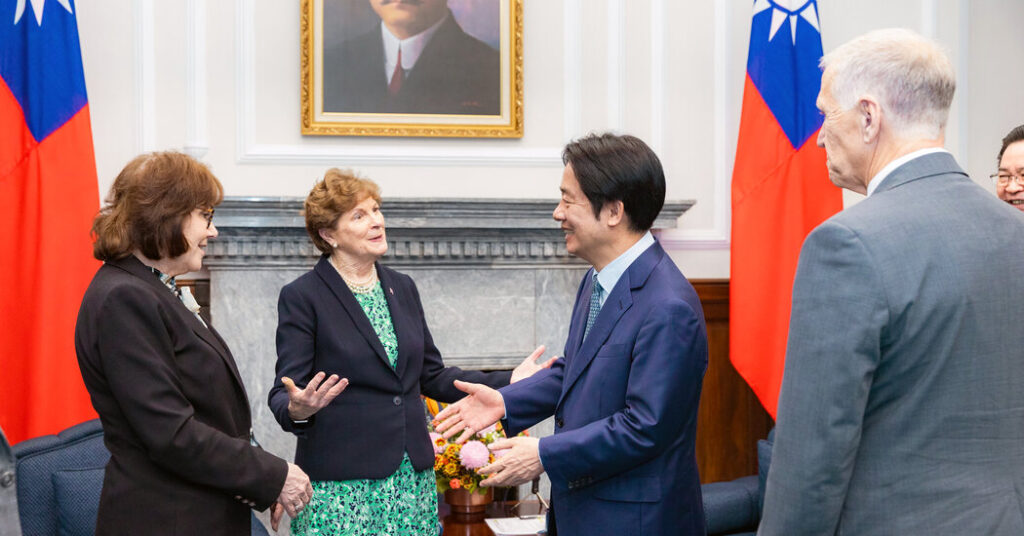
For the last few months, a plan by President Lai Ching-te of Taiwan to increase military spending by $40 billion over eight years has been held up by his political rivals. This week, a bipartisan group of U.S. senators used a visit to Taiwan to throw their support behind the plan, which is seen as a building block for easing concerns in Washington about Taiwan’s commitment to its own defense.
The two Republican and two Democratic members of the Senate Foreign Relations Committee also tried to demonstrate U.S. commitment to the island at a time when the Trump administration has made negotiations with Beijing a priority.
Even so, the senators heard concerns from Taiwan about delays in deliveries of U.S. weapons already purchased. And China, which claims Taiwan as its territory and has urged President Trump to curb arms sales to Taiwan, protested the visit.
Why Taiwan’s $40 Billion Defense Plan is Stuck
At least two of the senators publicly urged Taiwanese lawmakers to approve President Lai’s spending proposal, and Senator John Curtis, a Republican from Utah, said that the issue was being watched closely in Washington.
President Lai’s proposal, which he put forward after pressure from the Trump administration on Taiwan to spend more on its own defense, has been bogged down in the legislature, where opposition parties have a majority.
Taiwan’s Nationalist Party, the main opposition, has criticized Mr. Lai’s proposal, saying it lacks transparency. They have also cited concerns about a backlog of undelivered arms orders from the United States.
On Monday, Deputy Defense Minister Hsu Szu-chien of Taiwan aired those concerns to the senators during a visit to a research institute that is developing drones. “There are still items that we have already paid for and are not yet delivered,” Mr. Hsu said in televised comments, explaining that he was relaying a message from a Taiwanese opposition lawmaker.
The Nationalist Party’s chairwoman, Cheng Li-wun, has proposed $12 billion in funding to pay for more weapons from the United States, with more purchases possible later.
The senators’ comments matter in Taiwan, where voters and many politicians are generally sensitive to views from Washington, and they could embolden some opposition politicians to back bigger increases in military spending.
How a Trump-Xi Summit Could Change the Stakes
President Trump is scheduled to meet China’s leader, Xi Jinping, in mid-May, prompting speculation about whether Mr. Trump could soften U.S. verbal support for Taiwan. Already, the Trump administration has delayed announcing a package of arms sales to Taiwan valued at billions of dollars to avoid upsetting Mr. Xi, according to U.S. officials. In a phone call last month, Mr. Xi warned Mr. Trump that arms sales to Taiwan should be carefully handled.
Some experts have said, for example, that Mr. Xi may try to coax Mr. Trump to say that the United States opposes independence for Taiwan. There are no signs that Taiwan wants to claim formal independence, and opposition from Washington to any such move would not be new. But such words would carry more weight if Mr. Trump uttered them in Beijing, and could magnify jitters in Taiwan about Mr. Trump’s commitment to the island.
China Warns of ‘Wrong Signals’ Sent by Visit
The visit by the senators was met with protest in Beijing, in line with the Chinese government’s long opposition to visits by foreign lawmakers to Taipei, which China views as an endorsement of the island’s push for international recognition.
Mao Ning, a Foreign Ministry spokeswoman, accused the United States of sending “wrong signals” to so-called separatist forces. That is Beijing’s term for the government of Mr. Lai’s party, which is skeptical of Beijing and asserts that Taiwan is in effect independent.
Chinese media cited Chinese scholars as saying the visit was nothing more than a political show by the governing party of Taiwan to pressure the opposition.
China has also sought to show that it has influence in Taiwan’s political landscape. The Senate delegation’s visit to Taiwan coincided with an announcement on Monday from Ms. Cheng of the Nationalist Party that she will visit China next week, possibly for a meeting with Mr. Xi.
Chris Buckley, the chief China correspondent for The Times, reports on China and Taiwan from Taipei, focused on politics, social change and security and military issues.
The post U.S. Senators Press Taiwan to Raise Military Spending as China Protests appeared first on New York Times.