When a fire broke out this month in a shopping center a few minutes’ walk from the Kremlin, one of Russia’s scrappy Telegram news channels sent a reporter to the scene.
There was one problem. Mobile data was completely down in the center of Moscow, and Telegram, the most popular app in the country, was being throttled.
“It was like 1997,” said Sergei Titov, the editor of the channel, Ostorozhno Novosti, who recounted how the reporter, unable to send photos or videos, called the outlet’s landline to narrate — “three fire engines, two ambulances, many people running.”
The dayslong outage in the most important part of Moscow crystallized fears that President Vladimir V. Putin would go further than Russians imagined to cut them off from the world and interrupt their lives as he brings the nation’s internet fully under Kremlin control.
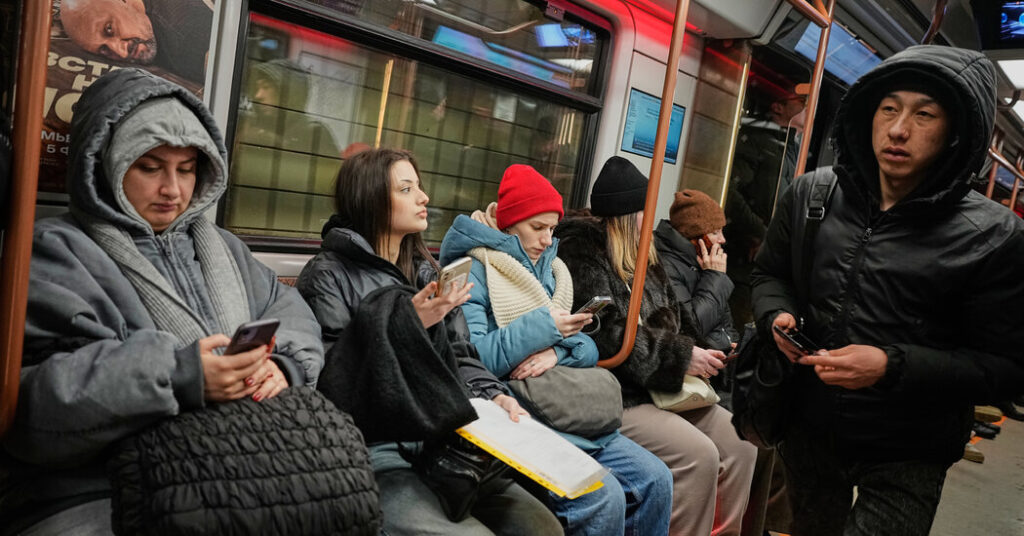
Russians in recent weeks have faced two disruptions at once. The authorities, armed with new technical capabilities and wartime pretexts, have been pulling the plug on the mobile internet in certain places. They have also been blocking ever more foreign apps used by millions of Russians.
The government has cited security reasons for the internet outages, calling them precautions against Ukrainian drone attacks that use Russian mobile networks for targeting. But experts say the government is also conducting the sort of targeted blackouts that it would impose in the event of unrest, like the mass demonstrations that swept Iran this year.
Even bolder, in the eyes of many Russians, is Mr. Putin’s assault on Telegram. Having blocked Facebook, Instagram, WhatsApp and YouTube, the Russian leader is now moving to hobble an app that more than 100 million Russians use every month to communicate and read news, including from exiled outlets banned in Russia.
Moscow is pressuring Russians instead to use a new Kremlin-approved “super app” known as MAX. Russian media outlets have reported that Moscow plans to block Telegram fully starting on Wednesday, but signs have emerged that they could delay the move amid a public backlash.
Of all the examples of growing repression in Russia during four years of war in Ukraine, few have touched more people than the internet restrictions.
The on-again, off-again blackouts and blockages have caused havoc as the digital services that power everyday life have flickered in and out, forcing people into a frustrating hunt for workarounds.
When the mobile internet went out in parts of Moscow, people started paying in cash. With taxi apps rendered useless, some hitched rides in passing cars. Sales of walkie-talkies, analog telephone lines, paper maps and old-school MP3 players spiked online. Even in the halls of the Kremlin, officials returned to using landlines.
Some of the impacts have been perilous. During outages, glucose-monitoring devices worn by children with diabetes, for instance, haven’t been able to transmit real-time updates that parents need to adjust the insulin levels.
Amid all the disruption, signs of public anger have bubbled up, with efforts in some cities to hold protests over the internet outages and app throttling, though they have been blocked by the authorities. To keep apps like Telegram working, millions of Russians have turned to virtual private networks, or VPNs, to circumvent the restrictions.
Mr. Titov, the editor of Ostorozhno Novosti, which is owned by the Russian socialite and former presidential candidate Ksenia Sobchak, underscored that Telegram was not simply a “social network” but the foundation of what remained of the unfettered Russian internet.
“Telegram for Russians, at least of my generation, those who started using it at, say, 20 years old, is their entire internet life,” Mr. Titov said. In that sense, he said, “the entire internet system that people are used to is being destroyed right now.”
Disappearing Freedom
For decades, Russians enjoyed a largely free and decentralized internet. A vibrant digital culture took root, with Russians expressing themselves openly, organizing politically and regularly using Western tech platforms.
After mass protests against Mr. Putin swept Moscow in 2011 and 2012, the Kremlin began to see the freewheeling Russian internet as a serious threat. Frustrated by the power of U.S. tech giants, Mr. Putin set out to build a “sovereign internet”— a hived-off online world he could control.
Perhaps no one represented the threat for the Kremlin more than the anti-corruption campaigner Aleksei A. Navalny, who rose to prominence as a LiveJournal blogger calling out state corruption. With videos garnering millions of views, he showed how viral online content could lead to real-world protests.
Led by Roskomnadzor, the Russian communications regulator, the Russian authorities blocked his website and pressured Western tech giants to remove his protest-voting app and video ads.
Then, after Mr. Putin launched his full-scale invasion of Ukraine in 2022, the Kremlin began curtailing Russian internet freedom with much bolder, more disruptive actions.
Moscow swiftly banned Twitter, Instagram and Facebook outright, and eventually turned its attention to suffocating YouTube, long one of Russia’s most heavily used sites, as well as WhatsApp. VPN use soared.
Amid the state onslaught, Telegram remained a relatively open space.
Armed with its own network of Telegram channels, the Kremlin relied on the app to spread its messages of propaganda about the war, and soldiers used the app to stay in touch with their families and raise money for their units. At the same time, Russians could read unfiltered news and commentary by even the fiercest government critics.
One of them was the Russian mercenary boss Yevgeny V. Prigozhin, who posted unvarnished and expletive-laden videos on Telegram from the front. He developed a cult following among discontented soldiers that exploded into a failed coup in 2023, underscoring to the Kremlin how Telegram posts could fuel a real threat.
‘Enemy Form of Communication’
More than two years later, Roskomnadzor announced that it was throttling Telegram, saying in February that the app had violated Russian law by failing to protect personal data, combat fraud and prevent its use by terrorists and criminals.
Intermittent blockages of the service began. The New York Times tested access to Telegram in mid-March using 72 servers across Russia and found that only 39 were able to load the app’s browser version.
Conventional wisdom long held that because Russia’s internet began free, it would be impossible both technologically and politically for the Kremlin to put the genie back in the bottle.
Alena Epifanova, a Russia analyst at the German Council on Foreign Relations, said that while Russia was not able to replicate China’s “Great Firewall” approach, which closed off the Chinese internet from the start, it was quickly moving toward an Iranian model. That approach involves “white lists” of approved sites, targeted outages and an internal intranet under the government’s thumb, she said.
Many Russians, including supporters of Mr. Putin, view disabling Telegram as a bridge too far.
In an uncharacteristically blunt statement in late March, Vyacheslav Gladkov, the governor of the Belgorod region bordering Ukraine, called Telegram critical survival infrastructure used by residents for information like air raid alerts. He said the disruptions were leading to “needless deaths.”
In a flood of videos posted online, masked Russian soldiers hiding their identities said the messenger was critical to their operations on the front and asked the Kremlin to stand down.
The decision even led to a fleeting return of politics in Russia’s rubber-stamp Parliament.
Sergei M. Mironov, the leader of the party A Just Russia and a vocal supporter of the war, called Telegram the “only reliable means of communication” for the Russian military.
“Those who are shedding blood have no contact with their relatives and friends,” Mr. Mironov said. “What are you doing, you idiots?”
In a vote in Russia’s lower house of Parliament, 77 deputies, including those from Mr. Mironov’s party and the Communist bloc, voted to ask the Russian authorities to justify their decision. The measure failed, with 102 opposing it, but revealed rare divisions.
Mr. Putin, who has said that Moscow must “strangle” foreign tech firms to defend its sovereignty, has been largely silent on the matter.
In a March 5 meeting at the Kremlin, though, he pointedly asked a military officer whether using communication systems that “are not under our control” was dangerous for personnel.
The officer said it was and called Telegram an “enemy form of communication.” Russian journalists later found that the officer had a premium Telegram account.
Stifled Discontent
Telegram, which combines the functionality of Twitter and WhatsApp, was created by the Russian-born tech billionaire Pavel Durov, who now lives in the United Arab Emirates. Mr. Durov has denounced Moscow’s move as an affront to free speech and “a sad spectacle of a state afraid of its own people.” Russia has placed him under investigation.
Mr. Durov has yet to announce any countermoves but could make technical changes to Telegram that would help Russians access the app despite the blockages.
Attempts to organize protests have failed.
Permit requests for demonstrations against internet restrictions have been filed in 28 towns and cities across 17 Russian regions, according to Dmitri Kisiyev, a Russian political activist, but all were rejected. More than 20 people have been detained for protesting without permission, according to OVD-Info, a Russian legal aid group.
In Krasnodar, a city in Russia’s south, a local pro-war lawmaker, Alexander Safronov, received a permit for a 200-person protest, only to have it revoked, with city officials citing security concerns.
“Left-wing people, right-wing people — many disagree with what is happening with the blockages and the throttling,” he said in a telephone interview. “The state isn’t even trying to talk to citizens clearly or seriously and doesn’t explain anything to them.”
As millions of Russians find ways around the restrictions, the Kremlin may ultimately fall back on nontechnical methods to keep Russians away from foreign platforms.
The Russian authorities, for instance, could officially brand Telegram a “terrorist or extremist organization,” as they did with Meta. Anyone running a channel or paying for advertising on the app would risk prosecution.
The authorities could also step up efforts to curb VPN use or more aggressively enforce a new law that prohibits searching for or accessing “extremist” content.
Even as people express their anger and hope their workarounds last, many are resigned to a future under stricter state control.
Mr. Titov, the editor, predicted that his news outlet would not have the same success on the state-controlled app MAX, whose parent company, the social media giant VK, already censors critical comments and news. But he said he saw no way to roll everything back.
“It’s very easy to see dissatisfaction on the internet across all layers of society,” Mr. Titov said. “It just doesn’t go anywhere. Even among people who are for the war, there is a lot of criticism of the state, but everyone has sort of learned that you can’t do anything about it.”
Alina Lobzina, Nataliya Vasilyeva and Milana Mazaeva contributed reporting.
Paul Sonne is an international correspondent, focusing on Russia and the varied impacts of President Vladimir V. Putin’s domestic and foreign policies, with a focus on the war against Ukraine.
The post Putin’s Internet Blackout: A Chaotic Drive to Cut Off Russians From the World appeared first on New York Times.