In the decade since President Vladimir Putin of Russia directed a sweeping campaign of hacking and social media messaging to try to tilt the 2016 presidential election toward his preferred candidate, the United States has rightly focused on shoring up our elections against foreign meddling.
But I fear that foreign interference is no longer the most pressing danger to our elections. It is increasingly evident that the greatest threat now comes from inside our own government.
For months, President Trump has made his intentions clear. He has called for the federal government to “take over” elections, impose national rules and override state authority. Now we are beginning to see how he may plan to do this.
According to recent reporting in The Washington Post, allies of Mr. Trump’s working in coordination with people close to the White House have circulated a draft executive order that would declare a national emergency based on false claims of foreign interference in the 2020 election. That declaration would be used to unlock sweeping presidential powers over how Americans vote.
The proposal would allow the federal government to bar widely used voting methods, including mail ballots. It would force Americans to reregister to vote on short notice, requiring proof of citizenship. It would insert federal agencies into the voter verification process in novel ways. And it would attempt to override the constitutional role of states in administering elections.
And that is just what is envisioned by the draft executive order. Further steps could be justified, at least on paper, by invoking emergency powers. The president could also attempt to seize voting machines under the guise of a national security investigation. Federal agents could be deployed to polling places in the name of election integrity, intimidating voters rather than protecting them. Entire categories of lawful ballots could be seized or discarded based on unsubstantiated claims of interference.
There is no legitimate basis for such an emergency. That is not the point. The point is that the Trump administration could manufacture an impression of an emergency, creating a pretext for intervention.
There have already been some warning signs. In January, the director of national intelligence, Tulsi Gabbard, was present for a law enforcement raid in Fulton County, Ga., involving the seizure of ballots and voting machine records from 2020. According to Ms. Gabbard’s testimony before the Senate Intelligence Committee, she was there at the direction of Mr. Trump. When the warrant affidavit supporting that raid was later unsealed, it revealed no credible foreign interference concern. Instead, the would-be justification for the warrant was a slop of debunked conspiracy theories that had already been rejected repeatedly by courts, independent investigators and Georgia’s Republican secretary of state.
Ms. Gabbard’s appearance at this raid — as well as her involvement in seizing voting machines from Puerto Rico, again without any tie to foreign intelligence — was an extraordinary breach of the longstanding firewall between intelligence authorities and domestic political and law enforcement activity. One wonders what else she might be willing to do in service of Mr. Trump’s demands: Might she or another Trump official be willing to manufacture a claim of foreign interference in order to justify federal intervention in elections?
It is worth noting that people who played central roles in efforts to overturn the 2020 election are now operating inside the federal government with access to sensitive election security information and the ability to influence law enforcement actions. One example is Kurt Olsen, the White House’s director of election security and integrity. According to court filings, Mr. Olsen helped trigger the seizure of ballots in Georgia.
To intervene in the midterms at the federal level, Ms. Gabbard would not even need to fabricate intelligence outright. She could selectively release fragments of existing intelligence collection, stripping out caveats and context in ways that create a distorted impression of a threat.
This is not how American democracy is supposed to work. Our voting system is deliberately decentralized. States and localities administer elections, creating a structure that is more resilient and less vulnerable to manipulation from any single point of control. While the federal government can provide resources to help ensure the security of our elections, the Constitution does not give the president the authority to disregard that system.
What we are seeing now is an effort to change that, not through a constitutional amendment but through the abuse of executive power, the making of false claims and the misuse of national security authorities. That effort must be stopped.
First, Congress must assert its constitutional role. That means rejecting efforts to nationalize election administration and conducting rigorous oversight of how federal authorities are being used or misused.
State and local officials must also hold the line. They are the stewards of our election system, and their adherence to the law is one of our strongest defenses against interference.
Republicans who believe in the Constitution have a particular obligation to speak out. The principle that voters, not politicians, decide elections should not be partisan. Silence in this moment will not be forgotten.
Lawyers across the country must be prepared to challenge any attempt to invoke emergency powers to interfere with elections. The courts will once again serve as a critical backstop — but only if cases are brought quickly and decisively.
Former intelligence and law enforcement officials also have a responsibility to speak out. If they see intelligence being distorted, misused or politicized, they must say so clearly and publicly.
Political observers must meet this moment with clarity. Claims about election interference or fraud from this administration must be evaluated with appropriate skepticism and subjected to rigorous scrutiny, not treated as just another political argument in which both sides are granted equal legitimacy.
Most of all, the American people must remain vigilant. Democracies rarely fail in a single moment. They are tested when the boundaries between lawful authority and political power are deliberately blurred. The idea that a president could fabricate an emergency to take control of elections would have been unthinkable not long ago. It must remain unacceptable now.
Mark R. Warner, a Democrat from Virginia, is the vice chairman of the Senate Intelligence Committee.
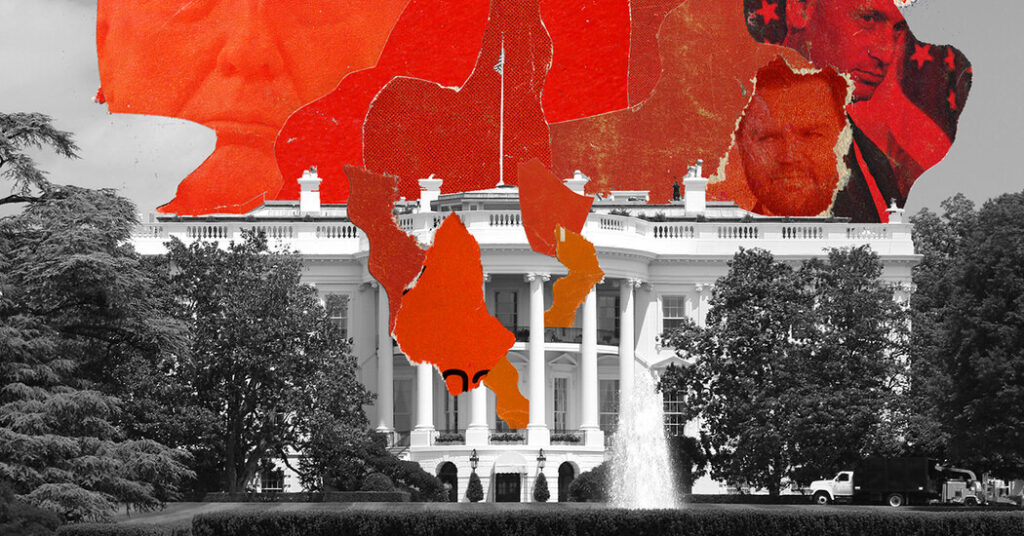
Photo illustration by Anthony Gerace; source photographs by Andrew Harnik, Jim Watson, Saul Loeb/Getty Images, Nathan Howard/Reuters.
The Times is committed to publishing a diversity of letters to the editor. We’d like to hear what you think about this or any of our articles. Here are some tips. And here’s our email: [email protected].
Follow the New York Times Opinion section on Facebook, Instagram, TikTok, Bluesky, WhatsApp and Threads.
The post The Greatest Threat to Our Elections Is No Longer Foreign appeared first on New York Times.