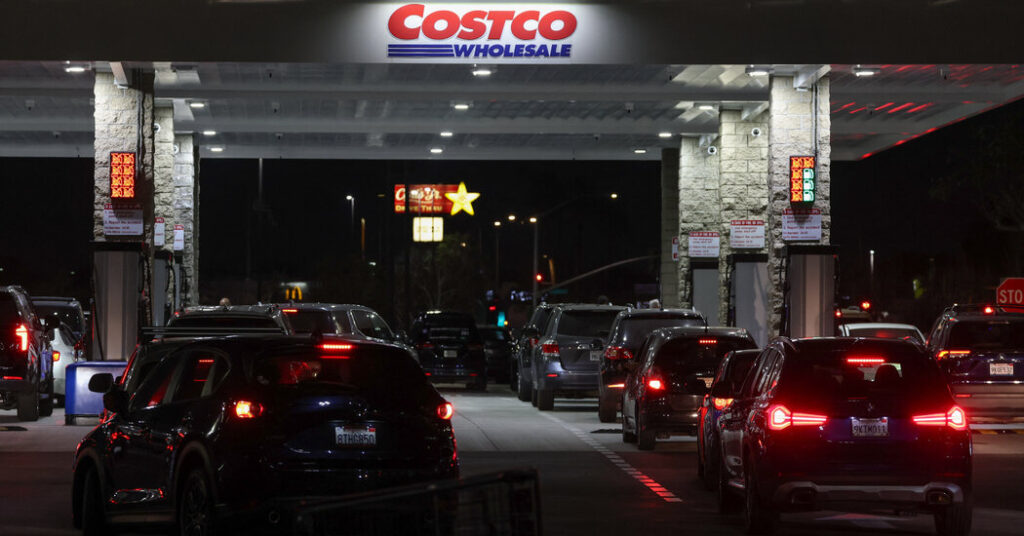
Gasoline in the United States crossed an average of $4 a gallon on Tuesday, a threshold it hadn’t reached since August 2022, continuing a series of nearly uninterrupted increases since the Middle East war began that are chipping away at the spending power of American consumers.
Since the end of February, the average cost of regular gasoline has jumped 35 percent, according to data from the AAA motor club.
Seeing gasoline at more than $4 a gallon — when it was below $3 a month ago — could push American drivers to change their spending habits.
“We have this obsession with gas prices because they dictate a lot of ‘Can we drive? Can we do things we enjoy?’ And now some of that is at risk,” said Patrick De Haan, an analyst at GasBuddy, which also tracks fuel prices.
“As we get to a month of increases and prices are much higher,” he added, “the amount of pressure on Americans’ budgets and their spending is going to ramp up.”
For President Trump, who not long ago was boasting about how prices had fallen since he was re-elected in 2024, the highly visible reminder of the war’s consequences is a political burden.
“It is the biggest headache for whoever happens to be in power when something like this happens,” said Kate Gordon, a former senior adviser in the Department of Energy who is now chief executive of California Forward, a nonprofit business group.
Presidents have little control over gas prices, she added, but this is an unusual circumstance.
“Usually, a hurricane hits the gulf and gas prices go up, and then whoever’s in power gets blamed for it,” Ms. Gordon said, referring to the Gulf of Mexico. Mr. Trump is “going to get blamed anyway because he’s in power, but also he made the decision to go to war in Iran.”
Although the United States isn’t dependent on oil exports from the Middle East — where attacks during the war have hit production and storage facilities — domestic prices have nevertheless surged because of how interconnected global energy markets are. Gas last eclipsed $4 a gallon after Russia invaded Ukraine in 2022.
There are also variations in how much drivers have to pay across the country because of state taxes, distribution costs and refining margins. The average cost for a gallon of regular gasoline in California, the highest in the nation, was $5.89 on Tuesday. In Kansas and Oklahoma, the lowest, drivers paid an average of $3.26.
Gasoline usually tracks the price of oil. Though oil has fallen from its highest point during the crisis, domestic crude futures are still up more than 50 percent since the end of February.
In countries that are more dependent on oil from the Middle East, in Asia in particular, governments are already taking measures to reduce consumption — including asking drivers to stay off the roads.
And prices usually rise at this time of year for other reasons: Stations begin to sell a more expensive summer-blend gas made for warmer weather, and demand rises as people prepare for spring and summer travel. The Trump administration said last week that it would temporarily suspend certain restrictions on summertime gasoline blends to try to alleviate pressure from high fuel costs.
Other fuel prices are also rising. Diesel prices stood at $5.42 a gallon on Tuesday, up from $3.76 a gallon before the war — an increase that will directly affect the cost of shipping nearly everything, from groceries to furniture.
Ultimately, economists fear that these rising costs will contribute to faster inflation and a slower economy. The longer the war lasts, the greater the potential damage.
Mr. Trump has sought to reassure Americans, saying the crisis is temporary, but he has also described the run-up in fuel costs as a small price to pay for his war aims.
More than 50 percent of American respondents said in a poll by Reuters/Ipsos, released on March 20, that their household finances had taken at least “somewhat” of a hit from the increases in gas prices. One in five of those seeing an impact said his or her finances were affected “a great deal.”
“There are some things you can change on the margins, but it’s not easy to change where you live, where you work, where you go to school,” Ms. Gordon said. “You can be more efficient, but it’s kind of a baked-in cost.”
The administration has taken some measures to try to curb the gains in oil prices — pledging to release 172 million barrels of oil from the United States’ strategic reserves; waiving a maritime law that restricts how cargo, including oil, can be transported throughout the country; and temporarily suspending sanctions on Russian and Iranian oil shipments already at sea.
Experts say the price of oil — and the price of gasoline — won’t meaningfully drop until supplies can again flow freely out of the Persian Gulf through the Strait of Hormuz.
Opening the strait “is the answer until it’s not,” Ms. Gordon said. “It’s the answer until someone attacks it again.”
Emmett Lindner is a business reporter for The Times.
The post Average Gasoline Price Hits $4 in U.S., a ‘Headache’ for Drivers and Trump appeared first on New York Times.