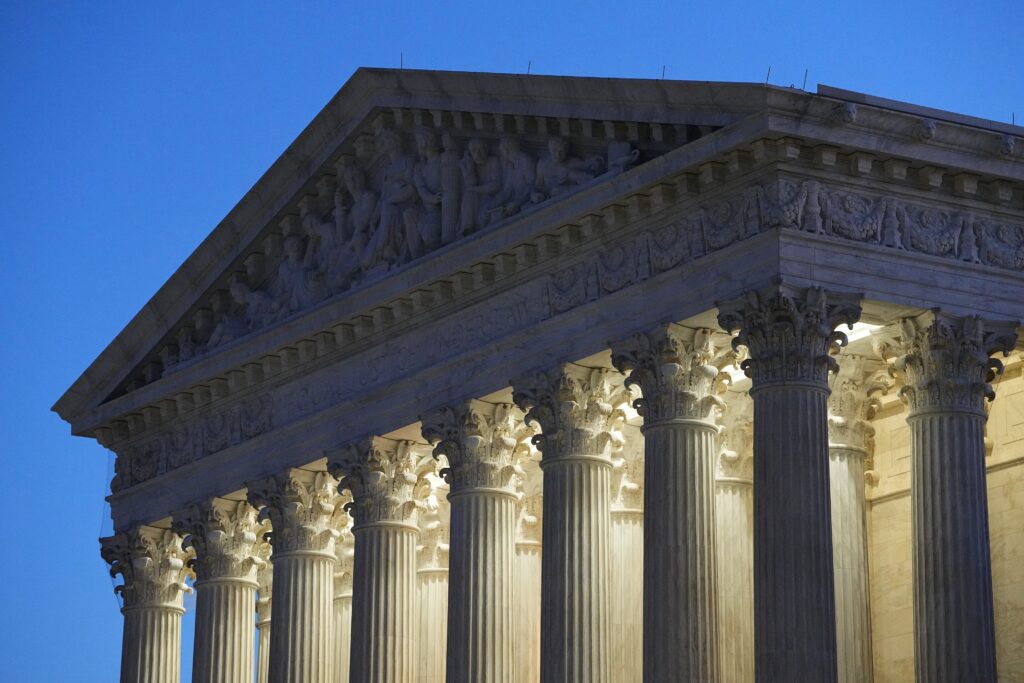
Donald Trump’s executive order claiming to deny citizenship to children of immigrants in the United States temporarily or unlawfully has been uniformly blocked by lower courts, and on Wednesday the Supreme Court will hear arguments on both sides. The administration’s chances of a win in Trump v. Barbara are extremely low, but one question is whether the justices opt for a sweeping constitutional ruling or a narrower one that gives Congress room to legislate on the subject.
The 14th Amendment to the U.S. Constitution, ratified after the Civil War to affirm the citizenship of Black Americans, says: “All persons born or naturalized in the United States, and subject to the jurisdiction thereof, are citizens of the United States.” That excluded the children of foreign diplomats, wartime conquerors, and members of Indian tribes — but would seem to include pretty much everyone else.
The Trump administration nonetheless claims the citizenship clause doesn’t cover the children of certain noncitizen immigrants. The problem — and it’s a big one for a textualist court — is that the text doesn’t naturally include that exception. The Trump administration has no reservations about charging unlawful immigrants with crimes, which is a key way the government exercises jurisdiction over people.
To overcome that intuitive reading of the 14th Amendment, the administration and its supporters excavate historical evidence to argue that the language had a narrower meaning in the past. Under the British monarchy, for example, the descendants of people subject to a foreign sovereign were not necessarily subjects of Britain. Did that principle transfer to the American colonies and 19th-century understanding? If so, then the 14th Amendment’s “subject to the jurisdiction” clause might allow for more limitations than the current practice.
But revising settled practice requires a high burden of proof. This case echoes Trump v. Anderson, the 2024 dispute about whether states could throw Trump off the presidential ballot based on another historically contested part of the 14th Amendment. The challengers mustered some intriguing evidence to support their view, but it was too fragmented and ambiguous to support a radical break from the status quo.
One option for the justices is to leave the constitutional debate for another day. That’s because — as an amicus brief from 217 members of Congress points out — the Immigration and Nationality Act of 1952 probably codified birthright citizenship independently of the 14th Amendment. It uses the same “subject to the jurisdiction” language as the 14th Amendment, and legislative debates in the 20th century strongly imply that members of Congress took birthright citizenship for granted.
Even if the history around the 14th Amendment is too ambiguous for a firm constitutional holding, in other words, the justices could decide that Congress has written birthright citizenship into the country’s immigration laws more recently. The president can’t override immigration law with an executive order.
There are reasonable policy critiques of birthright citizenship in its current form, including that it incentivizes illegal immigration. That’s why most European countries are more restrictive. Even the current Republican-controlled Congress probably wouldn’t curtail birthright citizenship, which is why Trump tried a unilateral workaround. But a future Congress might want to try its hand at tightening of citizenship policy. That would be a better occasion for the Supreme Court to settle the constitutional meaning.
The post The Supreme Court’s birthright citizenship options appeared first on Washington Post.