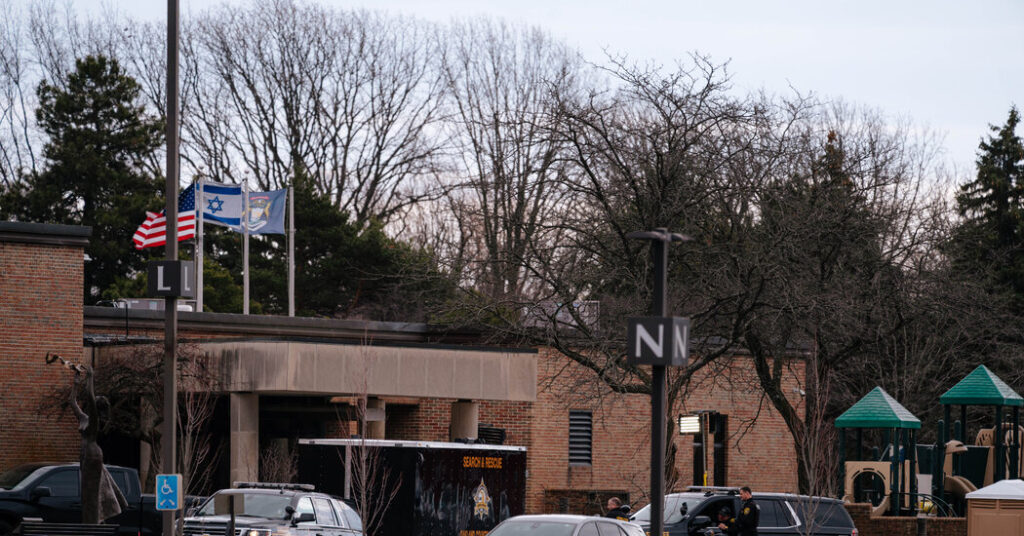
The man who rammed his truck into a Michigan synagogue and killed himself during a firefight with security guards this month was “motivated and inspired by Hezbollah’s militant ideology,” federal officials said on Monday.
The attack was “purposely targeting the Jewish community and the largest Jewish temple in Michigan,” Jennifer Runyan, the special agent in charge of the F.B.I. office in Detroit, said at a news conference. Officials described the attack as a clear indication of rising antisemitism.
The attacker, identified by federal officials as Ayman Mohamad Ghazali, a 41-year-old naturalized United States citizen born in Lebanon, sat in his vehicle outside of the synagogue, Temple Israel in West Bloomfield Township, for about two hours before driving into the building.
During that time, Special Agent Runyan said, the attacker sent 19 messages, including videos and photos, to his sister, who they believe was in Lebanon. The messages expressed his intent to commit a terrorist attack, she said, and included references to martyrdom and descriptions of his plan to target what he appeared to consider the largest gathering of Jews in Michigan.
Those messages “affirmed” the attacker’s Hezbollah-inspired ideology, Special Agent Runyan said. Hezbollah, an Iranian-supported militant group in Lebanon, has been designated by the United States as a terror organization, but it is also an established political party in Lebanon with support particularly among Shiite Lebanese.
Officials have said that several days before the attack, four of Mr. Ghazali’s relatives were killed in an Israeli airstrike in Lebanon as part of the U.S.-Israeli war in the Middle East. Israel has said that one of the relatives, a brother, was a Hezbollah commander.
Special Agent Runyan said that the F.B.I. had not been able to determine whether the attacker was a member of Hezbollah, adding that he had never been the subject of an F.B.I. investigation.
Jerome F. Gorgon Jr., the U.S. attorney in Detroit, said that the terrorism designation did not depend on whether the attacker was in direct communication with Hezbollah.
“Terrorist propaganda is designed to activate the so-called lone wolf to act on behalf of the terrorist organization,” he said, adding that it did not make any legal difference whether or not the attacker had received instructions from Hezbollah’s leadership.
The vehicle the attacker used was found to be loaded with fireworks. One guard was injured in the attack. Roughly 140 children and staff members at the temple’s preschool were safely evacuated.
The attacker lived in Dearborn Heights, Mich., which is home to a large Muslim community about 20 minutes from the synagogue in West Bloomfield Township. Both towns are suburbs of Detroit.
He had worked the front counter of a Lebanese restaurant in Dearborn Heights, Mich. His attack prompted anxiety for members of the area’s large Arab community, many of whom said they worried they would face new scrutiny.
In the days before driving his vehicle into the synagogue, the attacker searched online for nearby places where Jewish people gathered and then tried to delete his search history, according to Special Agent Runyan. He posted pro-Hezbollah content on social media, she said, along with calls for vengeance.
The attacker’s relatives who were killed in the Israeli airstrike on March 5 were his brother, Ibrahim, and his two children, as well as another brother, Qassem, according to a Lebanese official and a Muslim leader in Michigan.
This month, Israel said that after an intelligence analysis it had confirmed the death of Ibrahim Mohamad Ghazali and his role in Hezbollah but provided no details about how it had verified the information. It did not link the attacker in Michigan to Hezbollah.
In the days after the Michigan attack, a Hezbollah official, speaking on condition of anonymity to talk to the media, denied that Ibrahim or his family were affiliated with the group. Officials on Monday did not discuss whether the attacker’s family members were affiliated with Hezbollah.
Jacey Fortin covers a wide range of subjects for The Times, including extreme weather, court cases and state politics across the country.
The post Michigan Synagogue Attack Was ‘Inspired by Hezbollah,’ Officials Say appeared first on New York Times.