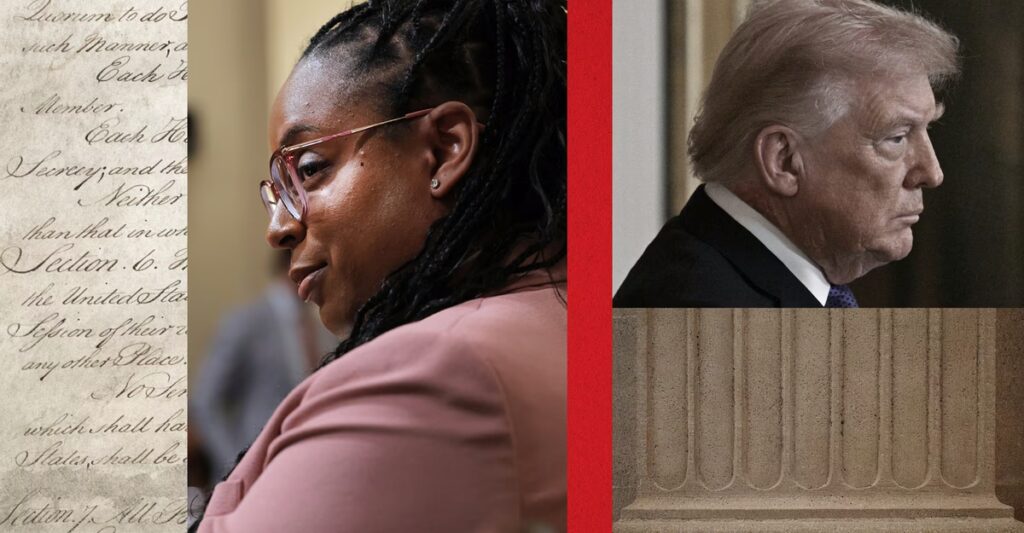
The Trump administration has made a habit of pressing criminal charges against Americans observing and protesting harsh immigration-enforcement tactics, using the power of the executive branch to intimidate and punish those who visibly dissent from the president’s political agenda. In many ways, the prosecution of LaMonica McIver is in line with this general approach. Last May, she was charged with “assaulting, resisting, or impeding” federal officials after ICE agents tangled with her outside a Newark, New Jersey, immigration detention center, at one point violently pushing her. But an important factor makes McIver’s case unique: She is a member of Congress.
McIver’s case reflects both President Trump’s aggressive tactics on immigration and the broader dynamics between Trump and Congress: a vindictive executive and a struggling legislative branch yet to find its footing in a legal system tilted in favor of presidential power. Trump has ignored congressional budgetary outlays, attempted to shut entire congressionally mandated agencies, and treated House and Senate hearings with contempt. But the McIver case represents his most sustained attack on an individual lawmaker. Earlier today, McIver filed her first brief before an appeals court, asking the judges to throw out her prosecution as an illegal infringement on the protections afforded to Congress under the speech-or-debate clause of the Constitution.
McIver has rejected the prosecution as “dangerous, baseless, and designed to stop me from doing my job.” She has every reason to understand the charges as an effort to scare Congress out of conducting oversight. But that may not be enough to protect her.
[Quinta Jurecic: The Trump administration’s favorite tool for criminalizing dissent]
The case against McIver turns on a scuffle that took place in the parking lot of Delaney Hall, an immigration detention center in McIver’s congressional district. On May 9, 2025, she and two other Democratic representatives from New Jersey, Bonnie Watson Coleman and Rob Menendez, came to tour the facility. While the three lawmakers were waiting outside the building, Newark Mayor Ras Baraka arrived, and a scrum developed when ICE agents attempted to arrest Baraka for trespassing. Security and body-camera footage from that day shows McIver and the other representatives gathering around Baraka to shield him from the ICE agents. As the agents pull Baraka inside the gate of Delaney Hall, one agent shoves McIver, who then tries to keep moving forward.
Trump’s power over the Justice Department shadowed the incident from the beginning. Body-camera footage shows an ICE agent announcing the plan to arrest the mayor “per the deputy attorney general of the United States,” an unusual and disturbing level of direct involvement for a high-level official. The U.S. Attorney’s Office for the District of New Jersey, under the leadership of Trump’s former personal lawyer Alina Habba, filed charges against Baraka for stepping onto land owned by a private prison—only to dismiss them shortly afterward. Habba then unveiled a new case against McIver under a criminal statute that forbids “assaulting, resisting, or impeding” federal officers. McIver had “slammed her forearm into” and used “her forearms to forcibly strike” ICE agents, the indictment alleged. Speaking to reporters in the Oval Office, Trump described her as “out of control” and declared, “The days of woke are over.”
McIver promised to fight the charges. “At the end of the day, this is all about political intimidation,” she told a crowd of supporters outside the courthouse after entering a plea of not guilty.
Other members of Congress targeted for prosecution by the Trump administration have managed to get their cases thrown out early on, thanks to irregularities or incompetence on the Justice Department’s part. One investigation, of Senator Adam Schiff, reportedly petered out after prosecutors could not find any evidence of the supposed mortgage fraud that Trump allies had alleged. Another—focused on six lawmakers who released a video encouraging members of the armed services to disobey illegal orders—failed when a grand jury unanimously rejected DOJ’s effort to bring charges. McIver has had less success. District Judge Jamel K. Semper, a Biden appointee, rejected her arguments both that the Trump administration had unfairly targeted her in what is known as a “vindictive or selective” prosecution, and that constitutional protections for lawmakers shield her from the charges. McIver’s brief filed today is her first crack at convincing the appeals court, which will likely hold oral arguments on her case this summer.
The appeals court will probably be most interested in McIver’s reasoning concerning the speech-or-debate clause, which creates a level of legislative immunity to shield members of Congress from legal consequences for their work as lawmakers. In McIver’s argument, because she arrived at Delaney Hall to conduct oversight of ICE, this immunity should extend to her interactions with the agents in the parking-lot scuffle.
The ideal of speech-or-debate immunity derives from high-minded concerns by the Founders over the separation of powers. The “fundamental purpose” of the speech-or-debate clause, the Supreme Court wrote in 1972, is “freeing the legislator from executive and judicial oversight that realistically threatens to control his conduct as a legislator.”
Framed this way, McIver’s case seems like a near-perfect example of what legislative immunity is meant to defend against: political pressure by an executive seeking to dissuade members of Congress from carrying out oversight that the administration dislikes. Stan Brand, who served as general counsel to the House of Representatives from 1976 to 1983, described the litigation to me as part of an American “heritage” of a sort, a continuation of a long-running “battle between an overreaching executive and Congress.” Along these lines, McIver’s lawyers have emphasized that her presence at Delaney Hall was in service of her responsibilities as a member of Congress. The facility is in her district; she sits on the House Homeland Security Committee, which is tasked with oversight of ICE; and the three lawmakers were armed with a statutory provision, passed in 2020, that requires DHS to allow members of Congress access to ICE facilities for inspection. Her tangle with ICE, in this view, was in response to the agents’ obstruction of her protected legislative work.
But this argument is not as firmly grounded in the law as McIver and her allies might hope. In declining to dismiss McIver’s case, Judge Semper ruled that McIver’s conduct should be understood more granularly. From this standpoint, her legislative aims in inspecting Delaney Hall are unrelated to her intervention in Baraka’s arrest. Some of this disagreement derives from different interpretations of the chaotic body-camera footage from May 9: After the ICE agent standing at the gate pushed McIver, did she move back toward the gate in an effort to get onto the facility’s grounds (as McIver argues), or to obstruct the agent from reaching Baraka (as the government argues)?
Beyond the frame-by-frame analysis is a broader issue. McIver’s case is unusual, without much precedent to guide it. The speech-or-debate clause “is kind of obscure,” Brand told me. “It’s not in the forefront the way a lot of constitutional issues are”—in part because the Justice Department has typically held back from prosecuting members of Congress in anything but the most serious and well-substantiated cases.
Brand seemed optimistic about McIver’s chances of succeeding on appeal, and suggested that her legal team could even take the case to the Supreme Court if the U.S. Court of Appeals for the Third Circuit rules against her. But other congressional experts I spoke with were more cautious. Courts have generally read legislative immunity rather narrowly, constraining its scope to the core of the legislative process. “I tend to doubt” that the speech-or-debate clause will protect McIver, Michael Stern, who formerly served as senior counsel to the House, told me.
That said, McIver’s appeal presents risks for the executive branch too. I spoke with John Keller, who resigned last year from his role as the acting chief of the Justice Department’s Public Integrity Section, which historically had to sign off on any DOJ investigation into a member of Congress. But the Justice Department scrapped that consultation requirement only a week before McIver was charged; according to Reuters, DOJ did not bother to seek approval from the Public Integrity Section in McIver’s case. Because there is so little jurisprudence on the speech-or-debate clause, Keller said, this is “a sensitive area where single cases could have outsized impact in terms of precedent.” He noted that an appellate ruling siding with McIver might “dramatically expand” the scope of legislative immunity in a way that could limit DOJ’s ability to prosecute serious corruption cases in the future. For that reason, Keller told me, the Public Integrity Section would, in the past, have wanted to closely scrutinize the facts and circumstances of a case like McIver’s before signing off on whether to prosecute.
Yet the Trump administration has shown itself to be uninterested in thinking that far ahead. The concern is not for the long-term interests of the executive branch, but for whatever instant gratification might be secured by harassing the president’s enemies. That spite and shortsightedness unbalances the constitutional dynamics between the president and Congress. And the speech-or-debate clause, as shaped by courts inclined to grant the benefit of the doubt to the executive, may—ironically, given the clause’s origins—be poorly suited to these extremes.
[David A. Graham: Trump’s newest crackdown on dissent]
This captures a paradox many Democratic members of Congress surely know all too well: Squaring off against a vindictive president, lawmakers are uniquely empowered and protected, but at the same time—because of their prominence—uniquely vulnerable. Congressional ethics restrictions prohibit McIver from accepting pro bono legal help and place limits on her ability to fundraise for her own defense. A recent profile in The New Yorker reported that, as of December, her legal expenses had risen to close to $1 million—money that will have to come out of her reelection campaign. Other Democratic members of Congress, spooked by McIver’s prosecution, have taken out liability insurance.
A loss on the speech-or-debate question would not be the end of McIver’s case. The charges against her are feeble, and a jury in blue New Jersey might be disinclined to convict. Still, even if she is acquitted, the Trump administration has gotten its message across—not through the consequences of a guilty verdict, but by the infliction of pain along the way.
The post Does the Constitution Protect This Congresswoman From Trump? appeared first on The Atlantic.