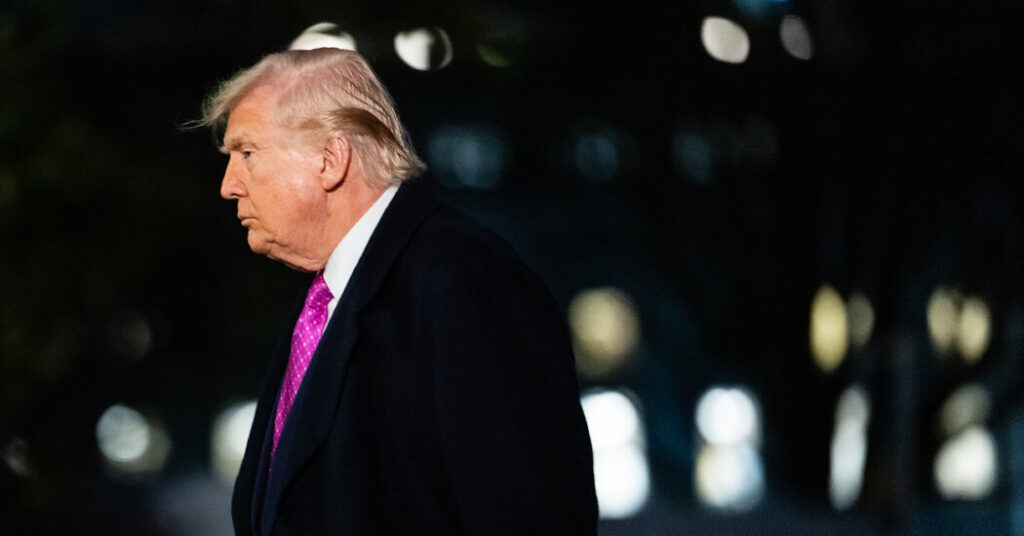
President Trump on Monday threatened a major escalation in the war in Iran, vowing to destroy Iranian oil facilities and other vital infrastructure if negotiations with Tehran — which he said had seen “great progress” — failed to produce a deal or reopen the Strait of Hormuz.
Mr. Trump’s stark warning, which was made in an early morning social media post, was among a dizzying flurry of zigzagging messages on the war and came as commodity traders further bid up the price of oil, which briefly touched $116 a barrel early Monday.
In the span of a dozen hours, as Mr. Trump returned to the White House from his weekend in Florida, the president argued that “regime change” in Iran had already been achieved through the killing of scores of Iranian top officials. At the same time, he raised the prospect of seizing Kharg Island, home to the largest Iranian oil facility, as thousands more U.S. troops continued to arrive in the Middle East, including Marines and Special Operations forces.
Mr. Trump claimed that Iran had agreed to allow 20 more oil tankers to pass through the Strait of Hormuz, the vital route for oil, gas and fertilizer shipments that Tehran has closed to most traffic. By Monday afternoon, two Chinese-owned container ships bound for Malaysia had passed the strait, but there were no reports of oil tankers going through.
In the same message that threatened mass destruction of Iranian infrastructure, the president also claimed that his administration was in “serious discussions with A NEW, AND MORE REASONABLE, REGIME.”
“Great progress has been made but, if for any reason a deal is not shortly reached, which it probably will be, and if the Hormuz Strait is not immediately ‘Open for Business,’ we will conclude our lovely ‘stay’ in Iran by blowing up and completely obliterating all of their Electric Generating Plants, Oil Wells and Kharg Island (and possibly all desalinization plants!), which we have purposefully not yet ‘touched,’” the president wrote in the post on Truth Social.
Even though the president said that great progress had been achieved in the negotiations to end the war, Iran continued to claim that no direct negotiations were taking place.
At a news conference on Monday, the spokesman for Iran’s Foreign Ministry, Esmail Baghaei, commented on the 15-point plan that American mediators have sent to Iran through Pakistani mediators. The plans has “excessive, unrealistic and unreasonable demands,” Mr. Baghaei said.
He described a meeting of foreign ministers of Pakistan, Egypt, Saudi Arabia and Turkey in Islamabad on Sunday to discuss efforts to end the war as “commendable.” But he stressed that Iran had not been involved.
Iran also appeared to reinforce its intention to selectively block the Strait of Hormuz. An Iranian parliamentary committee approved a plan to impose tolls on ships crossing the strait and banned transit by American and Israeli ships, according to Fars, Iran’s semiofficial news agency. It was unclear how the decision, which would require further approval by the full Parliament before entering into force, squared with Mr. Trump’s claims that Iran was allowing 20 ships through the strait.
Iran continued to exhibit offensive military capabilities on Monday with missile and drone strikes across the region. An oil refinery in the northern Israeli city of Haifa was struck during an Iranian missile attack Monday morning, setting it ablaze.
Kuwait’s Electricity Ministry said an Iranian attack had struck a service building at a power and water distillation station, killing one worker. Kuwait’s National Guard also said it had shot down one drone and four unmanned aircraft. In Saudi Arabia, the Defense Ministry said it had intercepted five drones.
Iran confirmed the killing last week of Alireza Tangsiri, who commanded the naval forces of the Islamic Revolutionary Guards Corps, and separately issued a statement of defiance saying that “the American enemy has still not learned that Iran is system-based, not person-based.”
Mr. Trump’s comments on regime change in Iran came aboard Air Force One as he returned to Washington.
“We’ve had regime change,” he told reporters. “The one regime was decimated, destroyed, they’re all dead — the next regime is mostly dead,” he said. The president suggested that Iran had moved on to its “third regime,” and that American negotiators were speaking to “a whole different group of people,” who have “been very reasonable.”
His comments on Sunday appeared to be another sign of scaling back his objectives in the war. The Iranian leaders the United States was dealing with now, he said, are “different people than anybody’s dealt with before.”
“I would consider that regime change,” he said, adding, “You can’t do much better than that.”
In an interview published on Sunday in The Financial Times, Mr. Trump said the United States had “about 3,000 targets left” in Iran. He said 13,000 targets in the country had already been struck.
Fars has reported 20 universities and dormitories were among the targets attacked. Officials in Iran warned on Sunday of possible retaliation against U.S. universities in the region.
“We advise all staff, professors and students of American universities in the region, as well as residents in their surrounding areas, to keep a distance of at least one kilometer from these universities to ensure their safety,” said a statement published on Sunday by Tasnim, a semiofficial news outlet affiliated with the Revolutionary Guards.
Intentional attacks against educational institutions may be considered a war crime under international law.
Israeli and U.S. military spokesmen did not immediately respond to a request for comment on the university attacks. But on Monday, Israel claimed strikes on a university that it said was being used for military research.
Iran’s critical infrastructure is increasingly becoming a target in the war. Strikes on energy installations have plunged parts of the capital into darkness and enveloped it in toxic fumes. Other recent attacks hit a water reservoir in country’s southwest and a steel plant in central Isfahan, and set fire to parts of a petrochemical complex in northwestern Tabriz.
The Israeli military said it had also destroyed more than 100 high-rise buildings in the Beirut area of Lebanon since launching strikes there earlier this month. Israel said the buildings were used by Hezbollah, the Iranian-backed militia, as command-and-control centers for attacks against Israel.
Weeks of Israeli strikes in Beirut and its suburbs have caused extensive damage and killed large numbers of civilians, including children. More than 1,200 people in Lebanon have been killed since the war began, and more than a million others have been displaced, according to the Lebanese authorities.
Prime Minister Benjamin Netanyahu of Israel on Sunday said he had ordered his forces to increase the territory they control in southern Lebanon, adding to fears among many Lebanese of a long-term military occupation of the area.
A United Nations report on Monday said two of the organization’s peacekeepers were killed in southern Lebanon when their convoy was “struck by an explosion of undetermined origin.” On Sunday, an Indonesian peacekeeper was killed in a separate attack amid clashes between Israel and Hezbollah.
Reporting was contributed by Shirin Hakim, Jason Karaian, Johnatan Reiss, Euan Ward, Amelia Nierenberg, Jenny Gross, Yan Zhuang, Eric Schmitt and Helene Cooper.
Aaron Boxerman is a Times reporter covering Israel and Gaza. He is based in Jerusalem.
The post Trump Zigzags on Iran, Claiming ‘Great Progress’ but Making Threats appeared first on New York Times.