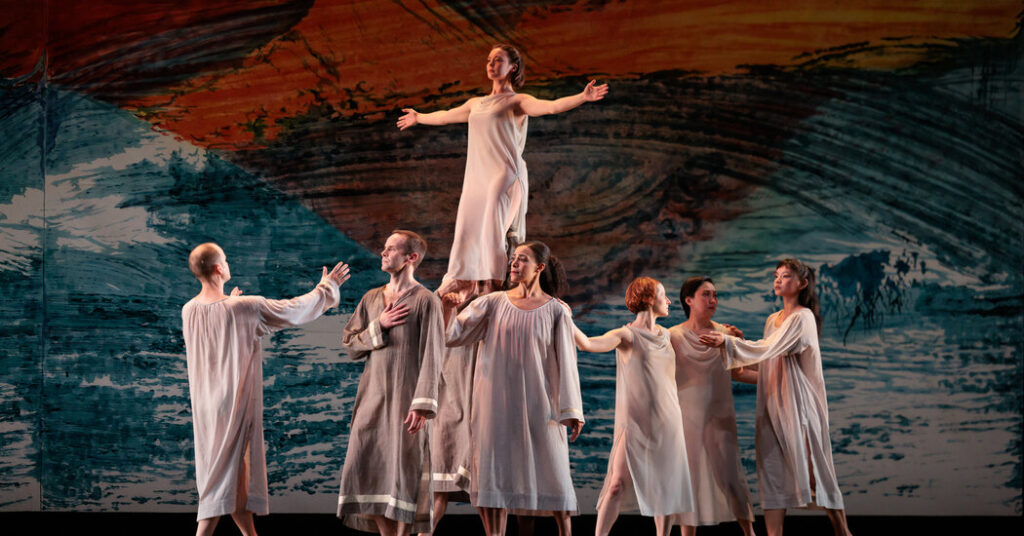
Mark Morris has always had a religious streak. Even when this long-established choreographer was an enfant terrible more than four decades ago, one way he rebelled was by making dances on unfashionable themes like the struggle for spiritual grace (“Gloria”) and the suffering of Mother Mary (“Stabat Mater”).
He’s still at it. Last weekend, just before Holy Week, the Mark Morris Dance Group presented the New York premiere of his “Via Dolorosa,” which is about the Stations of the Cross, the Good Friday path of Jesus from his condemnation through his crucifixion and burial. Like many of Morris’s best pieces, especially the religious ones, it is a work that seeks truth in plainness and uses simple means to devastating effect.
At the Brooklyn Academy, “Via Dolorosa” shared a program with “V,” a Morris classic from 2001, and alternated with a second program that featured the New York premiere of the much slighter “Moon.” “Dolorosa” is set to “The Street,” a spare and affecting Nico Muhly composition for solo harp. The backdrop is taken from a majestic painting by Howard Hodgkin, with stratified streaks of color that modulate, saturate and incandesce in Nicole Pearce’s lighting.
At the start of each of the 14 sections, a voice announces the station: Station 1, Jesus is condemned to death; Station 9, Jesus is nailed to the cross. Just as in Morris’s “Socrates” (2010), in which many dancers portray the philosopher, many dancers represent Jesus in “Via Dolorosa.” Many take up the cross, many fall three times. As Jesus walks down a line of people (and someone jumps up to get a better look), dancers take turns as him in a circular pattern.
The multiplication and circularity push the work from representation toward the abstract, from ritual repetition into musical form, but they also widen the implications. They open a space for all of us to imagine ourselves suffering as Christ did.
And as Mary did. During the “Jesus Meets His Mother” station, a male dancer emerges through the squatting legs of a female one. She carries him, then he teeteringly learns to walk. Later, as Jesus is laid in the tomb, that sequence is movingly repeated as a memory but by two men. The gender switch universalizes the loss even beyond the archetypes of mother and son. The man who died on the cross was someone’s child. Imagine it was yours.
Morris’s choreography stings like that: with the return and adjustment of simple vocabulary, with the resonance of physical facts (here as symbolically heavyweight as the cross and the Pietà) and with the exposure of human frailty. When Jesus is condemned, everyone points at the dancer temporarily representing him, swinging their arms from the elbow, as if casting stones or spells. Later, everyone points at everyone else, deflecting guilt.
Muhly’s quiet score (played with otherworldly clarity by Parker Ramsay) contributes its own restrained bite. When Jesus falls, the harp is briefly strummed to crack and buzz as if something had crashed into it. When Jesus dies, the sound is worse, more painful. I didn’t know that harps could make sounds like that.
The dancer playing Jesus at the moment of death skips around, freed in spirit. And after Jesus is laid in the tomb, the ensemble returns to a homely but hopeful gesture, lying supine but raising a leg perpendicularly toward the heavens, aspiring to resurrection or rapture. But the dominant tone of “Via Dolorosa” is somber. It ends in kneeling.
“Moon” is lighter fare, nearly a piece d’occasion. Made for the Kennedy Center last year, it opens with an animation by Wendall K. Harrington of President Kennedy (an applause-generating image at BAM) and a swing-band anthem about the world of tomorrow from the 1939 World’s Fair in New York. Much of what follows might serve as a fairground pageant, a theme park show.
The work switches quickly among three modes. The most pleasing are a series of old pop songs about the moon (“Blue Moon,” “Blue Moon of Kentucky”), which Morris handles lovingly, touching on romance and playing formal games with Isaac Mizrahi’s jumpsuits, black on one side and white on the other.
This “Moon” doesn’t really have a dark side, but in another mode, set to Ligeti’s creepy and wonderful “Musica Ricercata” (which Stanley Kubrick used for “Eyes Wide Shut,” not “2001: A Space Odyssey”), two groups or species cautiously meet. Not much more happens than hugging, but that’s a little more interesting than each time a scrim descends and the dancers do some low-gravity rolling around on wheeled seats to organ inventions by Marcel Dupré. It’s the Moon Landing on Ice.
Maybe Morris is being a little arch? Periodically, the performers rearrange astronaut statues the size of lawn ornaments. At intervals, we hear voices in many languages from the Golden Records sent into space with the Voyager probes in 1977. The secretary general of the U.N. offers greetings of peace and friendship, humility and hope. It’s the sound of an idealism that is also painful to hear these days.
The post Mark Morris’s Stations of the Cross: Simple and Stinging appeared first on New York Times.