Iranian officials have condemned a string of U.S. military attacks on several universities across the country and warned of possible retaliation against U.S. universities in the region.
The attacks on Iranian academic institutions come as the country’s critical infrastructure increasingly becomes a target in the U.S.-Israeli air war against Iran. Strikes on energy installations have plunged parts of the capital into darkness and enveloped it in toxic fumes. Other recent attacks hit a water reservoir in southwestern Iran and a steel plant in central Isfahan, and set fire to parts of a petrochemical complex in northwestern Tabriz.
The semiofficial news agency Fars reported that 20 universities and dormitories had been attacked in the monthlong war.
“Israel and its partner in crime believe that knowledge can be bombed away,” Iran’s foreign minister, Abbas Araghchi, said in a statement that only indirectly referred to the United States — part of Iranian officials’ efforts to portray Washington as serving Israeli interests by starting a war with Iran.
Intentional attacks against educational institutions may be considered a war crime under international law.
Israeli and U.S. military spokesmen did not immediately respond to a request for comment on four separate university attacks in the past two weeks. But on Monday, Israel claimed strikes on a university that it said was being used for military research.
On Sunday, the Revolutionary Guards warned of possible retaliation.
“We advise all staff, professors and students of American universities in the region, as well as residents in their surrounding areas, to keep a distance of at least one kilometer from these universities to ensure their safety,” said a statement published by Tasnim, a semiofficial news outlet affiliated with the Guards.
Many American universities in the region had already moved most of their courses online because of the war. But some campuses took further security measures after the warnings. The American University of Beirut said that while it had “no evidence of direct threats,” it had decided to move all classes online for Monday and Tuesday, and it had suspended the few exams and laboratory sessions still being held in person.
Iraq’s semiautonomous Kurdistan region — considered one of Washington’s most important regional security allies — closed not only American and international universities, but also all of its schools in response.
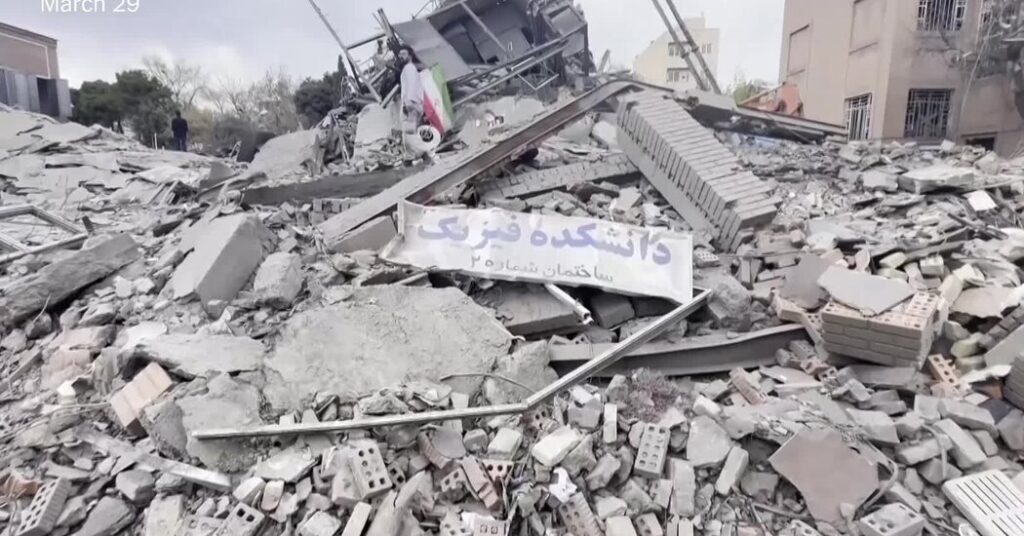
Videos posted on March 28 and 29 showed the aftermath of a recent attack on the Iran University of Science and Technology in Tehran, in which an entire building was reduced to rubble, while other classrooms were littered with shards of glass and debris.
Another strike on a research institute at the Isfahan University of Technology damaged several buildings and injured four staff members, according to the semiofficial news agency Mehr.
Other universities that have been hit, according to United Students, a group run by student activists, are the faculty of pharmacy at Shiraz University, in the south, and both the science and technology campus as well as the veterinary hospital campus at Urmia University in northeastern Iran.
Some universities that have been attacked were the sites of large demonstrations against the government just days before the war began, as students defied a bloody crackdown on protests that had already killed thousands earlier this year.
On Monday, Israel claimed strikes on the Imam Hossein University, which it called the “main military university” of the Revolutionary Guards.
It said the university contained wind tunnels used to test and develop ballistic missiles, as well as a chemistry center used for research and development of chemical weapons.
Hwaida Saad and Rawan Sheikh Ahmad contributed reporting
The post Iran Condemns Attacks on Its Universities, Warns of Retaliation appeared first on New York Times.