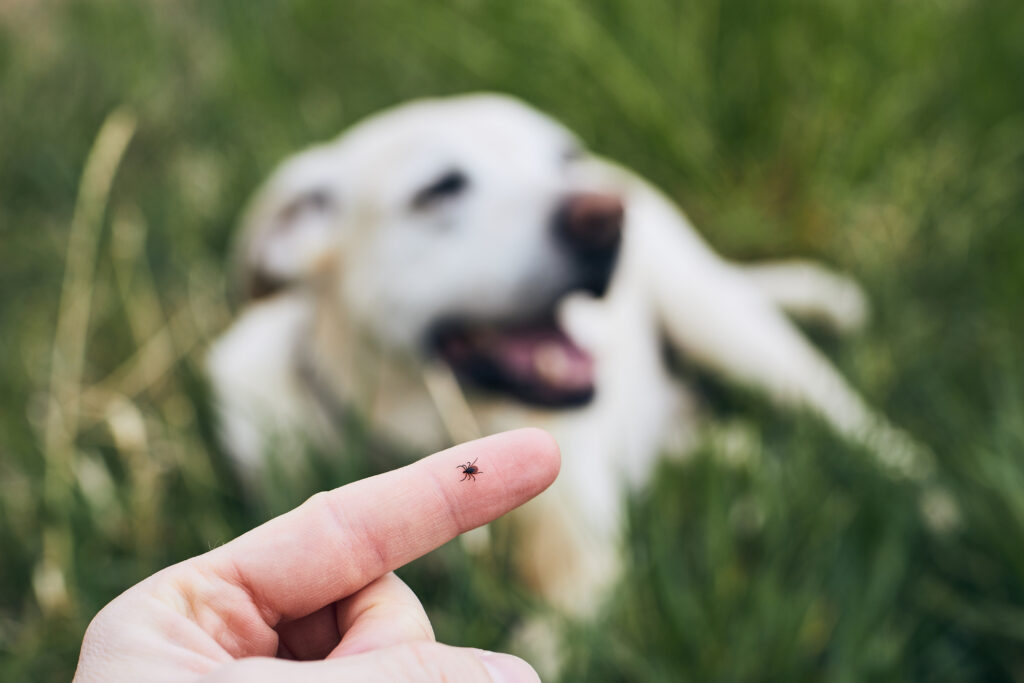
Q: What is the safest way to get a tick out of my dog’s body? Should I use tweezers or gloved hands? Are there ways to prevent ticks from sucking on his body?
A: Whatever you do, don’t remove ticks from your pet with your teeth (yes, people do this, and one man then developed the tick-borne disease Rocky Mountain spotted fever). Don’t use your hands either, because you’re more likely to crush the tick, force tick-borne pathogens into your pet or break in your skin, and leave the tick’s mouthparts behind (which can cause skin irritation and infection). Instead, place a tick-lifting tool or curved tweezers between your pet’s skin and the tick’s body, use gentle upward pressure to remove the tick, then flush it down the toilet. There’s a variety of tick-lifting tools available online, but fine-tipped curved tweezers also work well.
Your question is timely, with tick season just around the corner. Ticks will suck your pet’s blood, and they transmit some nasty infectious diseases. Pets also sometimes carry unattached ticks into the home, which can spread tick-borne diseases to people and other pets. Here’s what you need to know about ticks, the diseases they spread and the best ways to prevent them.
What ticks should I be worried about?
Ticks — and the diseases they transmit — vary depending on where you live. There’s a long list of tick-borne diseases, so I’ll focus on the most common ones in dogs and cats, some of which also affect people. There are four groups of ticks you need to know about.
Black-legged ticks (Ixodes). Black-legged, or deer ticks (Ixodes scapularis) transmit bacteria that cause Lyme disease (Borrelia burgdorferi) and granulocytic anaplasmosis (Anaplasma phagocytophilum). These diseases are most common in the Northeast and the Upper Midwest. Lyme disease is the number one vector-borne disease in the United States, and in some parts of the Northeast, up to 80 percent of adult ticks can be infected. Behind the scenes is the cute little white-footed mouse, which can be infected with large numbers of these bacteria and acts as a source of infection (a reservoir) for uninfected ticks.
If you live on the West Coast, don’t be lulled into a false sense of security. In California, Oregon and Washington, a related tick, the western black-legged tick (Ixodes pacificus), transmits the same diseases. This tick prefers to feed on lizards, which don’t make great reservoir hosts, so Lyme disease in the west is relatively rare. Many wildlife species can act as reservoirs in the west, but western gray squirrels are thought to be the most important.
The most common sign of Lyme disease in people is a bull’s eye-shaped rash at the site of a tick bite. Dogs don’t get the bull’s eye rash, and less than 5 percent of dogs get sick after infection. For these dogs, it takes a month or two before signs of illness appear, most commonly fever, decreased appetite, lethargy, and swelling and pain of multiple joints (a condition called polyarthritis). These signs typically respond well to a 4-week course of the antibiotic doxycycline. The most feared manifestation of Lyme disease in dogs is a condition called Lyme nephritis, which tends to affect retriever breeds. Dogs with Lyme nephritis develop kidney failure and lose protein in their urine, and the disease is usually fatal.
Like Lyme, anaplasmosis can be accompanied by fever and polyarthritis, and because ticks can carry both Anaplasma and Borrelia, dogs and people can acquire Lyme and anaplasmosis at the same time. Some dogs with anaplasmosis develop neurological signs (neck pain and rarely seizures), but the disease is rarely fatal and responds well to a short course of antibiotics.
American dog ticks (Dermacentor variabilis). Mostly found in the southeast, these ticks can transmit a variety of diseases to humans and dogs. One of the most serious is Rocky Mountain Spotted Fever (RMSF), which is caused by the bacteria Rickettsia rickettsii. When R. rickettsii gets into the body, it infects and damages small blood vessels, so that blood and fluid leak into tissues, including critical organs and the brain. Humans develop a spotted rash, and both humans and dogs can develop fever, neurological signs like seizures, organ failure and death. Although RMSF in both dogs and humans can be effectively treated with doxycycline, a delay in treatment (or the wrong antibiotic) for even two or three days can mean the difference between life and death. If your dog is diagnosed with RMSF and you become ill, immediately tell your doctor, because you and your dog might have been exposed to the same ticks.
Lone Star ticks (Amblyomma americanum). These ticks are of greatest concern in the southeast and south-central states. But with climate change, Lone Star ticks have been spreading north toward Ohio. They transmit Ehrlichia ewingii to dogs and humans, which causes an anaplasmosis-like disease.
Lone Star ticks can also transmit a serious disease to cats known as cytauxzoonosis (sigh-toh-zoh-uh-NOH-sis). It’s caused by a single-celled organism that tears apart red blood cells and causes rapid multiorgan failure and death. Last (but not least), Amblyomma ticks transmit hepatozoonosis (heh-PAT-oh-zoh-uh-NOH-sis) to dogs. This is a chronic disease with fever, bone pain and muscle wasting. These infections must be treated with special antiprotozoal drugs — they don’t respond to antibiotics.
Brown dog ticks (Rhipicephalus sanguineus). These can be found all over the United States, but they are most widespread in the southeast. Brown dog ticks transmit one of the most common infectious diseases of dogs worldwide, canine monocytic ehrlichiosis (CME). Most infected dogs show no signs. Some develop an acute disease with signs of fever, polyarthritis, lethargy, lymph node enlargement and sometimes bleeding. An even smaller percentage of dogs develop a chronic persistent infection that can result in bone marrow failure; often this is fatal.
In the southwestern states, brown dog ticks can also transmit RMSF. This has been a major problem for people in Mexico and on tribal lands in Arizona.
How can I prevent these diseases?
Reduce the chance of tick exposure. Remove brush and long grass in your yard, and when hiking, try to keep your dog on the trail (which can also help to protect you from exposure to poison oak or poison ivy oils — dogs also carry these into your car and home).
Inspect your pet for ticks after outdoor activities. The sooner ticks are removed, the better. After tick attachment, it takes about two hours before Ehrlichia can be transmitted, eight hours for Anaplasma, and at least 24 hours for Borrelia. After you have removed the tick, antibiotics are not recommended because there’s a low chance of infection, and overuse of antibiotics puts your pet at risk of future antibiotic-resistant infections. They also aren’t recommended if your dog happens to test positive for these infections at a wellness check, but this is a sign that you and your dog are getting exposed, so work on prevention.
Consider vaccinating your dog against Lyme. If you spend time with your dog in parts of the country where Lyme disease is common, get your dog vaccinated so they can. Vaccinated dogs develop antibodies against Borrelia that the tick ingests when it sucks blood. The antibodies destroy Borrelia inside the tick before it infects your dog.
Use parasite prevention products. A variety of long-acting parasite prevention products are available to prevent tick infestations and the diseases that ticks transmit. Your vet can prescribe the right product based on location and lifestyle.
Have questions about your pet’s behavior, health or other issues? Use this form to submit them to Dr. Sykes.
The post Ask a Vet: Tick season is almost here. Here’s what you need to know. appeared first on Washington Post.