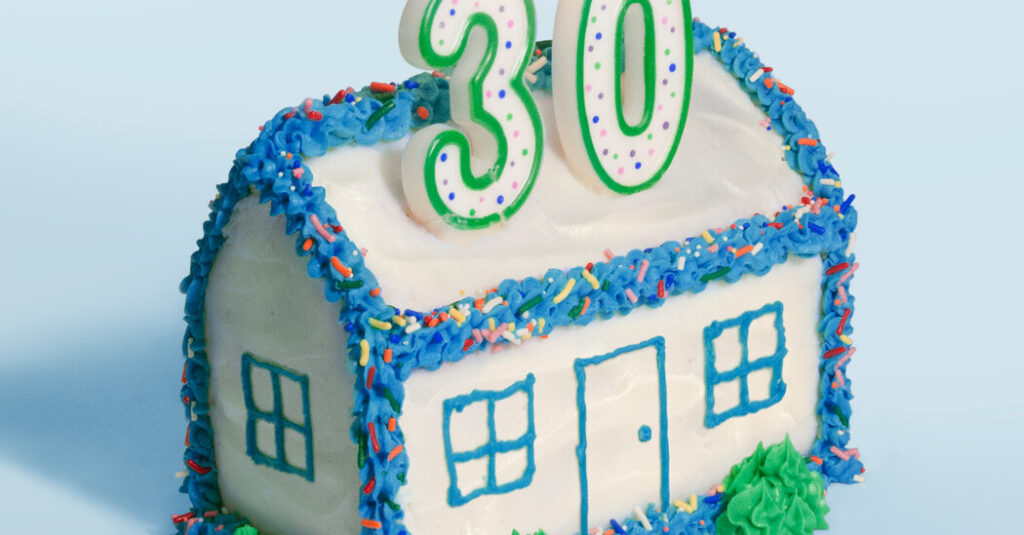
The Trump administration has declared that it is “bringing back the American dream of homeownership.” It is a good line, but the administration is doing little to make it a reality. First-time buyers last year made just 21 percent of all home purchases, the lowest share since records began in 1981. The share was almost twice as high until the Great Recession began in 2007.
I am turning 30 this year, and most of the people I grew up with in Bucks County, Pa., north of Philadelphia, have degrees and good-paying jobs, yet still rent. It is not because they failed, but because the government has stopped prioritizing homeownership.
For much of the 20th century, buying a first home was challenging but achievable. Today, it requires family wealth, extraordinary income or both in many parts of the country. Over the past three decades, home prices have risen far faster than wages. Student debt has delayed saving. Local zoning has limited new construction in regions where good-paying jobs are concentrated. Meanwhile, federal policy has largely focused on protecting the wealth older Americans already hold rather than helping younger Americans build it.
The past points to a solution; the federal government can once again make building wealth for young families a core mission. It can offer a simple promise: Anyone who works, pays taxes and plays by the rules should have a realistic path to buying a first home by age 30. The program would be called “House by 30.” This is more than a campaign promise; it is a principle rooted in American tradition.
The country once treated ownership as central to economic stability. Thomas Jefferson believed that land ownership created independent, virtuous citizens. Abraham Lincoln, as part of an economic agenda sometimes described as the “American system,” signed the Homestead Act in 1862, granting 160 acres of land to people willing to live on it for five years and improve it. Over the next seven decades, the law transferred 270 million acres, or more than 10 percent of the current area of the United States, to 1.6 million families.
In the 20th century, the New Deal created the Federal Housing Administration, standardizing the 30-year mortgage and reducing monthly payments. The G.I. Bill financed homes for millions of returning veterans who could never have afforded them on their own.
Suzanne Mettler, a political scientist at Cornell University, has a term for why those programs worked so well. They were part of what she calls the visible state. Social Security, Medicare and the Interstate System of highways are other examples. These programs were political successes because people could see them. People receive a monthly check or health insurance from the government. They drive on a road the government built and move into a house the government helped them buy. That visibility builds trust that the government is putting taxpayer money to good use rather than wasting it.
In recent decades, much of federal policy has shifted and been delivered through tax credits, subsidies and regulatory adjustments. Many are sound, but they do not read as promises delivered. They read as process, and process rarely creates allegiance. Ms. Mettler refers to these programs as part of the submerged state. A submerged state tends to be smaller than the visible state because it is less popular. Programs that voters cannot see are easier for opponents to cut, defund or let expire, because nobody misses what they never knew they had.
The generations most affected by this shift are Millennials and Gen Z, and they are poorer as a result. In 1990, more than two-thirds of wealth was held by working-age households. Today, the shares have flipped. Nearly two-thirds is held by American households over age 60.
Last year, only 37.9 percent of households headed by someone under 35 owned their home, down from about 43 percent two decades ago. Many can afford a monthly mortgage payment but have not saved the lump sum needed for a down payment. “I’ve seen people in fields like law, tech and finance who still need family help just to make a down payment,” said Sam Deutsch, an urban policy researcher and former policy fellow in the office of Senator Brian Schatz, a Democrat from Hawaii. “That’s not a sustainable system. If you need parental wealth to buy a first home, something has gone wrong.”
Americans born in the 1980s and 1990s inherited an economy that was already expensive and getting worse. Many of them entered the job market around the time of the financial crisis, and people who start their careers during a recession pay an enduring economic penalty, according to academic research. Younger adults also had the misfortune to come of age after decades in which stock prices and house prices had risen substantially.
Government policy has exacerbated these trends. In the 21st century, federal spending has become increasingly skewed toward older adults. They receive subsidized health insurance, which has become much more expensive. Most of them benefit from the mortgage interest deduction, which of course younger renters do not. Federal spending today is heavily weighted toward Americans who have already built wealth, and away from those still trying to. That is not an argument against Social Security or Medicare. It is an argument for giving younger Americans a program of comparable ambition.
The “House by 30” program would begin to correct this imbalance and restore faith in government among younger Americans who have grown cynical. The federal government would cover part of a first-time buyer’s down payment based on years of full-time work: The longer you have contributed, the more help you receive. That structure would advantage blue-collar workers, who often enter the work force earlier, rather than disproportionately rewarding those who spend more years in school.
Any first-time buyer, regardless of age or region, would be eligible. The benefit could accrue at roughly $5,000 a year, capped at $50,000, enough to cover a substantial share of a typical down payment on a median-priced home. The support would arrive at closing, not as a tax credit months later. It would be visible, not submerged.
A program at this scale would directly address one of the biggest barriers facing young buyers. “If the median home price is around or above $400,000, a typical first-time buyer is putting down about 10 percent, or roughly $40,000,” said Tahra Hoops, director of economic analysis at the Chamber of Progress, a business-backed group focused on cost-of-living issues. “A benefit in the $40,000 to $50,000 range could substantially cover that upfront cost.” For many younger households, she added, the challenge is not just affording monthly payments but accumulating enough savings to enter the market at all.
An obvious objection is cost. A program like this would be expensive. To pay for it, Congress could raise taxes on the wealthy and close loopholes that let billionaires pay lower tax rates than the people who work for them. That alone would generate hundreds of billions, or more, over a decade. The Homestead Act and the G.I. Bill required similar choices, and the returns on homeownership, new taxpayers and a broader base funding Social Security and Medicare outweighed the costs.
The program would also have social benefits. If workers cannot afford to buy homes and put down roots, the social fabric weakens. Communities lose teachers, nurses and firefighters who cannot afford to live where they work. New homeowners become new taxpayers.
This policy would not solve the country’s housing crisis on its own. America needs to build more housing, and movements such as the YIMBY and abundance movement are right about the housing supply problem. But zoning reform is not a promise anyone can organize his or her life around. A visible commitment to ownership does not compete with the rest of the housing agenda; it underwrites that agenda.
The political benefits for the Democratic Party could be large. Americans under 30 are not loyal to the party. In 2024, 55 percent of voters under 30 supported Kamala Harris, down from the 63 percent who voted for Hillary Clinton in 2016, according to Catalist, a Democratic-aligned data firm. Many voters say they do not believe either party will do anything to improve their lives.
Democrats, of course, cannot pass any of this tomorrow. They would need the White House and both chambers of Congress. They can campaign on it now. There is a long history of out-of-power parties making specific promises and winning on them. Newt Gingrich and Dick Armey built a congressional majority in 1994 around the Contract With America. Barack Obama ran on health care and delivered the Affordable Care Act. The promise came first, and the power came after. And right now, Democrats do not have a post-Trump agenda that voters can name. Running on a return to normalcy alone is an admission that you have nothing new to offer.
Housing will be a central issue in 2028, whether Democrats want it to be or not. The question is whether Democrats show up with vague gestures about building more housing, or a direct promise that if you work and pay in, you can own a home by 30. Without a promise, Republicans fill the vacuum the way they usually do, by blaming immigrants and offering little to improve Americans’ lives. At a moment when the president is cozying up to billionaire oligarchs, a clear housing promise can land.
Democrats built the middle class once. They did it with commitments so visible that Americans knew the government had helped them achieve their American dream. Democrats can do it again, and housing is where they should start.
Rotimi Adeoye is a contributing Opinion writer, a former congressional speechwriter and the author of American Pursuit, a newsletter on politics and policy.
The Times is committed to publishing a diversity of letters to the editor. We’d like to hear what you think about this or any of our articles. Here are some tips. And here’s our email: [email protected].
Follow the New York Times Opinion section on Facebook, Instagram, TikTok, Bluesky, WhatsApp and Threads.
The post Democrats Need a New Promise: A House by 30 appeared first on New York Times.