As he prepares for a summit with President Trump, China’s leader, Xi Jinping, has invited the chairwoman of Taiwan’s main opposition party for a rare visit aimed at countering Washington’s influence, and arms sales, through a show of good will toward the island.
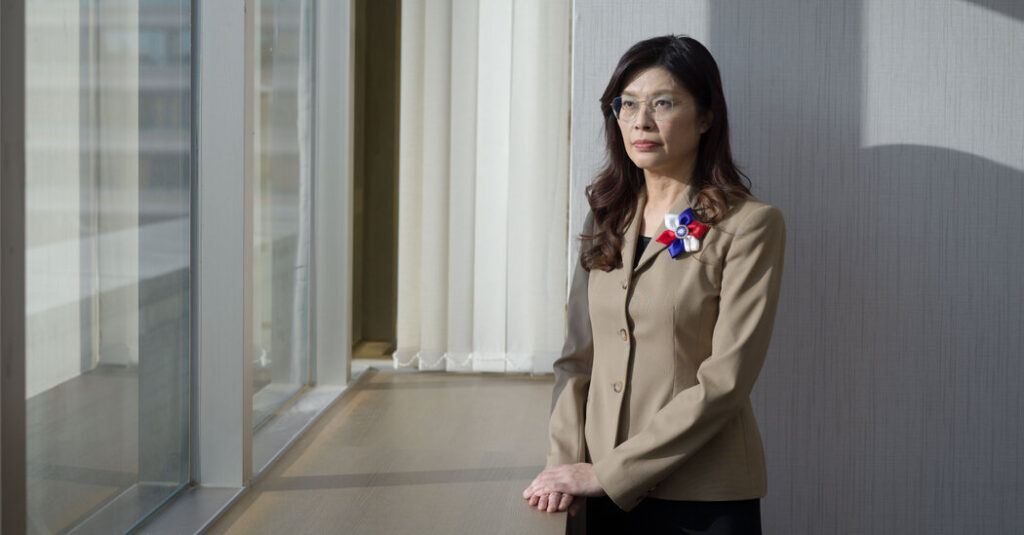
The invitation to the leader of the Nationalist Party, Cheng Li-wun, could help Mr. Xi bolster his argument to Mr. Trump that the United States should curtail weapons sales to Taiwan, the democratically governed island that China claims as its territory. Mr. Xi could also highlight Ms. Cheng’s visit next week to show that Beijing is willing to talk to some high-level Taiwanese politicians who accept its terms.
“For China, her visit will help to send a clear message that there is still a sizable enough number of China doves inside Taiwan,” said Wen-ti Sung, an expert on Taiwan at the Global China Hub of The Atlantic Council.
Ahead of Mr. Xi’s summit with Mr. Trump, expected in mid-May, “it helps China to have that on camera for public diplomacy purposes — that there’s a Taiwanese leader of significant weight that seems to be able to get along with Beijing,” Mr. Sung said.
Since winning an election to lead the Nationalist Party late last year, Ms. Cheng has argued that to ensure peace, Taiwan must build closer ties with China. She has said that she wants to visit China and meet Mr. Xi.
On Monday, Song Tao, the Chinese official in charge of Taiwan policy, said Mr. Xi had invited Ms. Cheng to promote “peaceful development” across the Taiwan Strait, the official Xinhua news agency reported. She would visit Jiangsu Province, Shanghai and Beijing, said the announcement, which did not specify if Mr. Xi would meet with her.
The Chinese Communist Party has strengthened ties with Ms. Cheng’s party while it seeks to isolate Taiwan’s governing Democratic Progressive Party, which is skeptical of Beijing and asserts that Taiwan is in effect independent.
At a news conference in Taipei on Monday, Ms. Cheng said she had accepted the invitation. China often holds off from confirming official meetings until closer to the date.
“We want to prove to the people of Taiwan and the entire world that conflict between the two sides of the strait is not inevitable,” she said. “Through our own wisdom and efforts, we can together forge a broad path of peace.”
Asked about Ms. Cheng’s planned trip to China, Taiwan’s official Mainland Affairs Council warned: “If peace is built solely on the good will of Chinese Communist leaders, that will be the greatest danger for Taiwan.”
Ms. Cheng’s courtship of Beijing is also dividing her own party. Her critics argue that by leaning so close to China, she risks undermining the island’s relationship with the United States, on which it relies to counter Chinese military threats.
China does not rule out using force to absorb Taiwan, and has ramped up military pressure around the island in recent years and sought to erode American support for Taiwan. In a phone call with Mr. Trump in February, Mr. Xi warned him about continued sales of U.S. weapons to Taiwan, an indication that the issue will be on the agenda during the summit.
China’s announcement coincided with a visit by a group of Republican and Democratic senators to Taiwan aimed at demonstrating U.S. commitment to the island. At least two of the senators openly urged Taiwanese lawmakers to pass President Lai Ching-te’s proposal for $40 billion of extra defense funds over eight years.
“I’d like to personally endorse the special defense budget and tell you back in Washington, D.C., that my colleagues are watching, that this is important,” Senator John Curtis, a Republican from Utah, told reporters in Taipei.
The Nationalist Party and a smaller opposition party hold a majority in Taiwan’s legislature, and they have held up President Lai’s proposal. Ms. Cheng and other Nationalist politicians have raised concerns about a backlog in deliveries of U.S. weapons for Taiwan and about potential corruption.
Some members of her own party say Ms. Cheng underestimates Mr. Xi’s determination to bring Taiwan to heel.
For the Nationalist Party, the visit by Ms. Cheng would be “a high-risk gamble,” wrote Jason Hsu, a former lawmaker for the party who has been critical of Ms. Cheng. “It may strengthen its ‘peace’ narrative domestically, but it also risks reinforcing a damaging image: engaging Beijing while undermining defense readiness.”
After pressure from Washington, Ms. Cheng announced that the Nationalists would support an initial sum of about $12 billion for an arms package already approved by the Trump administration, and would support subsequent purchases of U.S. weapons. Critics say that her approach is still too incremental.
“The fact is that the threat from the People’s Republic of China continues to grow at one of the fastest paces in the whole world,” said Tony Hu, a former Pentagon official. “Taiwan also needs to stay on the right side in the mind of Trump, and the Nationalist Party doesn’t seem to appreciate the importance of that right now.”
Chris Buckley, the chief China correspondent for The Times, reports on China and Taiwan from Taipei, focused on politics, social change and security and military issues.
The post Xi Invites Taiwan’s Opposition Leader to Talk ‘Peace’ Ahead of Trump Summit appeared first on New York Times.