The Israeli Parliament appeared ready on Monday to enact a death penalty that would in practice apply only to Palestinians convicted of deadly acts of terrorism, not to Jewish extremists, handing the country’s far right a long-sought victory.
The bill, which was being debated ahead of a final vote expected by Monday night, would make death by hanging the default sentence for Palestinians convicted in Israeli military courts of killing people in militant attacks, though judges would be allowed to make exceptions.
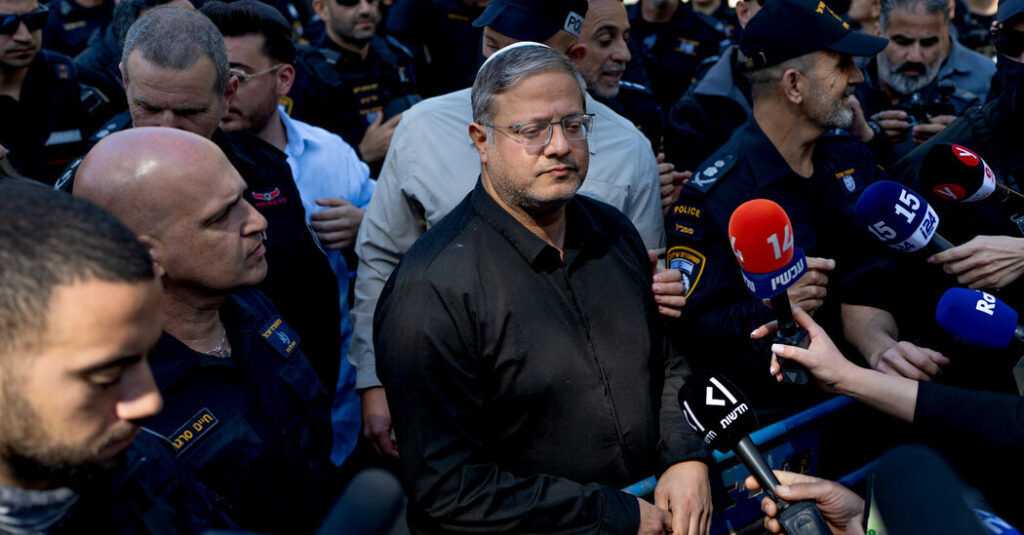
Israeli hard-liners, particularly Itamar Ben-Gvir, the national security minister, have long campaigned on executing Palestinian militants.
Critics in Israel and abroad say that the measure would strip away many of the safeguards intended to preserve due process, including the possibility of a pardon for those convicted in military courts.
“There’s nothing here but vengeance, hitched onto a narrative of Jewish pride and violence,” said Rabbi Benny Lau, a public intellectual from Jerusalem. “Somehow, we have to put this demon away.”
In theory, Jewish Israelis could also be executed under the new law, but legal experts say the odds are vanishingly small, because the death penalty could be imposed only for homicide where the intention was to “negate the existence of the State of Israel.”
That would exclude even an extremist like Baruch Goldstein, who gunned down 29 Palestinians at a West Bank holy site in 1994, said Yoav Sapir, a law professor at Tel Aviv University who formerly ran Israel’s public defender’s office.
“The intent is clearly for the law to apply to Palestinians and not to Jewish terrorism at all,” Mr. Sapir said.
He argued that Israel’s Supreme Court would most likely strike down the legislation.
Nonetheless, the measure was expected to pass with little public outcry and with the support of some members of the opposition. Opinion polls have consistently shown majority backing for the legislation among Jewish Israelis, reflecting the country’s right-wing shift in the wake of the two-year war in Gaza.
Few Western democracies other than the United States have executed criminals or even mass murderers in recent decades. Opponents say the death penalty risks executing the innocent and argue that there is little evidence the punishment prevents crime.
Israel already has a death penalty on its books, but it has been used just twice. The first execution, just weeks after Israel’s establishment in 1948, was of Meir Tobianski, an Israeli army officer accused of spying and speedily put to death — only to be publicly exonerated a year later. The second and final case, in 1962, was of Adolf Eichmann, one of the leading Nazi planners of the Holocaust.
Supporters of the new legislation say it is not about revenge. They argue that by executing some Palestinian militants rather than imprisoning them, Israel would reduce the incentive for armed groups like Hamas to seize Israeli hostages to use as bargaining chips to swap for Palestinian prisoners.
Israeli military courts, which try Palestinians who live under occupation in the West Bank and Gaza, already have weaker civil rights protections than Israeli civilian courts, and many Palestinians view them as fundamentally unfair.
Military prosecutors would not be permitted to waive their right to request the death penalty. While most U.S. states require a unanimous jury verdict to impose the death penalty, the Israeli law would require only a simple majority of judges. Palestinians sentenced to death would not be eligible for a pardon or for a commutation of their sentence.
Authors of the legislation resorted to the gallows after the union representing Israeli doctors rejected the idea of carrying out lethal injections.
Aaron Boxerman is a Times reporter covering Israel and Gaza. He is based in Jerusalem.
The post Israel to Vote on Death Penalty Targeting Palestinians Guilty of Lethal Attacks appeared first on New York Times.