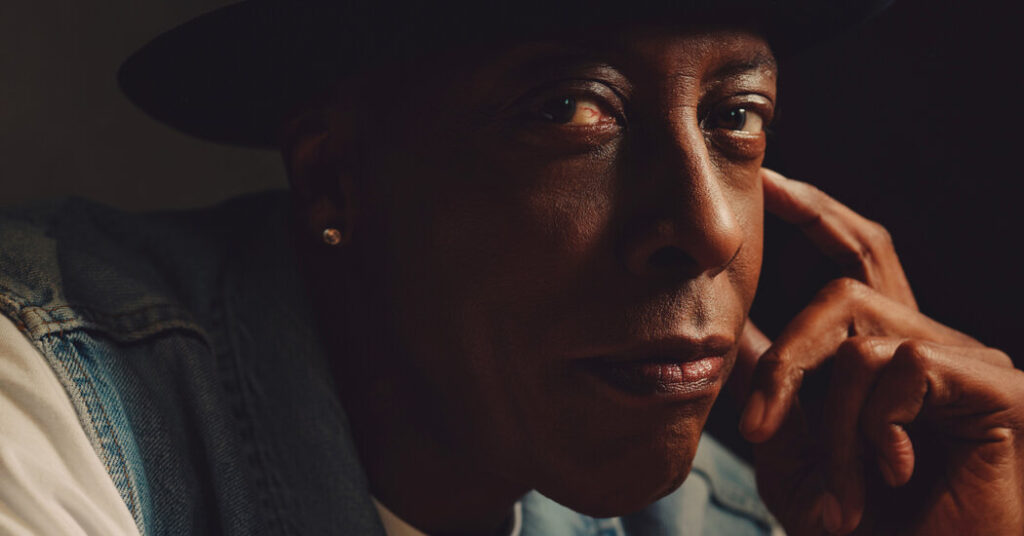
The late-night TV war of the early 1990s is usually framed as a battle between David Letterman and Jay Leno to succeed their comedy patriarch, Johnny Carson. But what often gets left out is the phenomenon of Arsenio Hall, the only Black late-night host then, who launched a syndicated show in 1989 that broke from convention and became a wildly buzzy hit.
Hall dispensed with the desk, the signature furniture of late night, and added a section of barking audience members called the Dog Pound. He embraced music acts ignored by competitors, giving a national platform to hip-hop stars like Tupac and Q-Tip when that was rare, and proved adept at creating water cooler moments: Bill Clinton playing the sax, Andrew Dice Clay breaking down in tears and (my personal favorite) Jason Voorhees, the “Friday the 13th” serial killer, appearing as a guest in a hilariously absurd segment.
This party atmosphere and seductive swagger drew a younger audience, and “The Arsenio Hall Show” became a real threat in the ratings, regularly beating “The Tonight Show” in the biggest markets in the country, even inspiring a “Saturday Night Live” sketch where Carson pandered to Hall’s audience by rebranding as “Carsenio.”
In his gossipy new memoir, “Arsenio,” out on March 31, Hall, 70, gives a little background on his youth in Cleveland as a preacher’s child, and his early years as a standup. But he focuses on the six-year run of the late-night show and its pop-culture legacy, describing how he convinced Snoop Dogg to overcome his fear of appearing on television and brokered a meeting that led to the creation of “The Fresh Prince of Bel Air.” In a recent Zoom interview, he reflected on the past and future of late night.
One thing that surprised me about your book is that while you came off like the life of the party on television, you present yourself here as a loner and a recluse.
I’m an only child, so I’m probably a little inept dealing with people. That show allowed me to fantasize, to be the guy I wanted to be, that I dreamed of being.
You write that “white people thought the show was too Black and Black people wanted it Blacker.” How did you navigate this?
I’m sure I was a mess some nights trying to please Paramount [who produced the show] but not having Ice Cube angry at me.
Ice Cube wasn’t the only one upset you didn’t book him. When O.J. Simpson was in “Naked Gun,” he came to your studio to complain.
He stood outside leaning against his car, and I’m like: O.J., you’re going to Suge Knight me? No, it’s not going down like that.
This is, of course, before his wife was killed.
If it was after, I’d have let O.J. host the show for a week [laughs]. If he got his hands on me, he probably could beat me up, but he couldn’t make sharp cuts then. I could dance around O.J.
During the height of your 1990s fame, you write that you went through a phase of “too many strip clubs, too much cocaine, too many women.”
The shy kid, the only child who couldn’t talk to girls, if he had coke, it did the talking. I didn’t want to be the preacher’s kid who was awkward and shy. I’m back to that now, but for a minute, cocaine freed me. It’s funny because whenever I got too far out, God pulled me back. If you remember my story about what was about to go down when Eddie [Murphy] and [John] Landis had their fight.
You mean your first menage a trois getting interrupted by a phone call telling you that “Coming to America,” the Landis movie you were starring in, was in trouble because Eddie had tried to strangle the director? Um, yes, I recall that one.
I got back to the menage a trois later.
I’m glad to hear it. You write that you then went to visit Eddie Murphy and got him drunk and stoned for the first time.
Eddie never drank after that night.
Is Eddie Murphy as funny when drunk and stoned?
Much funnier. When Eddie’s stoned, he comes up with classic bits. The next day, it probably wasn’t as funny as I thought it was.
You never explain in the book why Murphy choked Landis.
What I knew is from his cousin Ray. Landis said something to him in front of fans. It was not private. Ray’s language was: “Yo, he tried to front your boy in front of 20 fans asking for autographs.”
One fun thing about your old show is you leaned into controversy. You told Entertainment Weekly that you would “kick Leno’s ass,” then the next week you wrote them to complain again.
There were times when Jay thought I didn’t work as hard as he did. And he criticized my monologue. And somebody got that to me. We definitely battled.
You are now friends who have gone on tour. You also appeared on the Howard Stern Show a few years ago. That surprised me, because maybe your ugliest feud was with him.
When Magic Johnson contracted H.I.V. and Howard said, “I hope Arsenio dies,” that’s when I realized it wasn’t joking around. He really hated me. I’ll be honest: It hurt the business a lot. Howard has die-hard fans who do anything he says. Howard can hurt your numbers. My biggest struggle was not against other talk show hosts. It was against an angry Howard.
So how did you get to the point of going on his show?
I have pretty thick skin. I heard a therapist use a word called “weathering” once. When you’re Black, between the racism and hate that you experience, there’s a weathering that takes place. You build up a callus.
Late night hosts don’t have drama like this anymore.
We’re in a weird time where the hosts all came together to go against late night’s arch nemesis: Donald Trump. It’s like Trump kind of galvanized late night. We fought each other for numbers. Now they’re all together for a common cause. It’s very weird.
What do you think of the head of the F.C.C. going after late night?
What it really makes me think is: The country that I’m living in may not be the country I think it is.
Having Bill Clinton play the saxophone on your show helped him win the presidency, and you write that he not only said as much but invited you to the inauguration. But you didn’t go. Why?
Just don’t want to be that guy. If you tell me to shut up and dribble, I’ll grab a mic and start to do my thing because I really don’t want to be a part of it.
You also spent time with Donald Trump on a season of “Celebrity Apprentice.” What do the two presidents have in common?
They both really love women.
You write about the show “In Living Color” spoofing you. They poked fun at how often you bring up your friendship with Eddie Murphy. Did you ever think: I shouldn’t drop his name so much?
I think it’s tough when your friend is a huge movie star. I can sometimes sound a little annoying because of my life.
Your first talk show ended in the 1990s, but then you returned in 2013 for a brief stint. How had things changed?
I did a sketch where I had a rap battle with a young lady who wasn’t famous yet, named Tiffany Haddish. I found out she could speak Japanese. So I asked her to rap against Chance the Rapper, but I want your final bars to be in Japanese. It was a cute sketch, but what I realized was more people saw it on the internet than on my show. And I realized, uh-oh, this format, this late night thing, has probably jumped the shark.
What’s next?
I honestly don’t know. When I was a young man, Jay told me: Tell a joke, get a check. It’s as simple as that for me. If you’ve read my book, I think you understand why chilling is something I’m comfortable doing.
You don’t miss hosting a talk show?
I don’t. I went back to where I began: standup. Now that I’m famous, I can walk in a club in the world and they’ll let me talk to the audience.
You aren’t sentimental about where late night seems to be heading?
I’d rather end “The Tonight Show” than for it to whittle away to irrelevance. I love basketball but the all-star game will never be what it used to be. The all-star game is late night. How about doing three on three? How about if we play for each other’s wives? Guys, some things have to end.
Jason Zinoman is a critic at large for the Culture section of The Times and writes a column about comedy.
The post Arsenio Hall Shares How the Shy Kid Became the Life of the Party appeared first on New York Times.