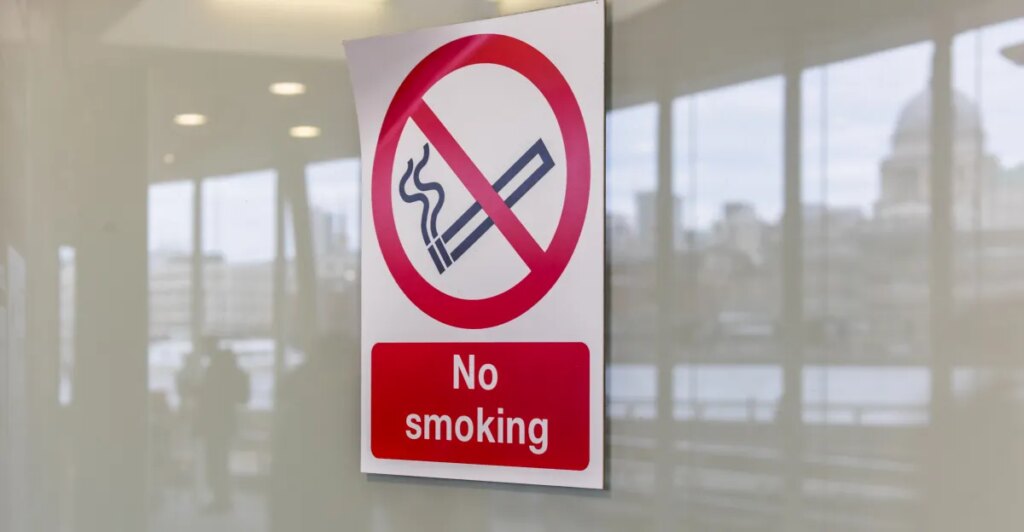
How old am I? Old enough to have flown on planes that had ashtrays in the armrests. Old enough to remember restaurants with smoking sections separated from the nonsmoking section by, essentially, nothing. Old enough to remember when “smoking or non” was a question the restaurant host actually asked you. Old enough that in the year I graduated high school — 1997 — more than a third of high schoolers smoked.
I’m 47 — not ancient, even if I sometimes feel that way — and yet the America I grew up in the 1980s was still so saturated with cigarette smoke that these memories feel like dispatches from another civilization. In 1980, roughly a third of American adults still smoked. The smoking mascot Joe Camel, whom critics would later accuse of being designed to appeal to children, debuted the year I turned 10.
Now here’s a number from 2024: 9.9 percent. That’s the share of American adults who smoke cigarettes, according to data from the National Health Interview Survey analyzed in a paper published this month in NEJM Evidence. It’s the first time the rate has fallen below 10 percent in the history of the survey. In the language of public health, smoking in America is now officially “rare.”
This decline — from 42.4 percent in 1965 to 9.9 percent, over about 60 years — is one of the great public health achievements of the modern era. It didn’t happen because of a single breakthrough or a miracle drug. It happened because science, policy, litigation, and sheer collective will chipped away at the problem for six decades against the fierce resistance of one of the most powerful industries on earth. If you’re looking for evidence that large-scale, long-term progress is possible — even when the odds seem impossible — there are few better examples than the story of smoking.
The smoke got in your eye
The scale of the change is hard to appreciate now. At the peak, Americans consumed more than 4,000 cigarettes per person per year, or more than half a pack a day. Roughly half of all physicians smoked. Cigarette companies spent billions on marketing and lobbied ferociously against any regulation while actively suppressing evidence of harm.
The toll was staggering. Since 1964, more than 20 million Americans have died from smoking-related causes. Smoking still kills approximately 480,000 Americans per year, contributing to about one in five deaths. Globally, tobacco killed roughly 100 million people in the 20th century — more than the total number of people killed in WWII. It is, by a wide margin, the leading cause of preventable death in the modern world.
The turning point came on January 11, 1964, when Surgeon General Luther Terry convened a press conference at the State Department to announce what his advisory committee had found after reviewing more than 7,000 scientific articles: Cigarette smoking causes lung cancer and probably causes heart disease. He deliberately chose to announce the findings on a Saturday — both to minimize stock market fallout and maximize Sunday newspaper coverage. It worked. The report, as Terry later recalled, “hit the country like a bombshell.”
But the tobacco industry didn’t go quietly. Internal documents showed that cigarette companies knew smoking caused cancer as early as the late 1950s and worked tirelessly to conceal it. A famous R.J. Reynolds internal memo distilled the strategy: “Doubt is our product.”
For decades, the industry funded sham research organizations, lobbied Congress with enormous budgets, and targeted children with advertising. In 1994, the CEOs of the seven largest tobacco companies testified before Congress that they did not believe nicotine was addictive. Internal documents proved they knew otherwise.
The industry had, at that point, never lost a lawsuit — in more than 800 cases. But that would change. In 1998, 46 state attorneys general reached the Master Settlement Agreement with the tobacco companies — a $246 billion settlement, the largest redistribution of corporate wrongdoing costs in American legal history. In 2006, a federal judge went so far as to rule that the tobacco companies had violated the RICO Act — the racketeering statute typically reserved for organized crime.
How cigarettes were beaten
No single policy killed the cigarette. It was a combination of interventions deployed over decades: warning labels on packages (1965), a ban on broadcast advertising (1970), smoke-free workplace laws (spreading from Minnesota in 1975 to most of the country by now), growing awareness of the risks of secondhand smoke (1986), progressive tax increases (a 10 percent price hike reduces consumption about 4 percent), FDA regulatory authority (2009), and cessation programs from nicotine patches to the CDC’s Tips From Former Smokers campaign. Maybe most importantly, smoking went from being something almost everyone did to something that was banned in most public spaces — which changed social norms as much as any law.
The result: an estimated 8 million lives saved between 1964 and 2014 alone, representing 157 million years of life — an average of about 20 extra years for each person who didn’t die prematurely from smoking. A 40-year-old American man in 2014 could expect to live nearly eight years longer than his 1964 counterpart, and roughly a third of that improvement comes from tobacco control alone.
The warning label
But we still have a ways to go in the effort to permanently stub out tobacco.
For one thing, 9.9 percent is an average, and averages lie. Smoking rates among people with a GED — meaning they didn’t graduate high school — are still 42.8 percent, barely less than the national rate in 1964. Rates remain high among low-income Americans (24.4 percent), rural residents (27 percent), people with disabilities (21.5 percent), and workers in construction and extraction jobs (around 29 percent). As overall consumption rates have declined, smoking has increasingly become a disease of poverty and disadvantage. The people who still smoke are disproportionately the people with the fewest resources to help them quit.
Second, even as cigarette smoking goes away, nicotine hasn’t. E-cigarette use holds steady at 7 percent among adults, and while cigarettes are almost extinct among 18- to 24-year-olds, nearly 15 percent vape nicotine.
But vaping is still better for you than smoking is. E-cigarettes have helped people quit tobacco and are generally less harmful than lighting dried leaves on fire and inhaling the smoke, even if their full long-term effects won’t be known for years.
Third, notably, this milestone of government action was not actually announced by the US government, even though that’s where the data comes from. Federal cuts have decimated the CDC’s Office on Smoking and Health, the very office that has tracked and driven this progress for decades. Instead, the analysis was published by an independent researcher through NEJM Evidence’s “Public Health Alerts” initiative — a new collaboration created specifically to fill gaps left by the gutted CDC. There’s every reason to worry that the federal health infrastructure as it stands now will struggle to keep the momentum going against tobacco.
The fight isn’t over
And in the rest of the world, we have a lot more work to do. About 80 percent of the world’s 1.3 billion tobacco users live in low- and middle-income countries. Tobacco kills over 7 million people a year worldwide, a number is projected to rise to 10 million by 2030 on current trends. While the 20th century saw roughly 100 million tobacco deaths, mostly in rich countries, some estimates project up to 1 billion in the 21st century, mostly in developing nations. Cigarette consumption in the Eastern Mediterranean and African WHO regions actually increased by 65 and 52 percent, respectively, between 1980 and 2016.
But looking at what’s happened in the US, we know those trends can change. From 42.6 percent to 9.9 percent, in 60 years. Eight million lives saved. This is the kind of progress that’s so gradual you barely notice it happening. And then you look at the numbers, and they’re astonishing.
The ashtrays are gone from the armrests now. The smoking sections are gone from the restaurants. The yellowish ceilings have been repainted. Most Americans under 30 have probably never seen anyone light a cigarette indoors. And the world they live in is measurably, dramatically safer because of decisions that were made — over decades, against long odds — before most of them were born. That’s what progress looks like.
A version of this story originally appeared in the Good News newsletter. Sign up here!
The post The most successful health campaign in modern history appeared first on Vox.