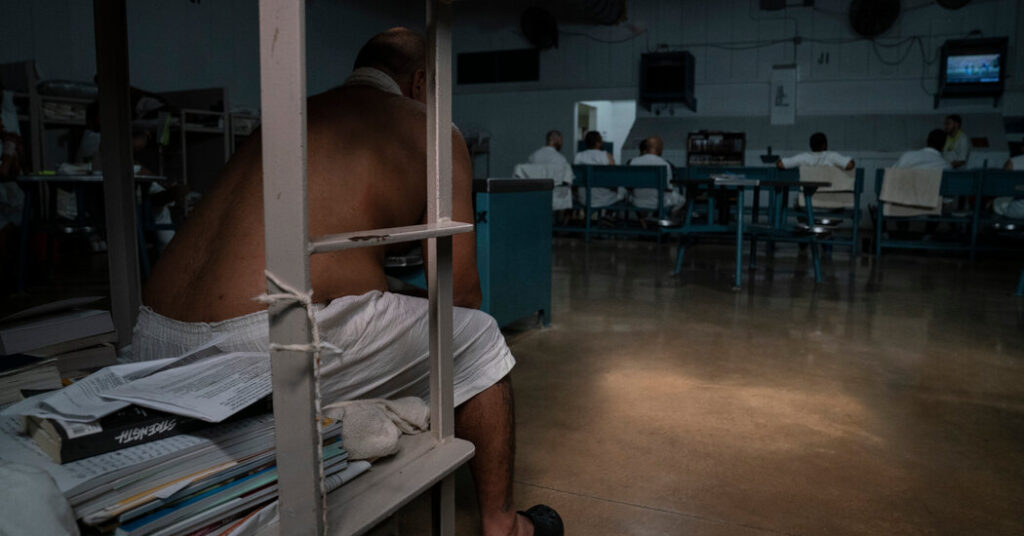
A federal judge in Austin will soon decide whether the lack of air-conditioning for inmates inside Texas prisons during the sweltering summer heat amounts to cruel and unusual punishment.
After years of legal wrangling, the case against Texas heads to trial on Monday in what lawyers said was one of the most far-reaching attempts in the nation to force a state to air-condition its prison system.
Other states, particularly in the South, have faced legal challenges over heat in prison. But the demands in the Texas case, before U.S. District Court Judge Robert Pittman, are more extensive.
The plaintiffs include advocacy organizations representing current inmates who want air-conditioning installed in every inmate housing area in every state-run lockup.
Texas has more prisoners than any other state, and most live in cells and dorms without air-conditioning. Heat readings from inside state lockups have regularly topped 100 degrees in recent years, as global temperatures have risen from climate change.
The Texas Department of Criminal Justice, the state’s prison agency, has acknowledged that high indoor temperatures have caused staff illnesses and injuries, and may have contributed to the deaths of three inmates in the summer of 2023.
Lawyers representing Texas prisoners have argued that the actual death toll from extreme heat is far higher than what has been officially recorded.
Texas prison officials were expected to defend the conditions inside state prisons and to argue that the indoor heat does not violate inmates’ constitutional rights. Last year, officials testified that Texas prisons are safe, even during the summer months, because staff undertakes mitigation measures that include providing inmates extra water and cool showers.
The Texas plaintiffs are seeking to have Judge Pittman order the state to make changes. They were expected to argue that the state will not quickly or fully fix what is an increasingly dangerous problem on its own.
Judge Pittman, an Obama appointee, said during earlier stages of the litigation that he believes the plaintiffs have a strong case. The trial should last about two weeks, and a decision was not expected to come immediately after its conclusion.
Central to the Texas case is the cost. The state system includes around 100 prisons that stretch across the state from Amarillo in the Texas Panhandle to Beaumont on the Gulf Coast. Some of the units are more than a century old, and one predates the Civil War. Roughly two thirds of the facilities are not fully air-conditioned.
The state has said providing air-conditioning to all its prisons could cost $1 billion. Even with a court order, state lawmakers would need to allocate the funding in the state budget. Texas lawmakers won’t meet for their next regular session again until January.
As the case in Texas moves to trial, prison heat cases were also being litigated in at least four other states.
A federal case in Florida centers around the lack of air conditioning at one facility, Dade Correctional Institution. In Missouri, plaintiffs are fighting in state court to get air conditioning for inmates at one unit for those who are particularly vulnerable, including the elderly, and those on certain medications. An effort in federal court in Louisiana has been focused on inmates who work in prison farming operations. And in California, where lawyers have said just one in four prisons have full air conditioning, prisoners’ rights advocates have litigated conditions behind bars in federal court for decades.
Lawyers in most of these cases said they are watching the Texas lawsuit as it heads to court for how it might help their cause.
“The Constitution requires relief for those suffering in Texas,” said Erica Grossman, one of the lawyers representing the Texas plaintiffs. “And it is our hope that this case will serve as a bellwether for other similar cases across the country, from Florida to California.”
The Texas case was originally filed in 2023 by Bernie Tiede, whose criminal case was depicted in the movie “Bernie” about an East Texas murder for which Mr. Tiede is currently serving a life sentence. He sued the state after he said he had a stroke in a cell without air-conditioning.
Mr. Tiede is no longer a party to the case because the prison agency moved him to housing with air conditioning. But about 90,000 people remain in Texas prisons without air conditioning, Ms. Grossman said.
“We brought this case because prisoners are being cooked to death,” she said.
The post Federal Trial Opens Over Lack of Air Conditioning in Texas Prisons appeared first on New York Times.