In Troieshchyna, a residential neighborhood at Kyiv’s northeastern edge, the slide into darkness and cold began during a single night early this year. For much of the war, Russia had been targeting the energy infrastructure in Ukraine’s capital. But after each strike, fires were doused, debris was cleaned up and power and heat were mostly restored. That changed overnight on Jan. 8, when explosions thundered across the city and the descent into sustained, frigid misery began.
The barrages that night resembled others preceding them. Russia’s military launched more than 240 long-range drones and three dozen cruise and ballistic missiles that flew in waves above the wintry countryside. But this attack would be consequentially different. As salvos screamed toward the capital, a circumstance invisible to the public had left the city exposed. Russia’s unrelenting campaign had depleted Ukrainian stocks of Patriot PAC-3 interceptors, its most effective air-defense weapons. Ukraine’s shield was down.
Shortly before midnight, the first missiles arrived. Kyiv’s heating and power plants absorbed devastating hits. Lights went out. More missiles followed hours behind. So began the most difficult run of winter weeks in Kyiv since the privations of World War II.
Now, almost three months on, Ukraine has just emerged from its coldest winter in close to 20 years, a difficult season that Russia weaponized with long-range strikes to make large parts of Kyiv barely inhabitable. During the harshest stretch of weather, in late January and early February, indoor temperatures plunged so low in Troieshchyna that residents’ breath sometimes frosted the air in their homes and the holy water in the district’s most prominent church froze in its basins. As the cold deepened, President Trump even asked his counterpart in the Kremlin, Vladimir V. Putin, to pause strikes against energy infrastructure for a week.
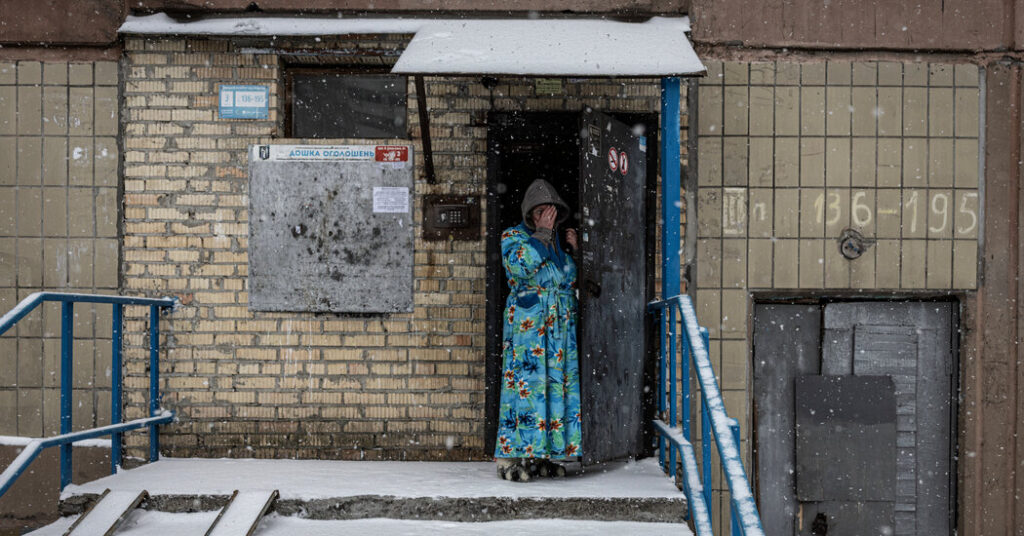
Cunning Russian tactics exploited Kyiv’s structural vulnerability. The dominant architecture in Troieshchyna is a common form of late-Soviet-era apartment building known as a panelka; in plural, panelky. Erected from prefabricated reinforced concrete panels welded together like enormous houses of cards, panelka after panelka line Troieshchyna’s streets, often looming 15 stories or more above traffic. Some are narrow vertical towers, others massive rectangular blocks. Together they stand in clusters or rows, along with a few arranged in huge circles around a central courtyard.
The Kremlin’s wars against former vassal states and Russia’s own citizens have shown for decades that concrete-paneled housing towers possess built-in strengths under bombardment. The buildings themselves are fire-resistant and sturdy; hollowed out and abandoned panelky from Grozny to Kupiansk have demonstrated the structural integrity to withstand, up to a point, direct hits from much of Russia’s conventional arsenal.
But they have a vulnerability, allowing them to be severed from modern utilities by the dozens, even hundreds. The weakness lies in urban-planning decisions from generations back. Panelky were a rapid and cost-contained solution to housing shortages as populations grew after World War II. Few of these buildings have boilers in their basements. Instead, Soviet authorities built centralized thermal plants, mammoth structures scattered throughout cityscapes, to supply hot running water and heat to residential neighborhoods — baseline conditions essential to contemporary urban life.
For a military force willing to set aside law, a neighborhood of panelky can be rendered almost uninhabitable more quickly, and at far lower expense, by hitting these energy plants rather than striking the buildings directly. Entire neighborhoods go dark, then turn cold; because panelky tend to be poorly insulated, the discomfort can swiftly turn dangerous.
The attacks of early January severed more than 400,000 households from electricity, city officials said, and left 6,000 buildings without heat. Problems compounded from there. Once buildings become cold enough, pipes freeze and residents lose running water. In this way, a measure of cruelty from long-range attacks can be distributed to an entire population in their homes without hitting the homes at all. Call it sanctuary denial on the cheap or, in the words of Oleksandr Kharchenko, director of the Energy Industry Research Center in Kyiv, a premeditated assault “on the life-support system of a modern city.”
International law prohibits deliberate attacks on civilian energy infrastructure, on the basis that the machinery distributing utility service to populations amounts to “civilian objects,” which are protected under the Geneva Conventions. On these grounds, in 2024 the International Criminal Court issued warrants for the arrests, for crimes against humanity, of four senior Russian military officers accused of involvement in energy-grid attacks up to that point. After the court issued these warrants, the attacks increased.
Ukrainians have a name for the experience that followed: the kholodomor. The term combines the Ukrainian words for “cold” and “plague” and echoes the older holodomor, the famine that killed millions of people in the early 1930s and resonates today as a defining national tragedy and sinister example of the lengths the Kremlin has gone against a neighboring people. The holodomor served Joseph Stalin’s totalitarian designs — to assert control over the country’s black-earth farmland, force peasants onto state-run collective farms and break Ukrainian national identity and will. To Ukrainians, attacks on energy infrastructure represent a fresh round of Russian collective punishment against noncombatants, intended to create the requisite amount of economic damage and human suffering to force capitulation.
It has not worked. Many Ukrainians who survived this winter expressed sentiments similar to those of Svitlana, 66, a resident of a panelka in Troieshchyna who asked that her surname be withheld for her personal security. She in many ways fit a category of Ukrainian citizen that Putin claims as his own — her family hailed from Russia, she long preferred the Russian language over the Ukrainian and, after Ukraine’s independence in 1991, she did not trouble herself to learn her new national anthem. She saw herself as a Russian on adjacent land. Russia’s full invasion, and the deeper suffering she went on to endure, ended all that. “I’m ethnically Russian,” she said. “Russia forced me to be Ukrainian.”
During the attack on Jan. 8, Svitlana felt the explosions from her ground-floor apartment where she lives with her cat, Manyasha. Troieshchyna shook. Lights went out. Soon the temperature in her apartment fell, the start of punishing living conditions that would last until spring. For her, the kholodomor did more than drive her from the Kremlin’s grasp — it extinguished her remaining affinity to the culture of her past.
By late January, Vitali Klitschko, the mayor of Kyiv, announced that cellphone data indicated more than 600,000 people had evacuated from the city, roughly one-sixth of the capital’s prewar population of more than three million. The city’s military administration questioned the claim, but whatever the precise tally, signs of exodus abounded. As the freeze lengthened, many residents departed for villages or to live with relatives with heat — including in homes warmed by firewood, an old form of energy independence. Apartments stood empty. Chilled corridors fell more quiet.
The remaining people made do. Outside, life moved on, at a slower pace. Children sledded on a small slope behind Svitlana’s building. To the north, the memorably named Mafia restaurant served sushi, soups and pizza from a kitchen powered by a generator. A kiosk near the courtyard used another generator to heat coffee. The Epicentr hypermarket set up displays of jugs of potable water, small butane camp stoves and pressurized cans of fuel. To the south, the blue-domed Cathedral of the Holy Trinity held regular services in its basement, where temperatures were a notch warmer. Framed photographic portraits arranged in a memorial near the staircase to the basement honored at least 60 service members killed in action.
Insulated warming tents in Troieshchyna offered shelter to those who needed relief. To battle boredom and simply get out, on weekends people found escape in other ways, taking the club scene into the open-air chill by gathering on the frozen surface of Kyiv Reservoir, to the city’s north, to defy the notion that life had been fully dulled. Thumping beats reverberated on thick, snow-covered ice. Alternating D.J.s selected tracks, beat matching and mixing, while dancers drank shots, smoked from hookahs and warmed themselves around steel drums converted to makeshift stoves. Just offshore, other revelers spun high-speed doughnuts on the slick ice, kicking up rooster tails of finely powdered snow.
Svitlana did not travel to the reservoir. She remained in the apartment she had moved into during summer 1993, back when work crews were completing finishing touches on the structure. As more residents arrived years ago, she assumed the responsibilities of dvirnyk, or yard keeper, a position on the building’s staff that involved sweeping entryways, staircases and the exterior grounds. As an original resident and constant presence outside the 12 entrance doors, Svitlana filled a unique role, first as caretaker, then as keeper of the panelka’s history. She watched new neighbors make the housing block home, planting apricot, mulberry and cherry trees, along with grape vines, roses, hibiscuses, irises and tulips.
The early years of Ukrainian independence were not easy. But it was a time of peace. Now the building was roughly 300 miles from the active ground-combat line. And as the war’s effects permeated Ukrainian society, its residents weathered hardship with a mix of adaptation, resolve, resignation and sorrow. Grief hovered in the chilled corridors, too: Some of Svitlana’s neighbors joined Ukraine’s armed forces, departed for war and did not return, including Andriy, whom Svitlana knew decades ago as a boy with an affinity for animals. He became a veterinarian as an adult, then enlisted in 2022. Andriy served as infantryman until falling wounded, after which he trained as a drone pilot and returned to duty. In 2025, he was declared missing. Last fall, the government informed Andriy’s mother that he had been killed. Shock drove her into seclusion; Svitlana had not seen her in weeks.
Andriy was not the only loss from the building’s first generation of children. Another boy she knew well, who had become a carpenter, enlisted at about age 35. He was missing, too. At the last exchange of prisoners, Svitlana watched the television news, hoping to spot his face among the freed troops. He was not there. “I hope he is alive and in captivity,” she said.
Outside, the wind blew, sculpting the snow around the panelka into wavy drifts like the surface of a white sea. For as long as she could, Svitlana held firm. To be a dvirnyk was to be practical; she was good with her hands. To convert her unheated space into survivable housing, she bought a roll of foil insulation and wrapped it around her door and door jamb, neatly folding corners and forming a barrier against the temperatures in the corridor. She lined the floor with blankets and extra carpets, blocking the foot-numbing cold of concrete. She managed to keep her home in the 40s Fahrenheit, enough to prevent the jugs of water she lugged home from freezing. Thus fortified, she could wash hands, make tea and flush her toilet.
After the attack in early January, the power authorities opted not to ration electricity to the building, because it had no heat. This allowed Svitlana to charge her phone, have light, run a small space heater and cook on her electric stove. But without running water, cooking remained a chore, as did cleaning up after. Some days, overwhelmed with stress, she did not eat at all. Bundled in clothing suited for ski slopes, often topped with a blue floral robe, she pursued a patriotic avocation — knitting two pairs of wool socks a day to send to soldiers at the front.
Resignation showed. A short walk separated her apartment from the nearest bomb shelter. At a brisk pace — starting from the entrance and ending at the supermarket a little more than 300 yards away — Svitlana could cover the distance with time to spare when air-raid sirens wailed. She no longer bothered. It was not that she was naïve. She’d felt the impact of a kamikaze drone that struck almost next door in fall, and another down the road. But attacks were too frequent, and lasted too long, for her to hustle into the cold, night upon night. She would hear air-raid sirens, listen for incoming weapons and wait in bed.
“I just lay down,” she said. “If it hits, it hits.”
On Jan. 29, Trump announced that, at his request, Putin had agreed to a weeklong cessation of Russian attacks on Ukrainian cities. Citing the “extraordinary cold,” he called Putin’s favorable reply a “considerate gesture.” The timing allowed for cautious hope. The Ukrainian word for February is lyutyi, which means “fierce,” a nod to winter’s peak fury. The new month lived up to reputation. Temperatures plummeted below zero Fahrenheit.
For a few nights, Kyiv did not face attack. But on Feb. 2, the fifth day of the supposed pause, the cessation was revealed as a sham. Roughly 450 drones and missiles flew toward targets. Five struck the Darnytsia Combined Heat and Power Plant, which had ceased generating electricity in January but still provided heat. The missiles knocked out that capacity, too. To Ukrainians, it looked as if Trump had been played. Intervals between major missile attacks often lasted days. The timing suggested that Russia went along with the language of peace while queuing up the next strikes in tempo with the war’s usual pace.
The next morning, a truckload of uniformed laborers arrived in the parking lot behind Svitlana’s building to try repairing heating pipes that had been frozen for weeks. Led by Andriy Udovyka, 31, the foreman of a maintenance crew that repaired railway lines in eastern Ukraine, they assembled on the sidewalk, smoking and readying equipment, while residents gathered in gratitude.
Udovyka’s suffering in the first year of the full invasion had taken a vicious form. He had served in Ukraine’s National Guard in 2018 and 2019, and his right shoulder bore a tattoo of the emblem of his former base. Seized in August 2022 by Russian troops who occupied his home city, he was turned over by his captors to former Ukrainian police officers collaborating with the occupiers, then held and tortured with scores of other local men in a district police department headquarters. Before he was freed in a Ukrainian counteroffensive, a jailer burned off his tattoo with a gas torch, taunting him as he did. A wrinkled white scar shows where it had been. After he recovered, he returned to work. Over the winter, the railroad temporarily assigned him to Kyiv, where he led a team of welders and crane operators, many displaced from former homes, trying to restore heating.
The crew descended to the basement with propane torches and welding equipment and commenced thawing frozen plumbing and replacing cracked pipes. After two days, they reconnected part of its heating system to the city’s remaining thermal-plant output. Hot water began flowing, bringing a modest temperature boost inside. “These men have golden hands,” Udovyka said. Many more addresses were in need of repair. The crew packed and left.
The good news was not what it seemed: The particulars of Svitlana’s apartment assured that she received no heat. Her unit, she said, was last on a loop of plumbing that carried hot water from the basement to the 15th floor, warming apartments as it rose, before descending to the basement and flowing back into what remained of the damaged municipal distribution system. By the time water reached her radiator on the ground floor, it had cooled. Adding to her troubles, because Udovyka reported the panelka as repaired, the power authorities began rationing its electricity, leaving residents with only a few hours of power a day. With no way to warm water for hours on end, Svitlana relied on camping heat tabs to make tea. The smoldering tabs left an acrid smell. At night, inside, the building returned to black. Her space heater no longer ran.
At last her son persuaded her to give in. On Feb. 5, he evacuated her to his apartment. One more unit stood empty.
Others had no such option, including Iryna Zlobina, 55, from the small eastern Ukrainian city of Popasna. Russian forces overran Popasna in 2022, shelling as they advanced and killing her brother, Pavlo, during a barrage. Already displaced, she lived in a third-floor unit and had no relatives to take her in or other home to which she might return. “My city doesn’t exist anymore,” she said, wearing a heavy coat indoors.
Her breath fogged the cold air beside the bed on which she huddled at night, alone, freighted with loss. When a roughly 400-pound kamikaze drone struck two buildings away in the fall, she said, her bed seemed to jump in the air. “Luckily the windows were not broken,” she said. Glass was all that separated her from the Arctic cold mass outside. She had no choice but to shelter in place and hope circumstances did not turn worse. “I’m very depressed because of all of this,” she said. “People say, ‘You should enjoy life because you are still alive.’” She shook her head. “I’m not sure I want to stay alive.”
To her, the modest success of the work crew was grounds for frustration and dread. As a former employee of a central heating plant, she knew her building was now on a lower-priority list for electricity, which she saw as unjust. “The heating does not work,” she said. “Just because you have heat on paper, it doesn’t mean that it’s here.”
Outraged at the electrical cuts, Iryna organized residents to sign a petition protesting the electricity rationing and succeeded in having a second work crew assigned to the panelka. But for most buildings, timely technical relief would not be coming — the damage to many central heating and electrical plants was all but irreparable. Kharchenko, of the Energy Industry Research Center, said restoring full electrical and heating capacity would not require weeks, or even months. “It will be years,” he said. “In the best-case scenario, we will be able to restore maybe 30 or 40 percent of electrical capacity before next winter.” Ukraine, he said, was in “survival mode: Restore what you can restore and start building what you can in time.” Getting back to full capacity, he added, will require as much as five years, as entire power plants would have to be erected and fortified. “It’s not possible to build something serious faster,” he said.
In the interim, he suggested, residents of many buildings would have to reduce their post-Soviet dependence on centralized heating plants and invest in a degree of energy independence: pooling funds for solar panels and buying generators or free-standing boilers. Such steps would reduce the power and impact of Russia’s long-range attacks, should the war continue into next year.
Chill gripped Kyiv through most of February. But days lengthened. Snow turned slushy. The frigid Arctic air mass began to yield. The Ukrainian word for March is berezen, derived from the word for birch tree, a reference to the spring and its implicit hope.
Five stories above the courtyard Svitlana once swept, Olena Vorobiova and her family kept faithful to demanding routines. Olena lived in the apartment with her daughter, Vladyslava, 13, and her second husband, Vadym Yudytskyi, who worked in a brewery. Beyond the grit and resolve required to endure their circumstances, they possessed something more — a kernel of Ukraine’s ambitions of leaving behind the early post-Soviet era for a Western European way of life.
Employed by a bank, Olena had responsibilities to fulfill. She also faced a particular challenge — creating a sense of stability for a teenager. “For a child to feel confident and safe,” she said, “the parents should be emotionally balanced.”
Stability was a choice requiring action. Anticipating a difficult winter, Olena bought a power bank last fall, set up a butane camp stove in the kitchen and signed up herself and her daughter for membership at a heated swimming pool, which they visited each weekend. After the building’s interior temperatures sank in January, she retreated from her bedroom, which was against an exterior wall, and moved with Vladyslava into the entryway. There they slept together on nights when Vadym worked; Shusha, their cat, and Ivi, their English spaniel, curled alongside.
Vladyslava had lived the war’s tensions firsthand. She was 9 when Russia’s mechanized brigades rolled over borders. Expecting an assault on Kyiv, she and her brother moved in with relatives in a village. It was a miscalculation: Russian soldiers seized the village. The pair spent weeks under occupation, remaining indoors until Ukraine’s soldiers drove the invaders back. Last year, her father enlisted in the army. He served in air defense, trying to shoot down the same weapons attacking his city.
Now in eighth grade in Kyiv and a perfect English speaker, Vladyslava followed Olena’s lead. Activity was agency and power. She kept to her schoolwork, studying English, German and mathematics. She was focused on the dream she formulated with her parents: to attend university in England and work in a Western bank.
As Kyiv shuddered in the cold, her insistence on maintaining the semblance of normality took shape. She participated in contemporary dance at One Room, a private studio, three nights a week. “Dance is not just physical activity,” said Kristina Shevchenko, the studio owner and lead choreographer, as Vladyslava and other students rehearsed one evening. “It’s also an opportunity to develop and to realize what is your soul.” The regimen nurtured a sense that ordinary life and hardship could coexist, and the former would prevail.
“Normal life,” she said, “is hope.”
By the numbers — the volume of drone and missile attacks, the count of power plants hit, the tally of nights without light or weeks without heat — Russia’s energy war could be read as indicators of the Kremlin’s martial success. They could also be read as signs of its weakness. As spring arrived and the war entered its fifth year, the strikes had required a retooling of Russia’s military-industrial complex, cost vast sums of money and landed four of its senior military leaders on wanted-for-war-crimes lists without achieving its principal intended effect. Ukraine had not yielded. It fought on, continuing to block Russia’s far larger army while littering the front with the invaders’ bodies. A targeted people had hardened in resentment and disgust.
Vladyslava kept true to her Western dream. Others reappraised their Soviet pasts. Just down the street from Svitlana’s panelka, Zoya Perevozchenko, 76, sat in the chilly dimness of her kitchen, recounting a strike on her building during the opening rounds of cold-season attacks last fall. A tall narrow panelka beside the highway, her building held a special connection to both Ukrainian and Soviet history. Among its residents were surviving families of “liquidators” — the first responders and cleanup crews who contained the radioactive waste after the nuclear accident at Chernobyl in 1986 — including Zoya, whose husband, Valeriy, succumbed to radiation poisoning 48 days after the blasts at Reactor No. 4.
The Soviet Union honored Valeriy at a special section of Mitinskoe Cemetery in Moscow. In recognition of Zoya’s suffering and loss, the authorities awarded her an apartment in the newly erected panelka in Troieshchyna, which was expanding into the farmland of Kyiv’s left bank. Other surviving families from the disaster resettled in the same tower, including Natalia Khodemchuk, widow of Valeriy Khodemchuk, an engineer who worked under Zoya’s husband and was Chernobyl’s first fatality. He too was honored at the same cemetery as his boss, though his body, lost within the rubble, was never found. Joined in grief and horror, determined to live and bestowed with official Kremlin recognition, Zoya and Natalia became close, enduring friends.
Five years after the nuclear accident, the Soviet Union collapsed. Russian officials continued to venerate Natalia and Zoya and hosted them at annual memorial services in Moscow. Relations remained warm until they turned cold. Honors dwindled after Russia illegally annexed Crimea in 2014 and organized a separatist war in eastern Ukraine. Civilian travel between the two countries declined. After the full invasion of 2022, back-and-forth travel all but ceased. Natalia was Ukrainian. She chose her people’s side. In the apartment the Soviet authorities had given her, she passed time knitting wool belts for Ukrainian troops to wear under body armor as they fought Russian soldiers, sent by the same Kremlin that once heralded her family’s sacrifice, before shunning her because of her ethnicity and address. Zoya, whose youngest grandson volunteered to serve in the Ukrainian armed forces upon turning 18, sometimes joined her.
The final outrage arrived in mid-November, in the form of a Shahed drone, or Geran-2, as the Russian knockoffs of the original Iranian design are also known. Russia has launched more than 57,000 Shaheds at Ukrainian targets. To reach Kyiv, some drones carry multiple SIM cards and fly along Ukraine’s border with Belarus, apparently while transmitting data to Russian military units on local cellphone networks, said Oleksandr, a government expert who examines and analyzes Russian weapons. (He asked for his surname to be withheld for security reasons.) When drones flying along the border draw near to their targets in Ukraine, he said, they turn south. Such routes can then pass over Troieshchyna. Moreover, Shaheds in the recent cold season often flew at remarkably low altitudes through Ukrainian airspace, sometimes below the height of housing towers. Intended to evade detection by radar, the tactic can endanger civilians in panelky.
The night that their panelka was hit, Zoya was in her apartment, listening to the weapons’ distinctive buzzing sound as they passed overhead. Natalia was on a couch in her seventh-floor apartment’s corridor when a Shaded crashed through her window.
Shaheds often carry warheads spiked with incendiary compounds; fire burned Natalia in the first flash. She rushed to the kitchen to douse herself at the sink, only to find, when she turned toward the apartment door, that a rising blaze blocked her path. Like her husband almost 40 years ago, she was trapped. She did not give up. She plunged into the flame, reached her door and forced herself into the corridor, then staggered down four flights of stairs to Zoya’s door, screaming for help. Burns covered more than 40 percent of her body. An ambulance hurried her to care. She died the next day.
After the strike, the blackened apartment, full of Natalia’s charred possessions, was open to the air. The tower still stood. Many residents remained, only to lose heat and electricity in January. In February, three men trudged up the tower’s staircase, planning to thaw a juncture of heating pipes in a service room on the top floor. Electricity was out. The stairway was lightless. They reached the top floor but had no key and could not pass the last door. The man leading them opted instead to go to the electrical utility office to demand power. It was a short walk away, over snow so cold it squeaked and crunched underfoot. The utility office had no electricity either. The receptionist sat at her desk in a parka, running the operation on a cellphone.
A cold night followed, without light. The next morning, Zoya recalled Natalia’s arrival at her door, burned like her husband before her. Together the two women had survived one of the Soviet Union’s most spectacular failures to become celebrated in Moscow as living examples of citizens whose families gave all. Now the full circle of their relationship to the Kremlin closed in darkness, cold and long-distance betrayal. If weaponizing winter had meant to bring Ukraine at last to compliance and heel, in the panelky of Troieshchyna, it failed. “The only feeling I have toward them,” Zoya said of the Russians who formerly offered official embrace, “is hate.”
Yurii Shyvala contributed reporting.
Finbarr O’Reilly is a visual journalist and author who has been working in conflict zones and complex humanitarian emergencies over the last 20 years.
The post How Russia Weaponized the Cold Ukrainian Winter appeared first on New York Times.