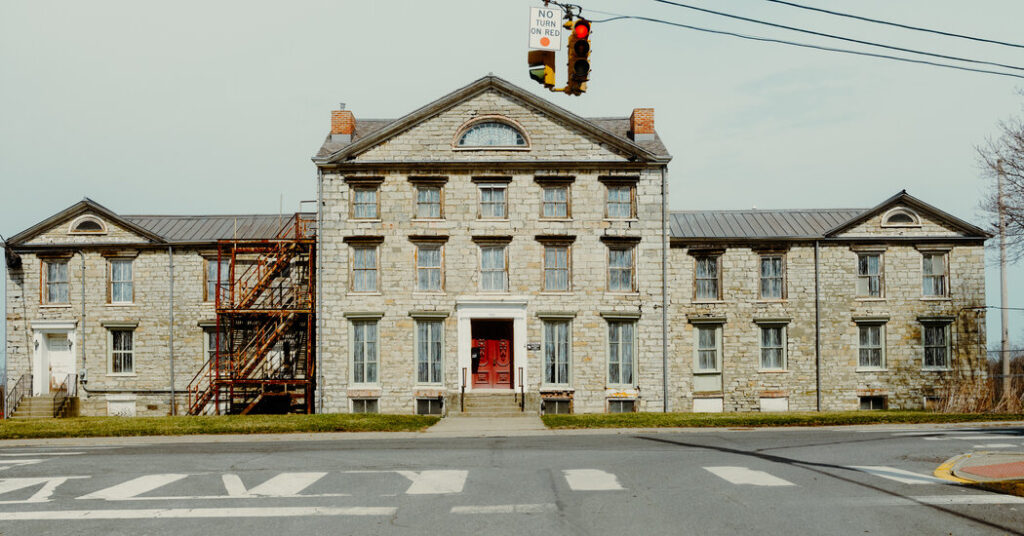
Last summer, residents of Hudson, N.Y., were stunned to learn that the nonprofit Galvan Initiatives Foundation, the city’s largest private property owner, had suddenly given away most of its huge portfolio of residential and commercial properties.
Even more surprising was what Galvan planned to do with it: More than 80 properties — storefronts, apartments and other homes, and public-use spaces, worth an estimated $82 million — would be donated to Bard College. Overnight, the liberal arts school, whose main campus is about 20 miles from Hudson, in Annandale-on-Hudson, went from owning no property in the city of roughly 5,600 people to being a major real estate player there.
What followed were weeks of panicked calls from tenants in Galvan’s properties wanting to know what the change would mean for them. Would they have to move? Would their homes be turned into student housing?
“We had to tell everybody the same thing: ‘We’re still gathering information. At this point we don’t know,’” said Kamal Johnson, who was Hudson’s mayor at the time.
Since then, Bard has tried to reassure Hudson’s residents that no major changes are coming. But it has provided few details about its plans, rattling a city already plagued by rising housing prices and divided over gentrification.
Hudson has for decades been transforming from a run-down river town with a large working-class population to a kind of Brooklyn North. New residents bought and renovated many of its stately Victorian-era houses. Warren Street, the city’s main drag, is now lined with upscale restaurants, art galleries and home-goods stores.
But the gentrification intensified during the Covid-19 pandemic, bringing a flood of newcomers and pushing up housing costs. Many low-income residents could no longer afford to live in the city, and restaurants and stores that once served the city’s large African American population slowly disappeared, said Tanya Jackson, a director at the Hudson/Catskill Housing Coalition, an advocacy group.
“The homeless population has gone up, and the Black population has gone down,” Ms. Jackson said.
People whose families had lived in Hudson for years had little say over the changes, Ms. Jackson added. The city’s Black population, which was 25 percent in 2013, dropped to 13 percent by 2024.
To some residents, the Galvan Foundation came to symbolize everything they disliked about the changes. Galvan had bought dozens of Hudson properties over the years, including historic single-family houses and much-loved buildings like the Armory. When a building went on the market, the foundation was often the first in line.
“People who had a house that they needed to sell would often contact them because they were ready to buy,” said Carole Osterink, a former member of Hudson’s Common Council who publishes a popular blog, “The Gossips of Rivertown.”
“It was an easy way to get rid of your house, particularly if it was not in very good shape,” she said.
It didn’t help that an air of secrecy sometimes seemed to surround Galvan.
The foundation was started by Henry van Ameringen, heir to a fortune in the fragrances business, who died in 2020, and his husband, T. Eric Galloway. (Galvan is a portmanteau of their names.) The two men tended to keep a low profile, even as their portfolio expanded.
“I used to publish long lists of all of the buildings that they owned, and then I kind of got tired of it because it got hard to follow,” Ms. Osterink said.
In 2012, the two men formed Galvan and transferred most of their properties to it. The foundation sat atop an opaque web of legal entities that sometimes made it hard to understand how it operated.
Critics complained that Galvan’s properties would sometimes be left unoccupied for years, worsening Hudson’s housing shortage.
“You’d see a house sitting vacant for months or years and then find out it was owned by Galvan,” said Claire Cousin, a Common Council member.
Mr. Galloway did not respond to requests for comment, but his spokesman, Dan Kent, rejected the complaint, noting that rehabilitating severely distressed historic properties and navigating the city’s approval process took time. (Mr. Kent was Galvan’s vice president until it transferred its properties to Bard and now works for the Civis Foundation, another nonprofit tied to Mr. Galloway.)
Mr. Johnson, who was himself sometimes criticized for his ties to the foundation — he lost re-election last November — said the complaints and rumors about Galvan obscured some of the good work it did.
The foundation leased the beloved Armory building to Hudson’s public library and other nonprofits for nominal rent and helped underwrite local activities like Winter Walk, a holiday gathering held on Warren Street in December. Properties it acquired included a large portfolio of subsidized apartments for low-income residents and a former motel it converted into housing for people without homes.
“In some instances, they were one of the only landlords that were offering low-income or somewhat affordable units,” Ms. Cousin said of Galvan.
Still, Galvan’s relations with city officials were sometimes rocky. In 2021, amid a dispute over a proposed tax break, Galvan’s lawyers accused the city of targeting Mr. Galloway for criticism because he is African American.
Mr. Kent said the foundation had “faced opposition and criticism from the very beginning of our work in Hudson.” In 2012, for example, it dropped plans for a homeless shelter after stiff community resistance. Still, navigating local opposition is part of the development process, especially in New York, Mr. Kent said.
“If we walked away from these types of challenges, we would not have built anything in Hudson,” he said.
Mr. Kent denied that community opposition was behind Galvan’s decision to leave Hudson, saying it was eager to move on to other challenges. Bard, with its record of managing large capital projects, such as its Fisher Center for the Performing Arts, was a natural steward of its properties, he said. Galvan had worked with Bard on an early-college program for youths in Hudson, and believed the college shared its commitment to the arts and affordable housing, he said.
Galvan’s donation helped jump-start Bard’s $1 billion endowment campaign, which had a $500 million matching pledge from the financier George Soros’s Open Society Foundations.
Still, Taun Toay, chief financial officer at Bard, acknowledged that the Galvan gift was “complicated.” Bard is taking on a sizable number of buildings requiring renovation, as well as commercial and residential properties with tenants. To keep the operation going, Bard has retained most of Galvan’s staff, Mr. Toay said.
The Hudson/Catskill Housing Coalition has called on residents and local leaders to press Bard for more information about its plans. It has pointed to how other university-led real estate projects, like the campus expansions by Columbia in Upper Manhattan or Harvard in Allston, Mass., can accelerate gentrification and displace longtime residents.
Bard has been embarking on what it called a “listening tour,” trying to squelch some of the rumors about its plans. No, it won’t be converting apartments into student housing. Yes, most leases will be renewed. No, it won’t be selling off a lot of properties right away.
“This is a sizable enough portfolio that we have to be mindful of not flooding the market or undercutting ourselves,” Mr. Toay said.
Bard is also facing controversy over ties between its longtime president, Leon Botstein, and the convicted sex offender Jeffrey Epstein. While that has no direct impact on Galvan’s donation, several people interviewed for this article worried that it would distract Bard from the work it faces in Hudson.
The current mayor, Joseph Ferris, noted that Bard had a fiduciary obligation to its donors that might conflict with Hudson’s interests.
“We have an affordability crisis and a housing crisis,” he said. “This could potentially be a game changer for our community, and I want to know where the best interests of Hudson fall in this process.”
The post How Bard College Became a Major Real Estate Player 20 Miles Away appeared first on New York Times.