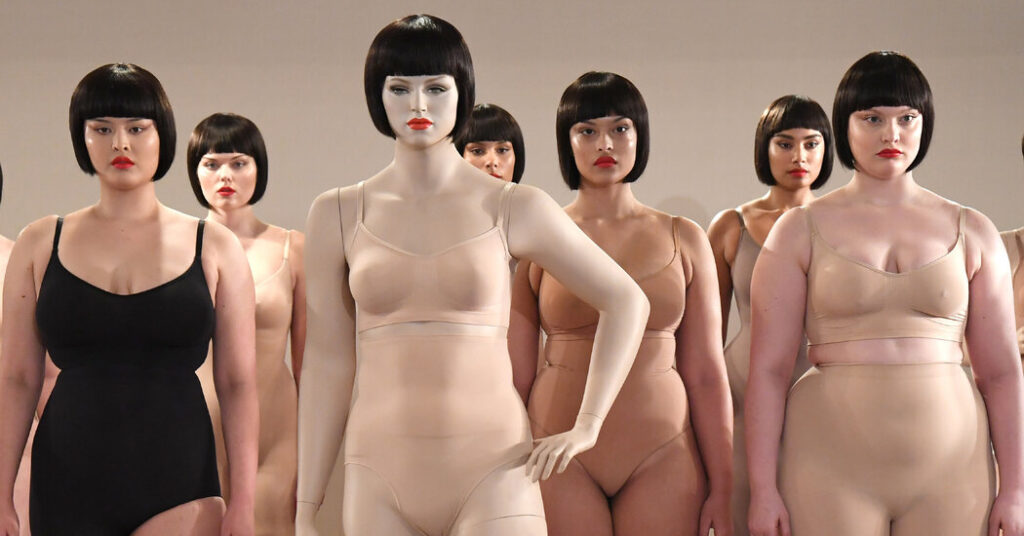
What is a really good tummy-flattening foundation garment for someone with a belly that seems too big for her body? And will such a garment actually work? — Zaza, Durham, N.C.
We seek it here, we seek it there, that damned elusive flat stomach. It’s harder to pin down than the Scarlet Pimpernel. When did this become the agreed-upon Platonic body ideal? Sometime after Peter Paul Rubens and before Bella Hadid.
However it happened, business empires have been built on helping women (and, increasingly, men) reach this near impossible goal, not just through punishing gym routines and diet, but also through clothing itself.
What started with Spanx — the contemporary equivalent of the girdle, which was itself a more modern iteration of the whalebone corset — has spawned Skims, Yitty (by Lizzo), Honeylove and Commando, to name a few of the companies now known euphemistically as “shapewear” brands. And it’s not going away any time soon: Estimated at $2.73 billion in 2024, the shapewear market is predicted to reach $4.32 billion by 2030, according to a report from Grandview Research. People are, apparently, putting their money where their body modification dreams are.
But how realistic are they?
The truth is, while shapewear can do a lot to smooth and compress our flesh, it can’t actually remake our bodies. Wearing a foundation garment — or, as Gwyneth Paltrow once told the world, two at once — can help sculpt what’s there, but it won’t erase it.
That’s why Karla Welch, the stylist who works with Sarah Paulson and Renate Reinsve, and Bailey Moon, who has worked with Jill Biden and Pamela Anderson, recommend shapewear for what Moon calls “creating a seamless look under clothing.”
But beyond acting as a tool to erase bra or panty lines and other obvious bulges, they each say: Manage your expectations.
I asked one of my colleagues, Zoe Vanderweide, who delved comprehensively into the world of shapewear for Wirecutter, how to think about the options. (For the purposes of this answer, I am going to focus on stomach-related shapewear, but as the photo of Skims above shows, there are options for all parts of the body.)
According to Zoe, shapewear comes in three tensions: light, which is kind of like a leotard; medium, which makes you feel more sucked in and can help if you are having trouble zipping up certain garments; and high, which involves more elaborate construction, including targeted panels. All of the above is made from some blend of nylon and elastane, but, Zoe said, “the secret to compression is in the knit.”
This is not information included on a garment tag, so Zoe recommends a stretch test: “More compressive fabric should feel stretchy yet firm — the harder it is to stretch, the more compressive it is,” she said.
She also suggested checking to see if there are little silicone strips that grip onto the skin at the top of a shapewear garment to keep it from rolling down, or little pieces of boning-like structure to make the top more rigid. Also snaps or hooks at the crotch, which will allow you to use the bathroom without having to disrobe.
Finally, Zoe said her hands-down favorite for balancing comfort and effect was the SPANXsculpt OnCore short. “It’s a really nice balance of effective smoothing and tummy control,” she said, “with a fabric that still feels quite smooth, light and comfortable.”
Still, there is another option. You can always avoid the issue entirely, Welch said, and opt for “cinching a waist with a belt,” perhaps over a full skirt, to create the illusion of shape.
“I’m tired of shrinking women,” she said. Perhaps shrink-wrapped is a better way to put it.
Your Style Questions, Answered
Every week on Open Thread, Vanessa will answer a reader’s fashion-related question, which you can send to her anytime via email or X. Questions are edited and condensed.
Vanessa Friedman has been the fashion director and chief fashion critic for The Times since 2014.
The post Can Shapewear Actually Give Me a Flat Stomach? appeared first on New York Times.